


WBJEE · Maths · Application of Derivatives
If \(f(x)=e^{x}(x-2)^{2},\) then
- A \(f\) is increasing in \((-\infty, 0)\) and \((2, \infty)\) and decreasing \(\operatorname{lin}(0,2)\)
- B \(t\) is increasing in \((-\infty, 0)\) and decreasing in \((0, \infty)\)
- C \(f\) is increasing in \((2, \infty)\) and decreasing in \((-\infty, 0)\)
- D \(f\) is increasing in (0,2) and decreasing in \((-\infty, 0)\) and \((2, \infty)\)
Answer & Solution
Correct Answer
(A) \(f\) is increasing in \((-\infty, 0)\) and \((2, \infty)\) and decreasing \(\operatorname{lin}(0,2)\)
Step-by-step Solution
Detailed explanation
Given function is, \(f(x)=e^{x}(x-2)^{2}\) \[ \begin{aligned} \Rightarrow f^{\prime}(x) &=e^{x}(x-2)^{2}+2(x-2) e^{x} \\ &=e^{x}(x-2)(x-2+2)=x(x-2) e^{x} \end{aligned} \] Now, sign scheme of \(f^{\prime}(x)\) is So, \(t\) is increasing in \((-\infty, 0)\) and \((2, \infty)\) and…
See the Complete Solution
Get step-by-step explanations for this and 2.5 Lakh+ more JEE, NEET & CET questions.
- Unlock all solutions
- Practice the full chapter
- Track accuracy across PYQs
4.8 rated on Google Play · 14,000+ reviews
More questions from Maths
- If \(A=\left(\begin{array}{cc}3 & x-1 \\ 2 x+3 & x+2\end{array}\right)\) is a symmetric matrix, then the value of \(x\) isWBJEE 2011 Easy
- If the sum of two unit vectors is a unit vector, then the magnitude of their difference isWBJEE 2017 Easy
- A plane meets the co-ordinate axes at the points \(A, B, C\) respectively in such a way that the centroid of \(\triangle A B C\) is \(\left(1, r, r^{2}\right)\) for some real \(r\). If the plane passes through the point \((5,5,-12)\) then \(r=\)WBJEE 2021 Medium
- A particle is projected vertically upwards. If it has to stay above the ground for 12 seconds, thenWBJEE 2020 Easy
- \(\text {If } \log _{0.2}(x-1)>\log _{0.04}(x+5), \text { then }\)WBJEE 2015 Easy
- The value of \(\lim _{x \rightarrow 0} \frac{\int_{0}^{x^{2}} \cos \left(t^{2}\right) d t}{x \sin x}\) isWBJEE 2014 Easy
More PYQs from WBJEE
- The value of \(\lim _{n \rightarrow \infty}\left[\left(\frac{1}{2 \cdot 3}+\frac{1}{2^2 \cdot 3}\right)+\left(\frac{1}{2^2 \cdot 3^2}+\frac{1}{2^3 \cdot 3^2}\right)+\ldots+\left(\frac{1}{2^n \cdot 3^n}+\frac{1}{2^{n+1} \cdot 3^n}\right)\right]\) isWBJEE 2023 Medium
- Which of the following mixtures will have the lowest pH at 298 K?WBJEE 2019 Hard
- A capacitor of capacitance \(C_{0}\) is charged to a potential \(V_{0}\) and is connected with another capacitor of capacitance \(C\) as shown. After closing the switch \(S,\) the common potential across the two capacitors becomes \(V\). The capacitance \(C\) is given by
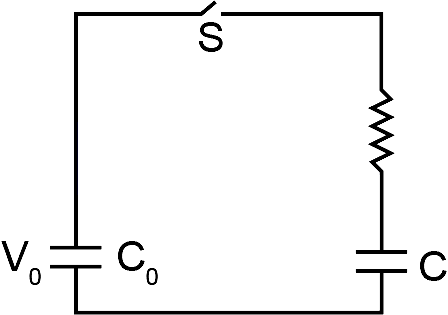 WBJEE 2013 Medium
 - In the following electron - dot structure, calculate the formal charge from left to right nitrogen atom; \(\ddot{\mathrm{N}}=\mathrm{N}=\ddot{\mathrm{N}}\)WBJEE 2011 Medium
- To which of the following the angular velocity of the electron in the \(n\) -th Bohr orbit is proportional?WBJEE 2019 Easy
- Out of 7 consonants and 4 vowels, the number of words (not necessarily meaningful) that can be made, each consisting of 3 consonants and 2 vowels, isWBJEE 2014 Medium