


WBJEE · Maths · Probability
\(A, B, C\) are mutually exclusive events such that \(P(A)=\frac{3 x+1}{3}, P(B)=\frac{1-x}{4}\) and \(P(C)=\frac{1-2 x}{2}\). Then the set of possible values of \(\mathrm{x}\) are in
- A \([0,1]\)
- B \(\left[\frac{1}{3}, \frac{1}{2}\right]\)
- C \(\left[\frac{1}{3}, \frac{2}{3}\right]\)
- D \(\left[\frac{1}{3}, \frac{13}{3}\right]\)
Answer & Solution
Correct Answer
(B) \(\left[\frac{1}{3}, \frac{1}{2}\right]\)
Step-by-step Solution
Detailed explanation
\(0 \leq \mathrm{P}(\mathrm{A})+\mathrm{P}(\mathrm{B})+\mathrm{P}(\mathrm{C}) \leq 1\) and \(0 \leq \mathrm{P}(\mathrm{A}) \leq 1,0 \leq \mathrm{P}(\mathrm{B}) \leq 1,0 \leq \mathrm{P}(\mathrm{C}) \leq 1 \Rightarrow \frac{1}{3} \leq \mathrm{x} \leq \frac{1}{2}\)
See the Complete Solution
Get step-by-step explanations for this and 2.5 Lakh+ more JEE, NEET & CET questions.
- Unlock all solutions
- Practice the full chapter
- Track accuracy across PYQs
4.8 rated on Google Play · 14,000+ reviews
More questions from Maths
- If \(f(x)\) is a function such that \(f^{\prime}(x)=(x-1)^{2}(4-x),\) thenWBJEE 2016 Medium
- If \(\left[\begin{array}{ll}2 & 1 \\ 3 & 2\end{array}\right] \cdot A \cdot\left[\begin{array}{cc}-3 & 2 \\ 5 & -3\end{array}\right]=\left[\begin{array}{ll}1 & 0 \\ 0 & 1\end{array}\right]\), then \(A=\)WBJEE 2024 Easy
- The area of the region bounded by the curves \(y=x^{2}\) and \(x=y^{2}\) isWBJEE 2014 Medium
- The equation \(r \cos \theta=2 a \sin ^2 \theta\) represents the curveWBJEE 2024 Easy
- \(F(x)=\cos x-1+\frac{x^2}{2!}, x \in \mathbb{R}\). Then \(f(x)\) isWBJEE 2024 Medium
- If the distance between the plane \(a x-2 y+z=k\) and the plane containing the lines \(\frac{x-1}{2}=\frac{y-2}{3}=\frac{z-3}{4}\) and \(\frac{x-2}{3}=\frac{y-3}{4}=\frac{z-4}{5}\) is \(\sqrt{6}\), then \(|k|\) isWBJEE 2023 Medium
More PYQs from WBJEE
- Let \(\mathrm{r}, \mathrm{v}, \mathrm{E}\) be the radius of orbit, speed of electron and total energy of electron respectively in a \(\mathrm{H}\)-atom. Which of the following quantities according to Bohr theory, is proportional to the quantum number \(\mathrm{n}\) ?WBJEE 2021 Easy
- A saturated solution of \(\mathrm{BaSO}_{4}\) at \(25^{\circ} \mathrm{C}\) is \(4 \times 10^{-5} \mathrm{M}\). The solubility of \(\mathrm{BaSO}_{4}\) in \(0.1 \mathrm{M} \mathrm{Na}_{2} \mathrm{SO}_{4}\) at this temperature will beWBJEE 2021 Medium
- In Sommerfeld's modification of Bohr's theory, the trajectory of an electron in a hydrogen atom isWBJEE 2010 Easy
- Molecular velocities of two gases at the same temperature \((\mathrm{T})\) are \(\mathrm{u}_{1}\) and \(\mathrm{u}_{2} .\) Their masses are \(\mathrm{m}_{1}\) and \(\mathrm{m}_{2}\) respectively. Which of the following expressions is correct at temperature \(\mathrm{T} ?\)WBJEE 2021 Easy
- If \((\alpha+\sqrt{\beta})\) and \((\alpha-\sqrt{\beta})\) are the roots of the equation \(x^{2}+p x+q=0,\) where \(\alpha, \beta, p\) and \(q\) are real, then the roots of the equation \(\left(p^{2}-4 q\right)\left(p^{2} x^{2}+4 p x\right)-16 q=0\) areWBJEE 2012 Medium
-
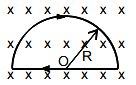
As shown in the figure, a wire is bent to form a D-shaped loop, carrying current I, where the curved part is semi-circle of radius \(\mathrm{R}\). the loop is placed in a uniform magnetic field \(\overrightarrow{\mathrm{B}}\), which is directed into the plane of the paper. The magnetic force left by the closed loop isWBJEE 2020 Easy