


WBJEE · Chemistry · Structure of Atom
As per de-Broglie's formula a macroscopic particle of mass \(100 \mathrm{g}\) and moving at a velocity of \(100 \mathrm{cm} \mathrm{s}^{-1}\) will have a wavelength of
- A \(6.6 \times 10^{-29} \mathrm{cm}\)
- B \(6.6 \times 10^{-30} \mathrm{cm}\)
- C \(6.6 \times 10^{-31} \mathrm{cm}\)
- D \(6.6 \times 10^{-32} \mathrm{cm}\)
Answer & Solution
Correct Answer
(C) \(6.6 \times 10^{-31} \mathrm{cm}\)
Step-by-step Solution
Detailed explanation
According to de-Broglie. wavelength, \(\lambda=\frac{h}{m v}\) Given, \(\quad m=100 \mathrm{g}, v=100 \mathrm{cm} \mathrm{s}^{-1}\) and \[ \begin{aligned} h &=6.6 \times 10^{-34} \mathrm{J}-\mathrm{s} \\ &=6.6 \times 10^{-27} \mathrm{erg}-\mathrm{s} \end{aligned} \] On…
See the Complete Solution
Get step-by-step explanations for this and 2.5 Lakh+ more JEE, NEET & CET questions.
- Unlock all solutions
- Practice the full chapter
- Track accuracy across PYQs
4.8 rated on Google Play · 14,000+ reviews
More questions from Chemistry
- The total number of aromatic species generated in the following reactions is
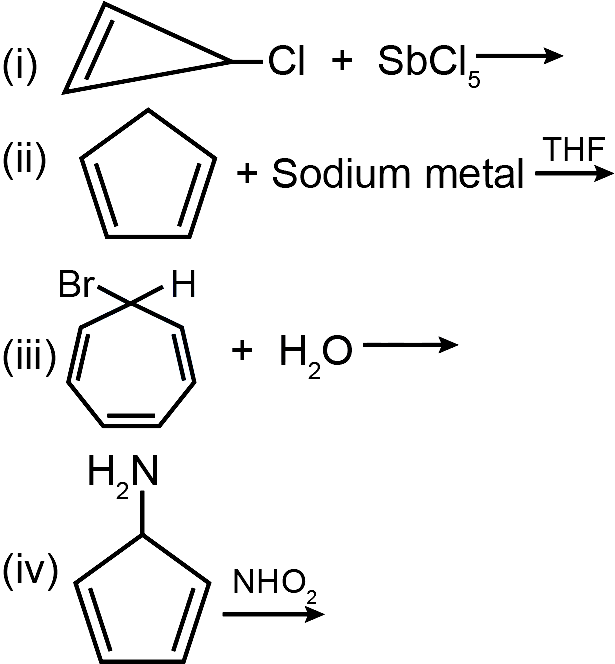 WBJEE 2015 Medium
 - The specific conductance \((\mathrm{k})\) of \(0.02(\mathrm{M})\) aqueous acetic acid solution at 298 K is \(1.65 \times 10^{-4} \mathrm{~S} \mathrm{~cm}^{-1}\). The degree of dissociation of acetic acid is \(\left[\lambda_{\mathrm{H}^{+}}=349.1 \mathrm{~S} \mathrm{~cm}^2 \mathrm{~mol}^{-1}\right.\) and \(\left.\lambda_{\mathrm{CH}_3 \mathrm{COO}^{-}}=40.9 \mathrm{~S} \mathrm{~cm}^2 \mathrm{~mol}^{-1}\right]\)WBJEE 2024 Hard
- In the following compound, the number of sp-bybridised carbons are
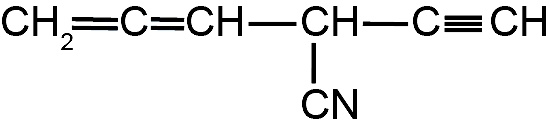 WBJEE 2015 Medium
 - A solution is saturated with \(\mathrm{SrCO}_{3}\) and \(\mathrm{Sr} \mathrm{F}_{2}\). The \(\left[\mathrm{CO}_{3}^{2-}\right]\) is found to be \(1.2 \times 10^{-3} \mathrm{M}\). The concentration of \(\mathrm{F}\) - in the solution would beWBJEE 2020 Hard
- Amongst the following compounds, the one that will not respond to Cannizzaro reaction upon treatment with alkali isWBJEE 2016 Medium
- The time taken for \(10 \%\) completion of a first order reactin is 20 mins. Then, for \(19 \%\) completion, the reaction will takeWBJEE 2009 Hard
More PYQs from WBJEE
- The reduction of benzenediazonium chloride to phenyl hydrazine can be accomplished byWBJEE 2017 Easy
- To which of the following quantities, the radius of the circular path of a charged particle moving at right angles to a uniform magnetic field is directly proportional?WBJEE 2019 Medium
- Product of any \(r\) consecutive natural numbers is always divisible byWBJEE 2009 Medium
- \(f(x)=\left\{\begin{array}{ll}0, & x=0 \\ x-3, & x > 0\end{array}\right.\) The function \(f(x)\) isWBJEE 2011 Medium
- For each \(n \in N, 2^{3 n}-1\) is divisible by
where \(\mathrm{N}\) is a set of natural numbersWBJEE 2009 Hard - Friedel-Craft's reaction using MeCl and anhydrous AlCl \(_{3}\) will take place most efficiently withWBJEE 2012 Medium