


TS EAMCET · Maths · Limits
\(\lim _{x \rightarrow 0} \frac{3^{\sin x}-2^{\tan x}}{\sin x}=\)
- A 0
- B 1
- C \(\log e 6\)
- D \(\log _e \frac{3}{2}\)
Answer & Solution
Correct Answer
(D) \(\log _e \frac{3}{2}\)
Step-by-step Solution
Detailed explanation
\(\lim _{x \rightarrow 0} \frac{3^{\sin x}-2^{\tan x}}{\sin x}\) \(=\lim _{x \rightarrow 0} \frac{3^{\sin x}-1-\left(2^{\tan x}-1\right)}{\sin x}=\ln 3-\ln 2=\ln \left(\frac{3}{2}\right)\)
See the Complete Solution
Get step-by-step explanations for this and 2.5 Lakh+ more JEE, NEET & CET questions.
- Unlock all solutions
- Practice the full chapter
- Track accuracy across PYQs
4.8 rated on Google Play · 14,000+ reviews
More questions from Maths
- In the matrix \(\left[\begin{array}{ccc}-1 & x & 3 \\ -4 & -5 & -6 \\ -7 & y & 9\end{array}\right]\), if the cofactors of -6 and -7 are respectively 22 and 27 , then \(5 x+y=\)TS EAMCET 2022 Medium
- Let be three real numbers and . If , then the line always passes through the fixed pointTS EAMCET 2018 Medium
- \(\frac{\cos x}{\cos (x-2 y)}=\lambda \Rightarrow \tan (x-y) \tan y\) is equal toTS EAMCET 2009 Medium
- The area (in sq. units) of the region bounded by the circle \(x^2+y^2=64\), positive \(x\)-axis and the line \(y=\sqrt{3} x\) isTS EAMCET 2023 Easy
- Let \(f(n)=A(-2)^n+B(-3)^n \forall A, B \in \mathbf{R}\) and \(n \in \mathbf{N}-\{1,2\}\). If \(f(n)+a f(n-1)+b f(n-2)=0\), then \((a+b)(b-a)=\)TS EAMCET 2020 Easy
- \(\int \frac{d x}{(x-1)^{\frac{3}{4}}(x+2)^{\frac{5}{4}}}=\)TS EAMCET 2023 Hard
More PYQs from TS EAMCET
- What is the formula of the product formed when \(\mathrm{F}^{-}\)reacts with enamel on teeth?TS EAMCET 2019 Medium
- The net work done by an ideal gas going through the cycle as shown in the diagram below is
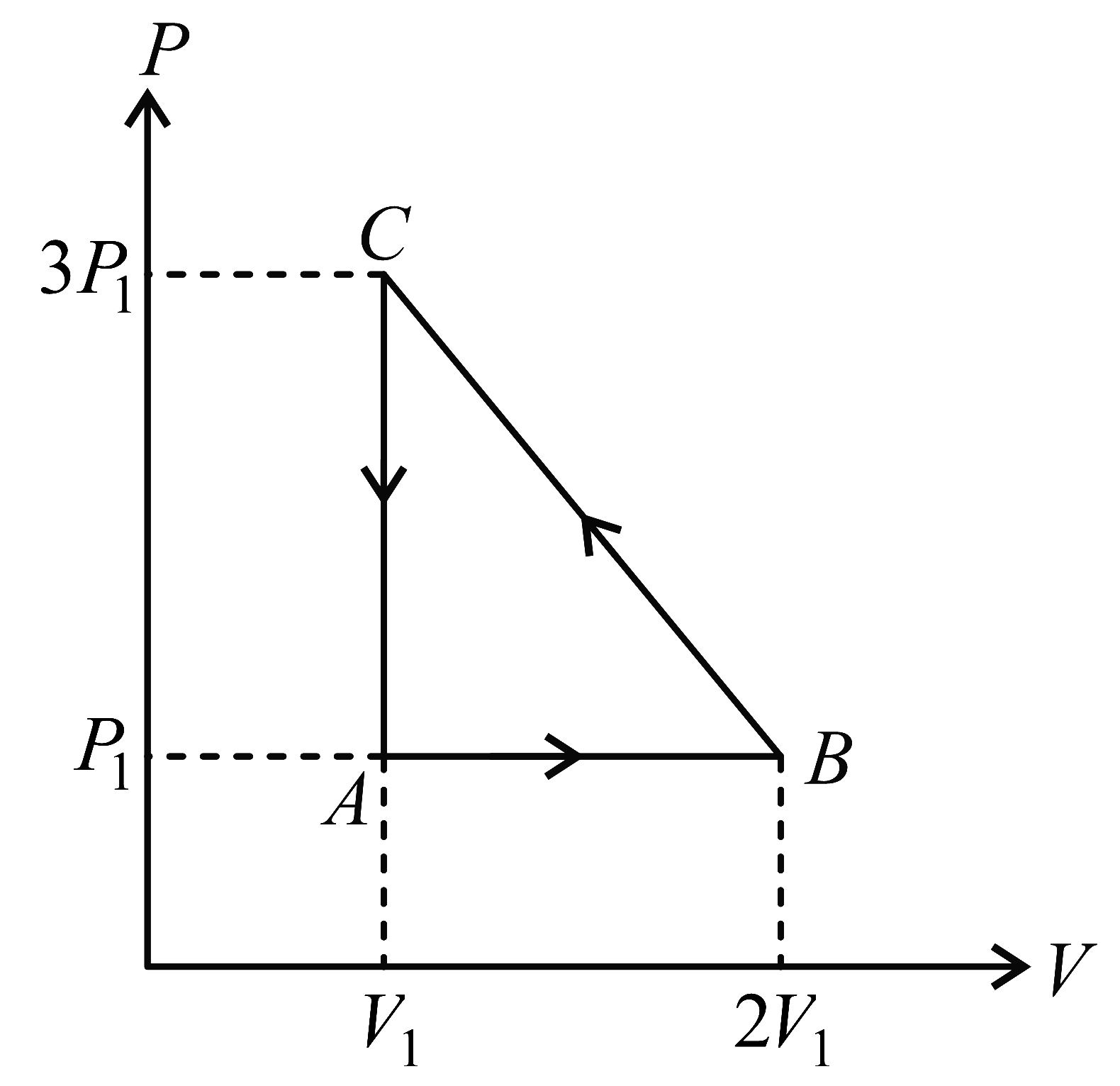 TS EAMCET 2022 Easy
 - If \(y=\sqrt{\sin (\log 2 x)+\sqrt{\sin (\log 2 x)+\sqrt{\sin (\log 2 x)+\ldots \infty}}}\), then \(\frac{d y}{d x}=\)TS EAMCET 2024 Medium
- The test that distinguishes primary amines from other amines isTS EAMCET 2021 Medium
- \(\vec{a}, \vec{b}, \vec{c}\) are three-unit vectors such that \(|\vec{a}+\vec{b}+\vec{c}|=1\) and \(\vec{a}\) is perpendicular to \(\vec{b}\). If \(\vec{c}\) makes angles \(\alpha, \beta\) with \(\vec{a}, \vec{b}\) respectively, then \(\cos \alpha+\cos \beta=\)TS EAMCET 2023 Easy
- The rank of
\(A=\left[\begin{array}{ccc}
1 & x & x+1 \\
2 x & x^2-x & x^2+x \\
3 x(x-1) & x\left(x^2-3 x+2\right) & x\left(x^2-1\right)
\end{array}\right] \text { is }\)TS EAMCET 2020 Hard