


TS EAMCET · Maths · Straight Lines
The area of the quadrilateral formed by the lines \(x+2 y+3=0,2 x+4 y+9=0\), \(x-2 y+3=0\) and \(3 x-6 y+11=0\) is
- A \(\frac{5}{12}\)
- B \(\frac{1}{4}\)
- C \(\frac{3}{4}\)
- D \(\frac{7}{12}\)
Answer & Solution
Correct Answer
(B) \(\frac{1}{4}\)
Step-by-step Solution
Detailed explanation
\(L_1: x+2y+3=0 \implies 2x+4y+6=0\) \(L_2: 2x+4y+9=0\) \(L_3: x-2y+3=0 \implies 3x-6y+9=0\) \(L_4: 3x-6y+11=0\) \(C_1=6, C_2=9\) \(C_3=9, C_4=11\) \(A_1=2, B_1=4\) \(A_2=3, B_2=-6\) \(Area = \frac{|(C_1-C_2)(C_3-C_4)|}{|A_1B_2-A_2B_1|}\)…
See the Complete Solution
Get step-by-step explanations for this and 2.5 Lakh+ more JEE, NEET & CET questions.
- Unlock all solutions
- Practice the full chapter
- Track accuracy across PYQs
4.8 rated on Google Play · 14,000+ reviews
More questions from Maths
- The probability that exactly 3 heads appear in six tosses of an unbiased coin, given that the first three tosses resulted in 2 or more heads isTS EAMCET 2024 Medium
- If the radical centre of the given three circles \(x^2+y^2=1, x^2+y^2-2 x-3=0\) and \(x^2+y^2-2 y-3=0\) is \(C(\alpha, \beta)\) and \(r\) is the sum of the radii of the given circles, then the circle with \(C(\alpha, \beta)\) as centre and r as radius isTS EAMCET 2023 Easy
- \(\int \frac{y^2+\sqrt[3]{y^4}+\sqrt[6]{y^2}}{y\left(1+\sqrt[3]{y^2}\right)} d y=\)TS EAMCET 2020 Medium
-
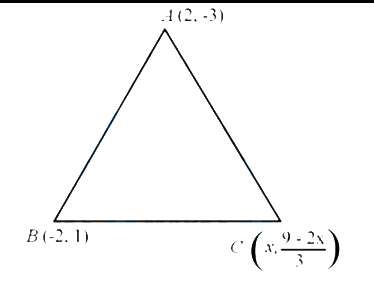
If \(A(2,-3)\) and \(B(-2,1)\) are two vertices of a triangle and third vertex moves on the line \(2 x+3 y=9\), then the locus of the centroid of the triangle isTS EAMCET 2023 Easy - The function \(f: R \rightarrow R\) is defined by \(f(x)=\cos ^2 x+\sin ^4 x\) for \(x \in R\), then \(f(R)\) is equal toTS EAMCET 2002 Hard
- The solution of isTS EAMCET 2021 Easy
More PYQs from TS EAMCET
- In a \(\triangle A B C\), the sides \(b, c\) are fixed. In measuring angle \(A\), if there is an error of \(\delta \mathrm{A}\), then the percentage error in measuring the length of the side \(a\) isTS EAMCET 2024 Easy
- \(P\) is the point of intersection of the diagonals of the parallelogram \(A B C D\). If \(S\) is any point in space and \(\mathbf{S A}+\mathbf{S B}+\mathbf{S C}+\mathbf{S D}=\lambda \mathbf{S P}\), then \(\lambda\) equalsTS EAMCET 2015 Easy
- Which one of the following reactions does not occur?TS EAMCET 2008 Medium
- \(\left|\begin{array}{lll}24 & 25 & 26 \\ 25 & 26 & 27 \\ 26 & 27 & 27\end{array}\right|\) is equal toTS EAMCET 2011 Easy
- A particle of mass \(4 m\) explodes into three pieces of masses \(m, m\) and \(2 \mathrm{~m}\). The equal masses move along \(X\)-axis and \(Y\)-axis with velocities \(4 \mathrm{~ms}^{-1}\) and \(6 \mathrm{~ms}^{-1}\) respectively. The magnitude of the velocity of the heavier mass isTS EAMCET 2009 Medium
- If \(\theta\) is the acute angle between the curves \(x^2+y^2=2020 \sqrt{2}\) and \(x^2-y^2=2020\), then \(\frac{\sin \theta+\cos \theta}{\tan \theta}\) is equal toTS EAMCET 2021 Hard