


TS EAMCET · Maths · Differentiation
let \(g(x) \neq 0, g^{\prime}(x) \neq 0, f(x) \neq 0, f^{\prime}(x) \neq 0\). If \(F(x)=f(x) g(x), G(x)=f^{\prime}(x) g^{\prime}(x)\) and \(F^{\prime}(x)=G(x) H(x)=F(x) K(x)\), then \(H(x)+K(x)=\)
- A \(\frac{f^{\prime}}{f}+\frac{f}{f^{\prime}}+\frac{g}{g^{\prime}}\)
- B \(\frac{f^{\prime}}{f}+\frac{g}{g^{\prime}}+\frac{g^{\prime}}{g}\)
- C \(\frac{f^{\prime} g^{\prime}+f g}{f f^{\prime} g g^{\prime}}\)
- D \(\frac{f^{\prime}}{f}+\frac{g}{g^{\prime}}+\frac{f}{f^{\prime}}+\frac{g^{\prime}}{g}\)
Answer & Solution
Correct Answer
(D) \(\frac{f^{\prime}}{f}+\frac{g}{g^{\prime}}+\frac{f}{f^{\prime}}+\frac{g^{\prime}}{g}\)
Step-by-step Solution
Detailed explanation
We have, \(F(x)=f(x) g(x)\)…
See the Complete Solution
Get step-by-step explanations for this and 2.5 Lakh+ more JEE, NEET & CET questions.
- Unlock all solutions
- Practice the full chapter
- Track accuracy across PYQs
4.8 rated on Google Play · 14,000+ reviews
More questions from Maths
- \(\lim _{n \rightarrow \infty} \frac{1}{n}\left[\frac{1}{n} \sin ^{-1} \frac{1}{n}+\frac{2}{n} \sin ^{-1} \frac{2}{n}+\ldots+\frac{\pi}{2}\right]=\)TS EAMCET 2020 Hard
- If the equation \(x^2-3 a x+a^2-2 a-\mathrm{K}=0\) has different real roots for every rational number \(a\), then K lies in the intervalTS EAMCET 2025 Hard
- If the vector \(\mathbf{a}=3 \hat{\mathbf{j}}+4 \hat{\mathbf{k}}\) is the sum of two vectors \(\mathbf{a}_1\) and \(\mathbf{a}_2\), vector \(\mathbf{a}_1\) is parallel to \(\mathbf{b}=\hat{\mathbf{i}}+\hat{\mathbf{j}}\) and vector \(\mathbf{a}_2\) is perpendicular to \(\mathbf{b}\), then \(\mathbf{a}_1=\)TS EAMCET 2019 Easy
- The line \(x=\frac{\pi}{4}\) divides the area of the region bounded by \(y=\sin x, y=\cos x\) and \(x\)-axis \(\left(0 \leq x \leq \frac{\pi}{2}\right)\) into two regions of areas \(A_1\) and \(A_2\). Then \(A_1, A_2\) equalsTS EAMCET 2009 Medium
- The value of \(\cos \frac{2 \pi}{15} \cos \frac{4 \pi}{15} \cos \frac{8 \pi}{15} \cos \frac{14 \pi}{15}\) is :TS EAMCET 2003 Easy
- If \(\quad z=\sec ^{-1}\left(\frac{x^4+y^4-8 x^2 y^2}{x^2+y^2}\right), \quad\) then \(x \frac{\partial z}{\partial x}+y \frac{\partial z}{\partial y}\) is equal toTS EAMCET 2008 Medium
More PYQs from TS EAMCET
- Which of the following reaction leads to the formation of benzonitrile?TS EAMCET 2018 Medium
- Assertion : Heat and work are modes of energy transfer to a system resulting in change in its internal energy. Reason : Heat and work in thermodynamics are state variables. The correct option among the following isTS EAMCET 2022 Medium
- The order of reactivity of the following compounds towards the esterification with acetic acid is
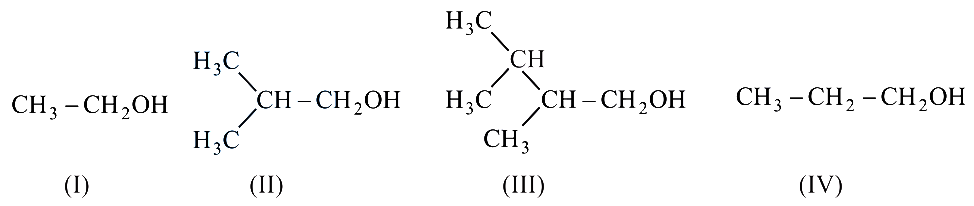 TS EAMCET 2022 Medium
 - Which of the following statements are correct for alkali metal compounds? (i) Superoxides are paramagnetic in nature. (ii) The basic strengths of hydroxides increases down the group. (iii) The conductivity of chlorides in their aqueous solutions decreases down the group. (iv) The basic nature of carbonates in aqueous solutions is due to cationic hydrolysis.TS EAMCET 2008 Hard
- If \(\frac{32 x^2+186 x}{\left(x^2+1\right)(x+5)}=\frac{37 x+1}{x^2+1}+\frac{\lambda}{x+5}\), then \(\frac{\lambda}{2}\) is equal toTS EAMCET 2021 Easy
- If the slope of the tangent drawn at any point \((x, y)\) to the curve \(\mathrm{y}=f(\mathrm{x})\) is \(3 \mathrm{x}^2-5\) and \(f(1)=2\), then the tangent at \((1,2)\) to the curve \(\mathrm{y}=f(\mathrm{x})\) intersects the curve at the pointTS EAMCET 2023 Easy