


TS EAMCET · Maths · Differentiation
Let \(\quad f(x)=e^x, \quad g(x)=\sin ^{-1} x \quad\) and \(h(x)=f(g(x))\), then \(\frac{h^{\prime}(x)}{h(x)}\) is equal to
- A \(\sin ^{-1} x\)
- B \(\frac{1}{\sqrt{1-x^2}}\)
- C \(-\frac{1}{\sqrt{1-x^2}}\)
- D \(e^{\sin ^{-1} x}\)
Answer & Solution
Correct Answer
(B) \(\frac{1}{\sqrt{1-x^2}}\)
Step-by-step Solution
Detailed explanation
We have, \[ \begin{aligned} h(x) & =f(g(x))=f\left(\sin ^{-1} x\right) \\ h(x) & =e^{\sin ^{-1} x} \\ \log h(x) & =\sin ^{-1} x \end{aligned} \] On differentiating w.r.t. \(x\), we get \[ \frac{h^{\prime}(x)}{h(x)}=\frac{1}{\sqrt{1-x^2}} \]
See the Complete Solution
Get step-by-step explanations for this and 2.5 Lakh+ more JEE, NEET & CET questions.
- Unlock all solutions
- Practice the full chapter
- Track accuracy across PYQs
4.8 rated on Google Play · 14,000+ reviews
More questions from Maths
- The direction cosines of the normal to the plane containing the lines having direction ratios \(1,2,1\) and \(4,5,-3\) areTS EAMCET 2020 Easy
- Observe the following lists
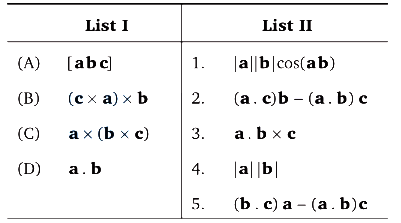
Then the correct match for List I from List II is A B C DTS EAMCET 2005 Medium - If any tangent drawn to the ellipse \(\frac{x^2}{16}+\frac{y^2}{9}=1\) touches one of the circles \(x^2+y^2=\alpha^2\), then the range of \(\alpha\) isTS EAMCET 2025 Medium
- If , thenTS EAMCET 2020 Medium
- If \(\tan \theta\) and \(\cot \theta\) are two distinct roots of the equation \(a x^2+b x+c=0, a \neq 0, b \neq 0\), thenTS EAMCET 2025 Medium
- If \(f_n(x)=\log \log \log \ldots \log x \quad(\log\) is repeated \(n\)-times), then \(\int\left(x f_1(x) f_2(x) \ldots f_n(x)\right)^{-1} d x\) is equal toTS EAMCET 2010 Hard
More PYQs from TS EAMCET
-
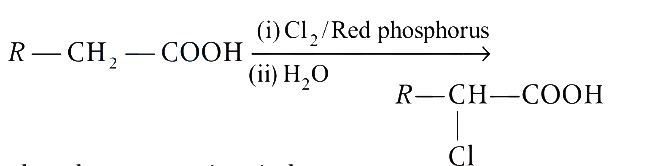
The above reaction is known asTS EAMCET 2021 Easy - Let \(a_n=\frac{10^n}{n !}\) for \(n=1,2,3, \ldots\) then the greatest value of \(n\) for which \(a_n\) is the greatest isTS EAMCET 2010 Medium
- When two dice are rolled, let be the probability of getting a sum of the numbers appear on the dice is at most . Let be the probability of getting a sum at least once when a pair of dice are rolled times. In order to have the minimum isTS EAMCET 2020 Medium
- A body of mass \(m_1=4 \mathrm{~kg}\) moves at \(5 \hat{\mathbf{i}} \mathrm{m} / \mathrm{s}\) and another body of mass \(m_2=2 \mathrm{~kg}\) moves at \(10 \hat{\mathbf{i}} \mathrm{m} / \mathrm{s}\). The kinetic energy of centre of mass isTS EAMCET 2010 Hard
- The structure given below is an example of
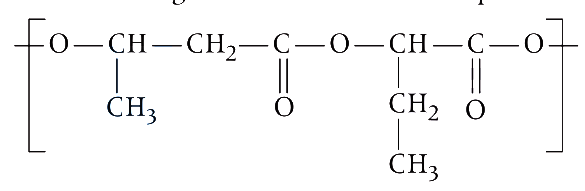
I. A condensation and biodegradable polymer.
II. A biodegradable and thermoplastic polymer.
III. A biodegradable and thermosetting polymer.
IV. A polyester and thermoplastic polymer.TS EAMCET 2020 Easy - If \(\frac{1-10 i \cos \theta}{1-10 \sqrt{3} i \sin \theta}\) is purely real, then one of the values of \(\theta\) isTS EAMCET 2018 Easy