


TS EAMCET · Maths · Vector Algebra
Let \(\overrightarrow{\mathrm{a}}=\hat{\mathrm{i}}+2 \hat{\mathrm{j}}+3 \hat{\mathrm{k}}, \overrightarrow{\mathrm{b}}=3 \hat{\mathrm{i}}-\hat{\mathrm{j}}+5 \hat{\mathrm{k}}\) and \(\overrightarrow{\mathrm{c}}=\hat{\mathrm{i}}-4 \hat{\mathrm{j}}-2 \hat{\mathrm{k}}\) be three vectors. Let \(\vec{r}\) be a vector perpendicular to both \(\vec{b}, \vec{c}\) and \(\vec{r}, \vec{a}=11\). Then the vector among the following that is perpendicular to \(\vec{r}\) is
- A \(\hat{\mathrm{i}}+\hat{\mathrm{j}}+\hat{\mathrm{k}}\)
- B \(\hat{\mathrm{i}}-\hat{\mathrm{j}}+\hat{\mathrm{k}}\)
- C \(\hat{\mathrm{i}}+\hat{\mathrm{j}}-\hat{\mathrm{k}}\)
- D \(\hat{\mathrm{i}}-\hat{\mathrm{j}}-\hat{\mathrm{k}}\)
Answer & Solution
Correct Answer
(B) \(\hat{\mathrm{i}}-\hat{\mathrm{j}}+\hat{\mathrm{k}}\)
Step-by-step Solution
Detailed explanation
Vector perpendicular to \(\vec{b}\) and \(\vec{c}=\lambda(\vec{b} \times \vec{c})\)…
See the Complete Solution
Get step-by-step explanations for this and 2.5 Lakh+ more JEE, NEET & CET questions.
- Unlock all solutions
- Practice the full chapter
- Track accuracy across PYQs
4.8 rated on Google Play · 14,000+ reviews
More questions from Maths
- If \(A=\left[\begin{array}{ccc}1 & 2 & -1 \\ -1 & 0 & 2 \\ 1 & 2 & 0\end{array}\right]\) and \(B=\left[\begin{array}{ccc}-3 & -2 & 4 \\ 2 & 2 & -1 \\ -2 & 0 & 3\end{array}\right]\), then \(A^2=\)TS EAMCET 2023 Easy
- TS EAMCET 2018 Hard
- If thenTS EAMCET 2020 Medium
- If \(y=\left(\sin ^{-1} 2 x\right)^2+\left(\cos ^{-1} 2 x\right)^2\), then \(\left(1-4 x^2\right) y_2-4 x y_1=\)TS EAMCET 2018 Medium
- The general solution of the differential equation \(\left(1+y^2\right) d x=\left(\tan ^{-1} y-x\right) d y\) isTS EAMCET 2018 Medium
- If and are two events such that and , thenTS EAMCET 2019 Easy
More PYQs from TS EAMCET
- \(\int \frac{x^3}{\sqrt{1+x^2}} d x\) is equal toTS EAMCET 2016 Easy
- Match the following :
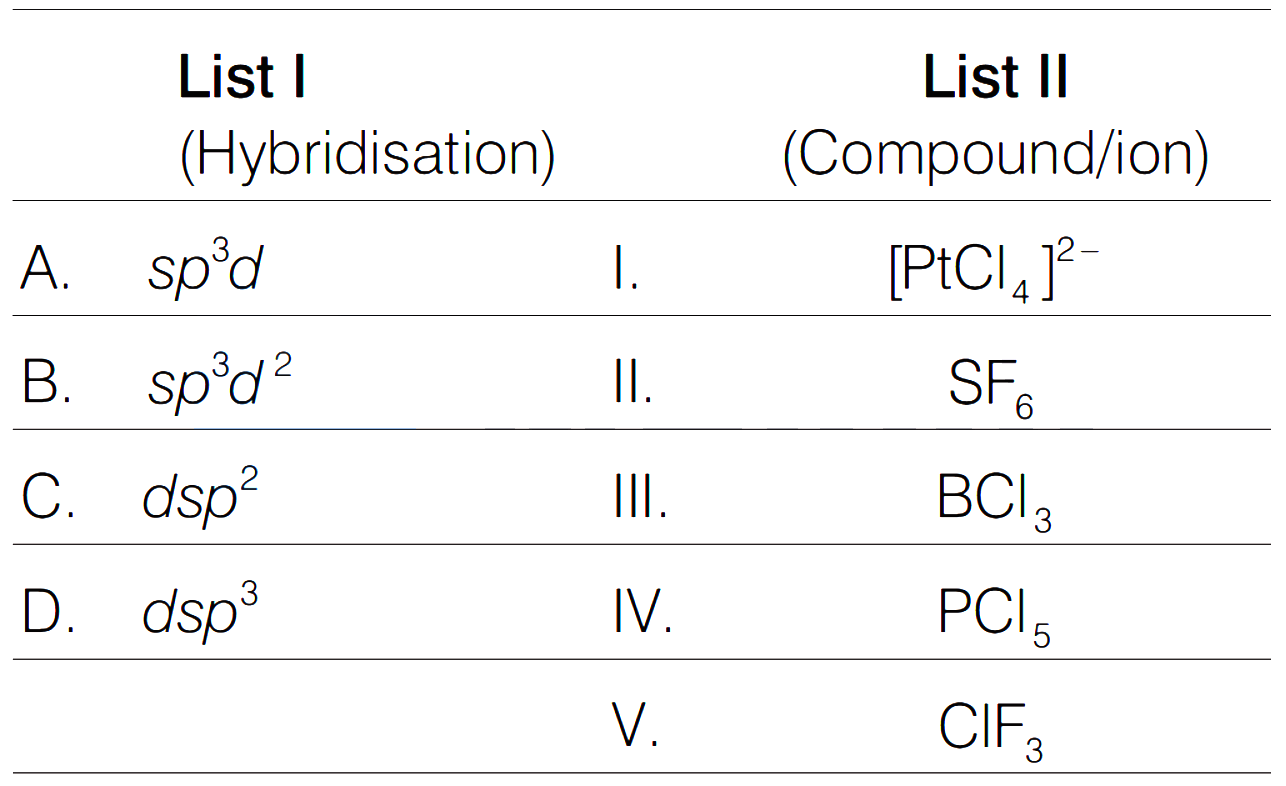
The correct match is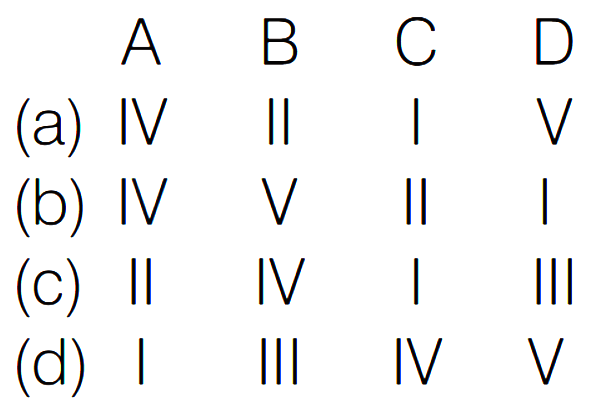 TS EAMCET 2019 Easy
 - For a first order reaction, a plot of \(\ln k\left(y\right.\)-axis) and \(\frac{1}{T}\) ( \(x\)-axis) gave the straight line with slope equal to \(-10^3 k\) and intercept equal to 2.303 (on \(y\)-axis). What is the activation energy ( \(E_a\) in \(\mathrm{kJ} \mathrm{mol}^{-1}\) ) of the reaction? (Given \(R=8.314\) \(\mathrm{J} \mathrm{mol}^{-1} \mathrm{~K}^{-1}\) )TS EAMCET 2024 Easy
- a. \(\vec{b}, \vec{c}\) are 3 vectors such that \(|\vec{a}|=3,|\vec{b}|=2 \sqrt{2},|\vec{c}|=5\) and \(\vec{c}\) is perpendicular to the plane of \(\vec{a}\) and \(\vec{b}\) If the angle between the vectors \(\vec{a}\) and \(\vec{b}\) is \(\frac{\pi}{4}\) then \(|\vec{a}+\vec{b}+\vec{c}|=\)TS EAMCET 2024 Medium
- and are three points on -plane. If a point which moves such that the area of triangle is twice the area of the triangle then the locus of the point isTS EAMCET 2021 Medium
- The objective and eyepiece of an astronomical telescope are double convex lenses with refractive index 1.5. When the telescope is adjusted to infinity, the separation between the two lenses is \(16 \mathrm{~cm}\). If the space between the lenses is now filled with water and again telescope is adjusted for infinity, then the present separation between the lenses isTS EAMCET 2012 Medium