


TS EAMCET · Maths · Differentiation
If \(y=a e^x+b e^{-x}+c\), where \(a, b, c\) are parameters, then \(y^{\prime \prime \prime}\) is equal to
- A \(0\)
- B \(y\)
- C \(y^{\prime}\)
- D \(y^{\prime \prime}\)
Answer & Solution
Correct Answer
(C) \(y^{\prime}\)
Step-by-step Solution
Detailed explanation
We have, \[ \begin{aligned} y & =a e^x+b e^{-x}+c \\ y^{\prime} & =a e^x-b e^{-x} \\ y^{\prime \prime} & =a e^x+b e^{-x} \\ y^{\prime \prime \prime} & =a e^x-b e^{-x}=y^{\prime} \end{aligned} \]
See the Complete Solution
Get step-by-step explanations for this and 2.5 Lakh+ more JEE, NEET & CET questions.
- Unlock all solutions
- Practice the full chapter
- Track accuracy across PYQs
4.8 rated on Google Play · 14,000+ reviews
More questions from Maths
- For \(h, k \in N\), let \(\mathrm{P}(h, k)\) be the point of intersection of the curves \(x^2 y-x^3=8\) and \(y^3-x y^2=32\). If \(\theta\) is the acute angle between these two curves at \(P, \operatorname{then} \tan \theta=\)TS EAMCET 2023 Easy
- If the roots of equation are real and unequal, then the roots of areTS EAMCET 2021 Easy
- If \(A=35^{\circ}, B=15^{\circ}\) and \(C=40^{\circ}\), then \(\tan A \cdot \tan B+\tan B \cdot \tan C+\tan C \cdot \tan A\) is equal toTS EAMCET 2008 Medium
- If \(a, b, c\) are distinct real numbers and \(P, Q, R\) are three points whose position vectors are respectively \(a \hat{\mathbf{i}}+b \hat{\mathbf{j}}+c \hat{\mathbf{k}}, b \hat{\mathbf{i}}+c \hat{\mathbf{j}}+a \hat{\mathbf{k}}\) and \(c \hat{\mathbf{i}}+a \hat{\mathbf{j}}+b \hat{\mathbf{k}}\), then \(\angle Q P R=\)TS EAMCET 2018 Hard
- If the mid points of the sides and of a triangle are respectively and then the centroid of the triangle isTS EAMCET 2021 Medium
- The equation of the circle that touches the -axis at a distance of units from the origin and cuts off an intercept of units on the -axis isTS EAMCET 2019 Easy
More PYQs from TS EAMCET
- In a triangle \(\mathrm{ABC},\left(r_2+r_3\right) \operatorname{cosec}^2\left(\frac{\mathrm{~A}}{2}\right)=\)TS EAMCET 2025 Medium
- In a \(\triangle A B C\), the sides \(b, c\) are fixed. In measuring angle \(A\), if there is an error of \(\delta \mathrm{A}\), then the percentage error in measuring the length of the side \(a\) isTS EAMCET 2024 Easy
- Let \(\mathbf{a}=2 \hat{\mathbf{i}}-3 \hat{\mathbf{j}}+4 \hat{\mathbf{k}}, \mathbf{b}=7 \hat{\mathbf{i}}+2 \hat{\mathbf{j}}-3 \hat{\mathbf{k}}\), \(\mathbf{c}=\hat{\mathbf{i}}+\hat{\mathbf{j}}+\hat{\mathbf{k}}\). The vector \(\mathbf{x}\) such that \(\mathbf{x} \cdot \mathbf{c}=60\) and perpendicular to both \(\mathbf{a}, \mathbf{b}\) isTS EAMCET 2020 Easy
- \(\int \frac{d x}{x^2 \sqrt{4+x^2}}\) is equal toTS EAMCET 2012 Hard
- A uniform cylinder of radius \(1 \mathrm{~m}\), mass \(1 \mathrm{~kg}\) spins about its axis with an angular velocity \(20 \mathrm{rad} / \mathrm{s}\). At certain moment, the cylinder is placed into a corner as shown in the figure. The coefficient of friction between the horizontal wall and the cylinder is \(\mu\), whereas the vertical wall is frictionless. If the number of rounds made by the cylinder is 5 before it stops, then the value of \(\mu\) is (acceleration due to gravity, \(g=10 \mathrm{~m} / \mathrm{s}^2\) )
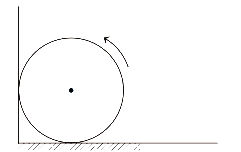 TS EAMCET 2018 Hard
 - The point \((4,1)\) undergoes the following transformations successively : (i) Reflection is the line \(x-y=0\) (ii) Shifting through a distance of 2 units along the positive \(X\)-axis (iii) Projection on \(X\)-axis The coordinates of the point in its final position areTS EAMCET 2020 Easy