


TS EAMCET · Maths · Differentiation
If \(x>0, x^y=e^{x-y}\), then \(\frac{d y}{d x}\) is equal to
- A \(\frac{1}{(1+\log x)^2}\)
- B \(\frac{\log x}{(1+\log x)^2}\)
- C \(\left(\frac{\log x}{1+\log x}\right)^2\)
- D \(\frac{(\log x)^2}{1+\log x}\)
Answer & Solution
Correct Answer
(B) \(\frac{\log x}{(1+\log x)^2}\)
Step-by-step Solution
Detailed explanation
\(y \ln x = x - y\) \(y(1+\ln x) = x\) \(y = \frac{x}{1+\ln x}\) \(\frac{d y}{d x} = \frac{(1+\ln x) \cdot 1 - x \cdot \frac{1}{x}}{(1+\ln x)^2}\) \(\frac{d y}{d x} = \frac{1+\ln x - 1}{(1+\ln x)^2}\) \(\frac{d y}{d x} = \frac{\ln x}{(1+\ln x)^2}\)
See the Complete Solution
Get step-by-step explanations for this and 2.5 Lakh+ more JEE, NEET & CET questions.
- Unlock all solutions
- Practice the full chapter
- Track accuracy across PYQs
4.8 rated on Google Play · 14,000+ reviews
More questions from Maths
- \(\lim _{n \rightarrow \infty}\left[\left(1+\frac{1}{n^2}\right)\left(1+\frac{4}{n^2}\right)\left(1+\frac{9}{n^2}\right) \ldots(2)\right]^{1 / n}=\)TS EAMCET 2024 Medium
- If \(f(x)=\int \frac{16 x^7+5 x^{10}}{\left(x^3+2+3 x^8\right)^2} d x(x \geq 0)\) and \(f(0)=1\), then the value of \(f(-1)\) isTS EAMCET 2022 Easy
- Let \(m\) be the slope of the normal \(L\) drawn at \((1,2)\) to the curve \(x=t^2-7 t+7, y=t^2-4 t-10\) and \(a x+b y+c=0\) be the equation of the normal L. If G.C.D of \((a, b, c)\) is 1 , then \(m(a+b+c)=\)TS EAMCET 2023 Easy
- A straight line passing through origin intersects the lines and at right angles and at the points and respectively. Then the ratio in which divides the line segment isTS EAMCET 2021 Easy
- If the function \(\mathrm{f}(\mathrm{x})=\mathrm{xe}^{-\mathrm{x}}, \mathrm{x} \in \mathbb{R}\) attains its maximum value \(\beta\) at \(x=\alpha\) then \((\alpha, \beta)=\)TS EAMCET 2023 Easy
- The condition that \(f(x)=a x^3+b x^2+c x+d\) has no extreme value, isTS EAMCET 2014 Hard
More PYQs from TS EAMCET
- The magnetic induction at point \(O\) of the given infinitely long current carrying wire shown in the figure below is
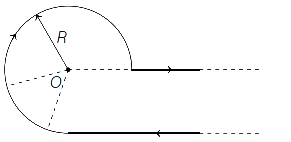 TS EAMCET 2018 Medium
 - Normals are drawn from the point \(\mathrm{P}(8,0)\) to the parabola \(y^2=12 x\). If \(\theta\) is the acute angle between two nonhorizontal normals among them, then \(\tan \theta=\)TS EAMCET 2023 Medium
- If the roots of equation are real and unequal, then the roots of areTS EAMCET 2021 Easy
- In a -type semiconductor, which of the following statement is true?TS EAMCET 2022 Medium
- A gas is at constant pressure \(4 \times 10^5 \mathrm{~N} / \mathrm{m}^2\). When a heat energy of \(2000 \mathrm{~J}\) is supplied to the gas, its volume changes by \(3 \times 10^{-3} \mathrm{~m}^3\). What is the increase in its internal energy?TS EAMCET 2020 Easy
- A metal cube absorbs of heat when its temperature is raised by . If the specific heat of the metal is , then the mass of the cube isTS EAMCET 2022 Easy