


TS EAMCET · Maths · Ellipse
If \(\mathrm{P}(\theta)\) and \(Q\left(\frac{\pi}{2}+\theta\right)\) are two points on the ellipse \(\frac{x^2}{a^2}+\frac{y^2}{b^2}=1\) and the locus of midpoint of PQ is \(\frac{x^2}{\alpha^2}+\frac{y^2}{\beta^2}=1\), then \(\frac{a+b}{\alpha+\beta}=\)
- A \(\frac{1}{\sqrt{2}}\)
- B \(\sqrt{3}\)
- C \(\frac{1}{\sqrt{3}}\)
- D \(\sqrt{2}\)
Answer & Solution
Correct Answer
(D) \(\sqrt{2}\)
Step-by-step Solution
Detailed explanation
Given two points \(\mathrm{P}(\theta)\) and \(\mathrm{Q}\left(\frac{\pi}{2}+\theta\right)\) are on the ellipse. Hence, \[ \mathrm{P}=(\mathrm{a} \cos \theta, \mathrm{b} \sin \theta), \mathrm{Q}=(-\mathrm{a} \sin \theta, \mathrm{b} \cos \theta) \] now mid point of \(P Q\)…
See the Complete Solution
Get step-by-step explanations for this and 2.5 Lakh+ more JEE, NEET & CET questions.
- Unlock all solutions
- Practice the full chapter
- Track accuracy across PYQs
4.8 rated on Google Play · 14,000+ reviews
More questions from Maths
- The positive value of 'a' for which the system of linear homogeneous equations \(x+a y+z=0, a x+2 y-z=0,2 x+3 y+z=0\) has non-trivial solutions isTS EAMCET 2025 Medium
- \(\begin{aligned} & \text { In } \quad \Delta A B C \text {, } \ & a\left(\cos ^2 B+\cos ^2 C\right)+\cos A(c \cos C+b \cos B) \text { is } \ & \text { equal to }\end{aligned}\)TS EAMCET 2005 Medium
- If the equations \(x^2+p x+2=0\) and \(x^2+x+2 p=0\) have a common root then the sum of the roots of the equation \(x^2+2 p x+8=0\) isTS EAMCET 2025 Medium
- TS EAMCET 2022 Medium
- Statement I : The differential equation corresponding to the family of circles having their centres on Y-axis and fixed radius \(k\) is \(\left(x^2-k^2\right)\left(\frac{d y}{d x}\right)^2+x^2=0\) Statement II : The differential equation of corresponding to the family of circles passing through the origin and having their centres on \(\mathrm{X}\)-axis is \(x^2-y^2+2 x y \frac{d y}{d x}=0\) Which of the above statements is (are) true?TS EAMCET 2022 Easy
- If \(\alpha, \beta, \gamma\) are the roots of \(x^3+2 x^2-3 x-1=0\) then \(\alpha^{-2}+\beta^{-2}+\gamma^{-2}=\)TS EAMCET 2005 Hard
More PYQs from TS EAMCET
- If the angle between the circles \(x^2+y^2-2 x+\mathrm{k} y+1=0\) and \(x^2+y^2-\mathrm{k} x-2 y+1=0\) is \(\operatorname{Cos}^{-1}\left(\frac{1}{4}\right)\) and \(\mathrm{k} < 0\) then the point which lies on the radical axis of the given circles isTS EAMCET 2025 Medium
- Two identical bar magnets of magnetic moment \(M\) each, are placed along \(X\) and \(Y\)-axes, respectively at a distance \(d\) from the origin (as shown in the figure). The origin lies on perpendicular bisector of magnet placed on \(X\)-axis and on the magnetic axis of magnet placed on \(Y\)-axis. If the magnitude of total magnetic field at the origin is \(B=\alpha\left[\frac{\mu_0}{4 \pi} \frac{M}{d^3}\right]\), then the value of constant \(\alpha\) will be \(\langle d>>l\), where \(l\) is the length of the bar magnets and direction of \(\mathrm{N}\) to \(\mathrm{S}\) in magnets is opposite with respect to each other)
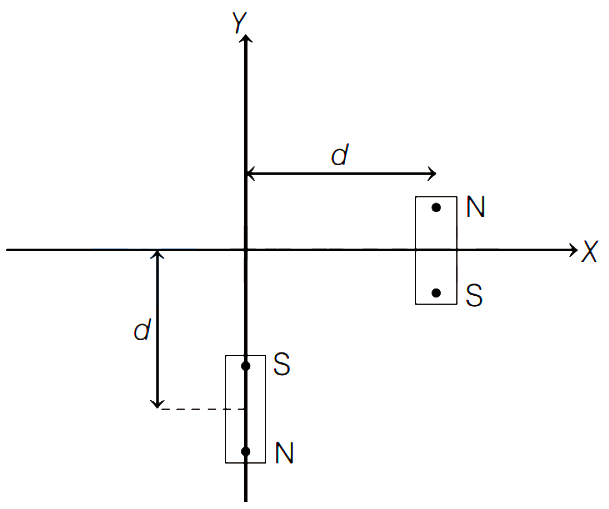 TS EAMCET 2018 Medium
 - \(\int \operatorname{cosec}^5 x d x=\)TS EAMCET 2019 Hard
- Which of the following is air pollutant?TS EAMCET 2020 Easy
- Which pair of elements on combustion in air give superoxides?TS EAMCET 2018 Easy
- The number of dissociable protons in "orthophosphoric acid" isTS EAMCET 2020 Medium