


TS EAMCET · Maths · Binomial Theorem
If \(a b \neq 0\) and the sum of the coefficients of \(x^7\) and \(x^4\) in the expansion of \(\left(\frac{x^2}{a}-\frac{b}{x}\right)^{11}\) is 0 , then
- A \(a=b\)
- B \(a+b=0\)
- C \(a b=-1\)
- D \(a b=1\)
Answer & Solution
Correct Answer
(D) \(a b=1\)
Step-by-step Solution
Detailed explanation
Given expansion is \(\left(\frac{x^2}{a}-\frac{b}{x}\right)^{11}\). \(\therefore\) The general term is…
See the Complete Solution
Get step-by-step explanations for this and 2.5 Lakh+ more JEE, NEET & CET questions.
- Unlock all solutions
- Practice the full chapter
- Track accuracy across PYQs
4.8 rated on Google Play · 14,000+ reviews
More questions from Maths
- If thenTS EAMCET 2021 Easy
- If \(\int \frac{\sin x}{\cos x(1+\cos x)} d x=f(x)+c\), then \(f(x)\) is equal toTS EAMCET 2005 Hard
- In a \(\triangle A B C\), if \(a \cos ^2 \frac{C}{2}+c \cos ^2 \frac{A}{2}=\frac{3 b}{2}\), thenTS EAMCET 2021 Easy
- Let \(A B C D\) be a parallelogram and \(E\) be the mid-point of \(A B\). If \(P\) is the point of intersection of \(D E\) and \(A C\), then \(\frac{D P}{P E}+\frac{A P}{P C}=\)TS EAMCET 2020 Easy
- If \(f(x)=2 x^4-13 x^2+a x+b\) is divisible by \(x^2-3 x+2\), then \((a, b)\) is equal toTS EAMCET 2009 Easy
- If is defined by , thenTS EAMCET 2018 Easy
More PYQs from TS EAMCET
- If \(\ell, \mathrm{m}, \mathrm{n}\) and \(\mathrm{a}, \mathrm{b}, \mathrm{c}\) are direction cosines of two lines thenTS EAMCET 2023 Easy
- The locus of the image of a variable point \((\alpha, 2 \alpha-1)\) with respect to the line \(3 x-2 y+4=0\), isTS EAMCET 2022 Hard
- The IUPAC name of
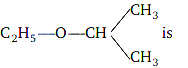 TS EAMCET 2008 Easy
 - The radii and Young's moduli of two uniform wires \(A\) and \(B\) are in the ratio \(2: 1\) and \(1: 2\) respectively. Both wires are subjected to the same longitudinal force. If the increase in length of the wire \(A\) is one percent, the percentage increase in length of the wire \(B\) isTS EAMCET 2005 Medium
- For a first order reaction is The specific rate constant in isTS EAMCET 2021 Medium
- Suppose \(\theta_1\) and \(\theta_2\) are such that \(\left(\theta_1-\theta_2\right)\) lies in \(3^{\text {rd }}\) or \(4^{\text {th }}\) quadrant. If \(\sin \theta_1+\sin \theta_2=-\frac{21}{65}\) and \(\cos \theta_1+\cos \theta_2=-\frac{27}{65}\) then \(\cos \left(\frac{\theta_1-\theta_2}{2}\right)=\)TS EAMCET 2024 Medium