


TS EAMCET · Maths · Complex Number
If \(1, \omega, \omega^2\) are the cube roots of unity and \(1, \alpha, \alpha^2, \alpha^3\) are the fourth roots of unity in usual notation then \(\alpha+\alpha \omega-\alpha^3 \omega^2=\)
- A 3
- B 1
- C 0
- D -1
Answer & Solution
Correct Answer
(C) 0
Step-by-step Solution
Detailed explanation
Given \(1, \omega, \omega^2\) are cube roots of unity and \(1, \alpha, \alpha^2\), \(\alpha^3\) are fourth roots of varity. We know that four roots of unity are \(1, i,-1,-\mathrm{i}\) Now, \(\alpha+\alpha \omega-\alpha^3 \omega^2=\mathrm{i}(1+\omega)+i \omega^2\)…
See the Complete Solution
Get step-by-step explanations for this and 2.5 Lakh+ more JEE, NEET & CET questions.
- Unlock all solutions
- Practice the full chapter
- Track accuracy across PYQs
4.8 rated on Google Play · 14,000+ reviews
More questions from Maths
- An ellipse \(\frac{x^2}{a^2}+\frac{y^2}{b^2}=1(a>b)\) is inscribed in a rectangle of dimensions \(2 a\) and \(2 b\) respectively, If the angle between the diagonals of the rectangle is \(\tan ^{-1}(4 \sqrt{3})\), then the eccentricity of that ellipse isTS EAMCET 2019 Hard
- \(\bar{i}+\bar{j}+\bar{k}, a_1 \bar{i}+b_1 \bar{j}+c_1 \bar{k}, a_2 \bar{i}+b_2 \bar{j}+c_2 \bar{k}, a_3 \bar{i}+b_3 \bar{j}+c_3 \bar{k}\) are the position vectors of the points \(\mathrm{A}, \mathrm{B}, \mathrm{C}, \mathrm{D}\) respectively. \(\frac{2}{3}(\bar{i}+\bar{j}+\bar{k})\) is the position vector of the centroid of the triangular face BCD of the tetrahedron ABCD. If \(\alpha \bar{i}+\beta \bar{j}+\gamma \bar{k}\) is the position vector of the centroid of the tetrahedron, then \(2 \alpha+\beta+\gamma=\)TS EAMCET 2025 Medium
- In the triangle with vertices at \(A(6,3), B(-6,3)\) and \(C(-6,-3)\), the median through \(A\) meets \(B C\) at \(P\), the line \(A C\) meets the \(x\)-axis at \(Q\), while \(R\) and \(S\) respectively denote the orthocentre and centroid of the triangle. Then the correct matching of the coordinates of points in List-I to List-II is \(\begin{array}{llll} & \text { List-I } & & \text { List-II } \ \text { (i) } & P & \text { (A) } & (0,0) \ \text { (ii) } & Q & \text { (B) } & (6,0) \ \text { (iii) } & R & \text { (C) } & (-2,1) \ \text { (iv) } & S & \text { (D) }(-6,0) \ & & \text { (E) }(-6,-3) \ & & \text { (F) }(-6,3)\end{array}\) (i) (ii) (iii) (iv)TS EAMCET 2007 Hard
- If the direction cosines of two lines are such that \(l+m+n=0, l^2+m^2-n^2=0\), then the angle between them is :TS EAMCET 2006 Easy
- If \(\cos ^{-1}\left(\frac{1}{2}\right)=\cot \left(\cos ^{-1} x\right)\), then the value of \(x\) isTS EAMCET 2015 Easy
- If the line intersects the circle at two points and then the centre of the circle which passes through the points and the point of intersection of the tangents drawn at and to the given circle isTS EAMCET 2019 Hard
More PYQs from TS EAMCET
- A solution of concentration \(C g\) equiv/L has a specific resistance \(R\). The equivalent conductance of the solution isTS EAMCET 2010 Easy
- A particle \(A\) moves along the line, \(y=30 \mathrm{~m}\) with a constant velocity, \(\mathbf{v}\) parallel to \(x\)-axis. At the moment particle \(A\) passes the \(y\)-axis, a particle \(B\) starts from the origin with zero initial speed and a constant acceleration, \(\mathbf{a}=0.40 \mathrm{~m} / \mathrm{sec}^2\). The angle between \(\mathbf{a}\) and \(y\)-axis is \(60^{\circ}\). If the particles \(A\) and \(B\) collide after sometimes, then the value of \(|\mathbf{v}|\) will beTS EAMCET 2019 Medium
- The domain and range of \(f(x)=\frac{1}{\sqrt{|x|-x^2}}\) are A and B respectively. Then \(\mathrm{A} \cup \mathrm{B}=\)TS EAMCET 2025 Medium
- When the engine is switched off a vehicle of mass \(M\) is moving on a rough horizontal road with momentum \(p\). If the coefficient of friction between the road and tyres of the vehicle is \(\mu_k\), the distance travelled by the vehicle before it comes to rest isTS EAMCET 2012 Easy
- \(\begin{aligned}
& 4 \mathrm{Ag}(\mathrm{s})+8 \mathrm{CN}^{-}(\mathrm{aq})+2 \mathrm{H}_2 \mathrm{O}(\mathrm{aq})+\mathrm{O}_2(\mathrm{~g}) \longrightarrow \longrightarrow \\
& 4\left[\mathrm{Ag}(\mathrm{CN})_2\right]^{-}(\mathrm{aq})+4^{-} \mathrm{OH}(\mathrm{aq})
\end{aligned}\)
The above reaction represents the process of concentration of ore in the extraction of silver. This process isTS EAMCET 2023 Easy - Match the following lists
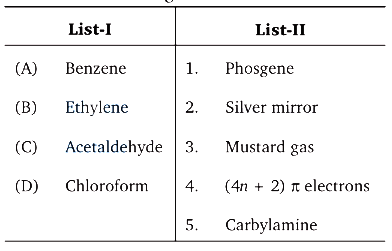
The correct answer is \(A \quad B \quad C \quad D\)TS EAMCET 2005 Easy