


TS EAMCET · Maths · Continuity and Differentiability
\(f:[2,10] \rightarrow R\) is defined as \[ f(x)=\left\{\begin{array}{cc} \frac{1}{2}(x-6)^2-3, & x \leq 4 \ x-5, & x>4 \end{array}\right. \] Which of the following is true?
- A \(f(2) \neq f(10)\)
- B \(f(x)\) is not continuous on \([2,10]\).
- C Rolle's theorem is not applicable for \(f(x)\) in \([2,10]\)
- D Rolle's theorem is applicable for \(f(x)\) in \([2,10]\) and Rolle's point \(c=6\).
Answer & Solution
Correct Answer
(C) Rolle's theorem is not applicable for \(f(x)\) in \([2,10]\)
Step-by-step Solution
Detailed explanation
It is obvious. \[ f(2)=\frac{1}{2}(2-6)^2-3=5 \text { and } f(10)=5 \] \(f(x)\) is continuous but not differentiable at \(x=4\). Hence Rolle's theorem is not applicable in \([2,10]\).
See the Complete Solution
Get step-by-step explanations for this and 2.5 Lakh+ more JEE, NEET & CET questions.
- Unlock all solutions
- Practice the full chapter
- Track accuracy across PYQs
4.8 rated on Google Play · 14,000+ reviews
More questions from Maths
- For \(0 < x < 1\), the expansion of \(\left(1+\frac{1}{x}\right)^{\frac{1}{2}}\) isTS EAMCET 2020 Easy
- The radical centre of the circles \(x^2+y^2-4 x-6 y+5=0\), \(x^2+y^2-2 x-4 y-1=0\) and \(x^2+y^2-6 x-2 y=0=0\) lies on the lineTS EAMCET 2017 Easy
- The perimeter of a \(\triangle \mathrm{ABC}\) is 6 times the arithmetic mean of the values of the sine of its angles. If its side \(\mathrm{BC}\) is of unit length, then \(\angle \mathrm{A}=\)TS EAMCET 2023 Easy
- \(\int_0^\pi \frac{1}{1+\sin x} d x\) is equal toTS EAMCET 2009 Medium
- If \(\frac{1+i \cos \theta}{1-2 i \cos \theta}\) is purely real then \(\cos ^3 \theta+\sin ^2 \theta+\cos \theta+1=\)TS EAMCET 2023 Easy
- If \(\quad d x+d y=(x+y)(d x-d y), \quad\) then \(\log (x+y)\) is equal toTS EAMCET 2005 Easy
More PYQs from TS EAMCET
- Which one of the following has longest covalent bond distance?TS EAMCET 2014 Easy
- The set of all real values of \(x\) for which the expansion of \(\left(125 x^2-\frac{27}{x}\right)^{-2 / 3}\) is valid, isTS EAMCET 2024 Medium
- The unit vector perpendicular to the vector and coplanar with the vectors and isTS EAMCET 2021 Medium
- If \(\int \mathrm{e}^x\left(\sin ^2 2 \mathrm{x}-8 \cos 4 \mathrm{x}\right) \mathrm{dx}=\mathrm{e}^x f(\mathrm{x})+\mathrm{c}\), then \(f\left(\frac{\pi}{4}\right)=\)TS EAMCET 2023 Medium
- A semi-infinite non conducting rod lies along -axis with its left end at the origin. The rod has uniform linear charge density The magnitude of electric field at a point on the -axis at the distance from the origin, will be
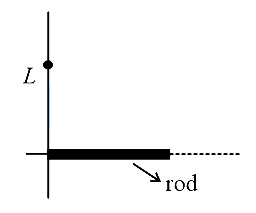 TS EAMCET 2021 Easy
 - In molecule, the hybridizations of carbon and oxygen atoms are respectivelyTS EAMCET 2020 Easy