


TS EAMCET · Maths · Binomial Theorem
Assertion (A) If \(|x| < 1\), then \[ \sum_{n=0}^{\infty}(-1)^n x^{n+1}=\frac{x}{x+1} \] Reason (R) If \(|x| < 1\), then \((1+x)^{-1}\) \[ =1-x+x^2-x^3+\ldots \] Which one of the following is true?
- A \((A)\) and \((R)\) are true, \((R)\) is a correct explanation of \((A)\)
- B \((A)\) and \((R)\) are true but \((R)\) is not a correct explanation of (A)
- C (A) is true, but \((R)\) is false
- D (A) is false, but ( \(\mathrm{R}\) ) is true
Answer & Solution
Correct Answer
(A) \((A)\) and \((R)\) are true, \((R)\) is a correct explanation of \((A)\)
Step-by-step Solution
Detailed explanation
We have, \[ \begin{aligned} \frac{x}{x+1} & =x(1+x)^{-1}=x\left(1-x+x^2-x^3+x^4-\ldots\right) \\ & =x-x^2+x^3-x^4+x^5-\ldots \\ & =\sum_{n=0}^{\infty}(-1)^n x^{n+1} \end{aligned} \] \(\therefore\) Assertion is true. Reason \((R)=(1+x)^{-1}=1-x+x^2-x^3+x^4-\ldots\) is also true…
See the Complete Solution
Get step-by-step explanations for this and 2.5 Lakh+ more JEE, NEET & CET questions.
- Unlock all solutions
- Practice the full chapter
- Track accuracy across PYQs
4.8 rated on Google Play · 14,000+ reviews
More questions from Maths
- If the roots of the equation are and thenTS EAMCET 2021 Hard
- If \(\cot \left(\frac{A}{2}\right)=\sqrt{\frac{1+a}{1-a}} \cdot \cot \left(\frac{\theta}{2}\right)\), then \(\cos \theta=\)TS EAMCET 2020 Easy
- \(\operatorname{Arg}\left(\sin \frac{6 \pi}{5}+i\left(1+\cos \frac{6 \pi}{5}\right)\right)=\)TS EAMCET 2023 Medium
- If the volume of parallelopiped with conterminus edges \(4 \hat{\mathbf{i}}+5 \hat{\mathbf{j}}+\hat{\mathbf{k}},-\hat{\mathbf{j}}+\hat{\mathbf{k}}\) and \(3 \hat{\mathbf{i}}+9 \hat{\mathbf{j}}+p \hat{\mathbf{k}}\) is 34 cubic units, then \(p\) is equal to :TS EAMCET 2006 Medium
- If \(\alpha\) is a non-real root of the equation \(x^6-1=0\), then \(\frac{\alpha^2+\alpha^3+\alpha^4+\alpha^5}{\alpha+1}\) is equal toTS EAMCET 2012 Easy
- \(P, Q, R\) and \(S\) are four points with the position vectors \(3 \mathbf{i}-4 \mathbf{j}+5 \mathbf{k},-4 \mathbf{i}+5 \mathbf{j}+\mathbf{k}\) and \(-3 \mathbf{i}+4 \mathbf{j}+3 \mathbf{k}\), respectively. Then, the line \(P Q\) meets the line \(R S\) at the pointTS EAMCET 2013 Medium
More PYQs from TS EAMCET
- A codon has a sequence of \(\underline{A}\), and specifies a particular \(\underline{B}\) that is to be incorporated into a \(\underline{C}\). What are \(\underline{A}, \underline{B}, \underline{C}\) ? \(\underline{A} \quad \underline{B} \quad \underline{C}\)TS EAMCET 2009 Medium
- The susceptibility of \(\mathrm{Al}\) is \(2 \times 10^{-5}\). The percent increase in the magnetic field when the space within a current carrying torroid to filled with \(\mathrm{Al}\) isTS EAMCET 2021 Easy
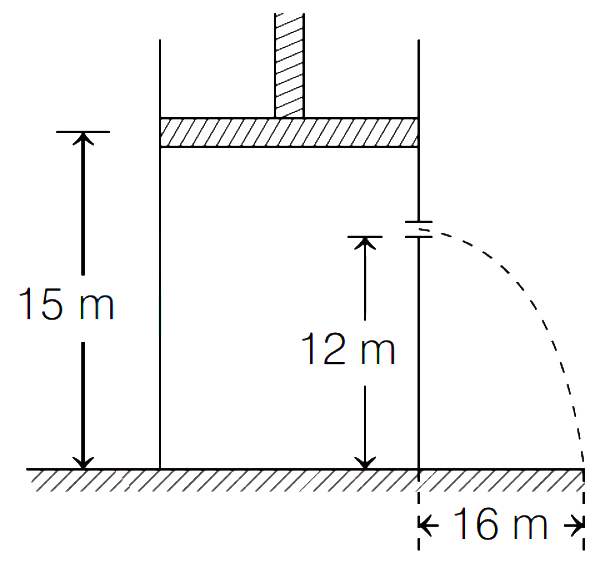
- A tank of height \(15 \mathrm{~m}\) and cross-section area \(10 \mathrm{~m}^2\) is filled with water. There is a small hole of cross-section area \(a\) which is much smaller than the container, located at a height of \(12 \mathrm{~m}\) from the base of the container. How much force should be applied with a piston at the top level, so that the water coming out of the hole hits the ground at a distance of \(16 \mathrm{~m}\) ? (Take, density of water \(=1000 \mathrm{~kg} \mathrm{~m}^{-3}\) )
 TS EAMCET 2018 Medium
 - At \(x=0, f(x)=\left\{\begin{array}{l}\frac{x}{|x|+2 x^2}, x \neq 0 \ k, \quad x=0\end{array}\right.\) isTS EAMCET 2020 Medium
- The area bounded by the curves \(y=2 x^2\), \(y=\max \{x-[x]+|x|\}\) and the lines \(x=0, x=2\) (in sq units), isTS EAMCET 2018 Medium
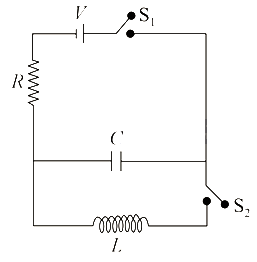
- In the circuit given below, the capacitor is charged by closing the switch and opening the switch . After charging, the switch is opened and is closed, then the maximum current in the circuit
 TS EAMCET 2018 Easy