


TS EAMCET · Maths · Quadratic Equation
\(\alpha, \beta, \gamma\) are the roots of the cubic equation \(x^3+p_1 x^2+p_2 x+p_3=0\). If \(S_\gamma=\alpha^\gamma+\beta^\gamma+\gamma^\gamma\), \(S_1=10, S_2=38\) and \(S_3=-1840\), then \(p_3=\)
- A -30
- B \(\frac{1910}{3}\)
- C 631
- D -31
Answer & Solution
Correct Answer
(B) \(\frac{1910}{3}\)
Step-by-step Solution
Detailed explanation
We have, \(\alpha, \beta, \gamma\) are roots of equation \[ \begin{aligned} x^3+p_1 x^2+p_2 x+p_3 & =0 \\ S_r & =\alpha^\mu+\beta^r+\gamma^r \\ S_1 & =\alpha+\beta+\gamma=10 \\ S_2 & =\alpha^2+\beta^2+\gamma^2=38 \\ S_3 & =\alpha^3+\beta^3+\gamma^3=-1840 \end{aligned} \] Now,…
See the Complete Solution
Get step-by-step explanations for this and 2.5 Lakh+ more JEE, NEET & CET questions.
- Unlock all solutions
- Practice the full chapter
- Track accuracy across PYQs
4.8 rated on Google Play · 14,000+ reviews
More questions from Maths
- The equation of any member of the family of all the ellipses whose axes are along the coordinate axes satisfies the differential equationTS EAMCET 2022 Easy
- If the lines and are concurrent then the cosine of the acute angle between the lines and isTS EAMCET 2022 Easy
- If \(\mathbf{a} \neq \mathbf{0}, \mathbf{b} \neq \mathbf{0}, \mathbf{c} \neq 0, \mathbf{a} \times \mathbf{b}=\mathbf{0}\) and \(\mathbf{b} \times \mathbf{c}=0\), then \(\mathbf{a} \times \mathbf{c}\) is equal toTS EAMCET 2013 Easy
- If \(z=x+i y\) and if the point P represents \(z\) in the Argand plane, then the locus of \(z\) satisfying the equation \(|z-1|+|z+i|=2\) isTS EAMCET 2024 Medium
- If \(\log (1+x)-\frac{2 x}{2+x}\) is increasing, thenTS EAMCET 2002 Easy
- The line \(2 x+y-3=0\) divides the line segment joining the points \(A(1,2)\) and \(B(-2,1)\) in the ratio \(a: b\) at the point \(C\). If the point \(C\) divides the line segment joining the points \(P\left(\frac{b}{3 a},-3\right)\) and \(Q\left(-3,-\frac{b}{3 a}\right)\) in the ratio \(p: q\), then \(\frac{p}{q}+\frac{q}{p}=\)TS EAMCET 2024 Easy
More PYQs from TS EAMCET
- If thenTS EAMCET 2021 Medium
- A car driver is trying to jump across a path as shown in figure by driving horizontally off a cliff at the speed . When he touches peak (ignore air resistance), what would be speed? (use )
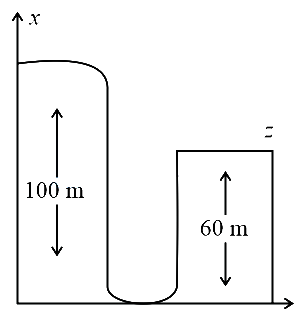 TS EAMCET 2021 Hard
 - \(A(1,2,3), B(2,3,1)\) and \(C(3,1,2)\) are three points. If the point \(\mathrm{P}\) divides \(\mathrm{AB}\) in the ratio \(1: 2\) and the point \(\mathrm{Q}\) divides \(\mathrm{BC}\) in the ratio \(-2: 3\), then the distance between \(P\) and \(Q\) isTS EAMCET 2023 Easy
- A body centred cubic lattice is made up of two different types of atoms X and Y. Atom X occupies the body centre and atoms \(\mathrm{Y}\) occupy the corner positions. One of the corners is left unoccupied per unit cell. The empirical formula of it isTS EAMCET 2023 Medium
- Three unequal resistors in parallel are equivalent to a resistance \(1 \mathrm{ohm}\). If two of them are in the ratio \(1: 2\) and if no resistance value is fractional, then the largest of the three resistances in ohms isTS EAMCET 2003 Easy
- A proton of velocity a \((3 \hat{\mathbf{i}}+2 \hat{\mathbf{j}}) \mathrm{ms}^{-1}\) enters field of magnetic induction \((2 \hat{\mathbf{j}}+3 \hat{\mathbf{k}})\) tesla, the acceleration produced in the proton in \(\mathrm{ms}^{-2}\) is \(\left(\right.\) Specific charge of proton \(=0.96 \times 10^8 \mathrm{Ckg}^{-1}\) )TS EAMCET 2002 Easy