


TS EAMCET · Chemistry · General Principles and Processes of Isolation of Metals
What is the role of limestone during the extraction of iron from haematite ore?
- A Leaching agent
- B Oxidising agent
- C Reducing agent
- D Flux
Answer & Solution
Correct Answer
(D) Flux
Step-by-step Solution
Detailed explanation
During extraction of iron from haematite ore, roasted ore, along with coke and limestone is heated in blast furnance. Here coke behaves as reducing agent and limestone is worked as flux. In this process, in reducing zone \(\left(400-900^{\circ} \mathrm{C}\right)\), spongy iron…
See the Complete Solution
Get step-by-step explanations for this and 2.5 Lakh+ more JEE, NEET & CET questions.
- Unlock all solutions
- Practice the full chapter
- Track accuracy across PYQs
4.8 rated on Google Play · 14,000+ reviews
More questions from Chemistry
- The of a galvanic cell consisting of two hydrogen electrodes is . If the solution of one of the electrodes has , the at the other electrode is:TS EAMCET 2018 Medium
- For a reversible reaction \(\quad A \rightleftharpoons B\), which one of the following statements is wrong from the given energy profile diagram?
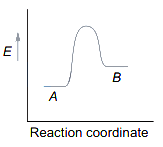 TS EAMCET 2008 Easy
 - Which of the following statements is not correct regarding kinetic theory of gases?TS EAMCET 2019 Easy
- Suitable reagents \(\mathrm{X}\) and \(\mathrm{Y}\), respectively, in the following reactions are
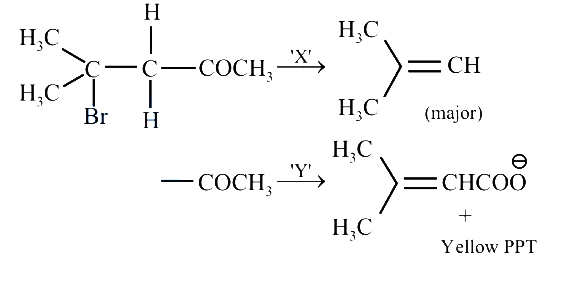 TS EAMCET 2022 Hard
 - In which of the following reactions the product is an ether?TS EAMCET 2005 Medium
- In Haber's process of manufacture of ammonia, the 'catalyst' the 'promoter' and 'poison for the catalyst' are respectivelyTS EAMCET 2024 Easy
More PYQs from TS EAMCET
- If \(u=\sin ^{-1}\left(\frac{x^2+y^2}{x+y}\right)\) then \(x \frac{\partial u}{\partial x}+y \frac{\partial u}{\partial y}\) equal to :TS EAMCET 2006 Medium
- If the sum of two of the roots of \(x^3+p x^2-q x+r=0\) is zero, then \(p q\) is equal toTS EAMCET 2003 Easy
- A particle is moving along the \(Y\)-axis. The position of the particle from the origin as a function of time \((t)\) is given as \(y(t)=10 t e^{-2 t}\). How far is the particle from the origin when it stops momentarily? ( \(y\) is given in units of metre and \(t\) is in units of second)TS EAMCET 2020 Medium
- If ' \(a\) ' is the point of discontinuity of the function \[ f(x)=\left\{\begin{array}{cl} \cos 2 x, & \text { for }-\infty < x < 0 \ e^{3 x}, & \text { for } 0 \leq x < 3 \ x^2-4 x+3, & \text { for } 3 \leq x \leq 6 \ \frac{\log (15 x-89)}{x-6}, & \text { for } x>6 \end{array}\right. \] Then, \(\lim _{x \rightarrow a} \frac{x^2-9}{x^3-5 x^2+9 x-9}=\)TS EAMCET 2019 Hard
- Henry's law is valid for A) Ammonia gas dissolution in water B) gas dissolution in unsaturated blood C) dissolution in water D) dissolution in waterTS EAMCET 2022 Medium
-
List-I (polymer) List-II (polymerisation) A. Natural rubber I. Free radical polymerisation B. PVC II. Side chain alternative C. Terylene III. Cis-polyisoprene D. Syndiotactic IV. Condensation TS EAMCET 2020 Medium