


TS EAMCET · Chemistry · Chemical Equilibrium
In a \(500 \mathrm{~mL}\) flask, the degree of dissociation of \(\mathrm{PCl}_5\) at equilibrium is \(40 \%\) and the initial amount is 5 moles. The value of equilibrium constant in \(\mathrm{mol} \mathrm{L}^{-1}\) for the decomposition of \(\mathrm{PCl}_5\) is
- A \(2.33\)
- B \(2.66\)
- C \(5.32\)
- D \(4.66\)
Answer & Solution
Correct Answer
(B) \(2.66\)
Step-by-step Solution
Detailed explanation
\begin{aligned} & \mathrm{PCl}_5 \rightleftharpoons \mathrm{PCl}_3+\mathrm{Cl}_2 \text { initial moles } \\ & \left.5(1)^5 \alpha\right) \quad 5 \alpha \quad 5 \alpha \text { moles at equilibrium } \\ & \frac{5(1-\alpha)}{0.5} \quad \frac{5 \alpha}{0.5} \quad \frac{5…
See the Complete Solution
Get step-by-step explanations for this and 2.5 Lakh+ more JEE, NEET & CET questions.
- Unlock all solutions
- Practice the full chapter
- Track accuracy across PYQs
4.8 rated on Google Play · 14,000+ reviews
More questions from Chemistry
- The number of moles of ferrous oxalate oxidised by one mole of \(\mathrm{KMnO}_4\) in acidic medium isTS EAMCET 2022 Medium
- Consider the following carbocations I. \(\quad \mathrm{C}_6 \mathrm{H}_5 \stackrel{+}{\mathrm{C}} \mathrm{H}_2\) II. \(\mathrm{CH}_2=\stackrel{+}{\mathrm{C}} \mathrm{H}\) III. \(\mathrm{CH}_3-\underset{| \atop \large \mathrm{CH}_3}{\stackrel{+}{\mathrm{C}}}-\mathrm{H}\) IV. \(\mathrm{CH}_3-\stackrel{+}{\mathrm{C}} \mathrm{H}_2\) V. \(\quad \mathrm{HC} \equiv \stackrel{+}{\mathrm{C}}\) Arrange the above carbocations in the order of decreasing stabilityTS EAMCET 2024 Easy
- The rates of diffusion of \(\mathrm{SO}_2, \mathrm{CO}_2, \mathrm{PCl}_3\) and \(\mathrm{SO}_3\) are in the following orderTS EAMCET 2020 Medium
- The sum of the total number of neutrons present in protium, deuterium and tritium isTS EAMCET 2021 Medium
- The correct statements about the products B and C in the given reactions are
\(\mathrm{CH}_3 \mathrm{CH}_2 \mathrm{OH} \xrightarrow[\text { Anhy } \mathrm{ZnCl}_2]{\mathrm{HCl} /} \mathrm{A} \xrightarrow[\text { AgCN }]{\text { ethanolic }} \underset{\text { Minor }}{\mathrm{B}}+\underset{\text { Major }}{\mathrm{C}}\)
I. \(B\) and \(C\) are functional isomers
II. With \(\mathrm{H}_2 \mid\) Catalyst B gives \(1^{\circ}\) amine and C gives \(2^{\circ}\)
III. \(B\) on acid hydrolysis gives formic acid and \(C\) gives \(\mathrm{C}_3 \mathrm{H}_6 \mathrm{O}_2\)
IV. C forms isocyanate with HgOTS EAMCET 2025 Hard - The formula of a metal oxide is \(\mathrm{M}_{0.96} \mathrm{O}_1\). The fractions of metal that exists as \(\mathrm{M}^{3+}\) and \(\mathrm{M}^{2+}\) ions in that oxide are respectivelyTS EAMCET 2023 Medium
More PYQs from TS EAMCET
- What is output of the logic circuit shown below?
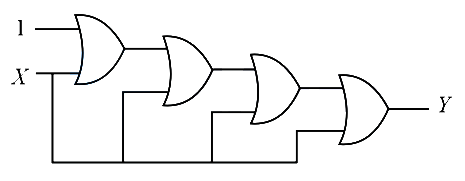 TS EAMCET 2021 Easy
 - Which of the following is not correct?TS EAMCET 2005 Easy
- The solution set of the equation \(\cos ^2 2 x+\sin ^2 3 x=1\) isTS EAMCET 2024 Hard
- Assertion (A) \(\mathrm{LiCl}\) and \(\mathrm{MgCl}_2\) are soluble in ethanol. Reason (R) Lithium and magnesium are harder than their respective group elements. The correct option among the following isTS EAMCET 2021 Easy
- The electric field for an electromangetic wave in free space is \(\mathbf{E}=\mathbf{i} 30 \cos \left(k z-5 \times 10^8 t\right)\), where magnitude of \(E\) is in \(\mathrm{V} / \mathrm{m}\). The magnitude of wave vector, \(k\) is (velocity of em wave in free space \(=3 \times 10^8 \mathrm{~m} / \mathrm{s}\) )TS EAMCET 2014 Medium
- When compared with alkaline earth metals, the alkali metals haveTS EAMCET 2023 Medium