


TS EAMCET · Chemistry · Chemical Equilibrium
For the reaction, \(0.5 \mathrm{C}(s)+0.5 \mathrm{CO}_2(g) \rightleftharpoons \mathrm{CO}(g)\) the equilibrium pressure is \(12 \mathrm{~atm}\). If, \(\mathrm{CO}_2\) conversion is \(50 \%\), the value of \(K_p\), in atm is
- A 4
- B 1
- C 0.5
- D 2
Answer & Solution
Correct Answer
(A) 4
Step-by-step Solution
Detailed explanation
For the reaction, \(\begin{aligned} & 0.5 \mathrm{C}(s)+0.5 \mathrm{CO}_2(g) \rightleftharpoons \mathrm{CO}(g) \\ & 0.5 \mathrm{CO}_2(g) \mathrm{can} \text { give } \mathrm{CO}(g) . \end{aligned}\) If \(50 \%\) conversion of \(\mathrm{CO}_2(g)\) takes place. We have…
See the Complete Solution
Get step-by-step explanations for this and 2.5 Lakh+ more JEE, NEET & CET questions.
- Unlock all solutions
- Practice the full chapter
- Track accuracy across PYQs
4.8 rated on Google Play · 14,000+ reviews
More questions from Chemistry
- The correct order of reactivity of hydrogen halides with ethyl alcohol isTS EAMCET 2008 Easy
- Identify the correct order of reactivity of the following haloarenes on treatment with \(\mathrm{NaOH} ?\)
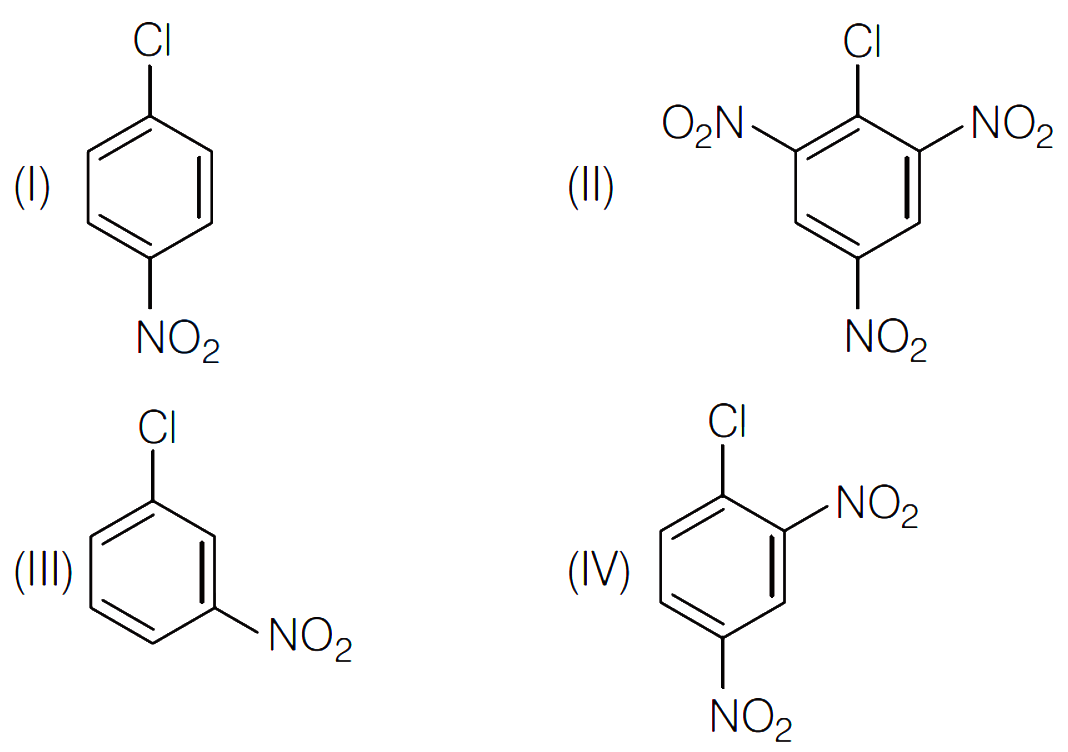 TS EAMCET 2019 Easy
 - The half-life of a zero order reaction \(\mathrm{A} \rightarrow\) products, is 0.5 hour. The initial concentration of A is \(4 \mathrm{~mol} \mathrm{~L}^{-1}\). How much time (in hr ) does it take for its concentration to come from \(2.0 \mathrm{~mol} \mathrm{~L}^{-1}\) to \(1.0 \mathrm{~mol} \mathrm{~L}^{-1} ?\)TS EAMCET 2025 Medium
- Which of the following vitamin is also called pyridoxine?TS EAMCET 2024 Easy
- Find the element, which displays greater ability to form \(p \pi-p \pi\) multiple bonds to itself and to other elements in the same block.TS EAMCET 2020 Easy
- Mustard gas among the following isTS EAMCET 2021 Medium
More PYQs from TS EAMCET
- Which of the following reaction leads to the formation of benzonitrile?TS EAMCET 2018 Medium
- \(S_1, S_2, \ldots \ldots, S_{10}\) are the speakers in a conference. If \(S_1\) addresses only after \(S_2\), then the number of ways the speakers address isTS EAMCET 2004 Medium
- \(\begin{array}{r}\lim _{n \rightarrow \infty}\left[\frac{n^{3 / 2}}{n^{5 / 2}}-\frac{n^{1 / 2}}{n^{3 / 2}}+\frac{n^{3 / 2}}{(n+2)^{5 / 2}}-\frac{n^{1 / 2}}{(n+3)^{3 / 2}}\right. \ +\frac{n^{3 / 2}}{(n+4)^{5 / 2}}-\frac{n^{1 / 2}}{(n+6)^{3 / 2}}+\ldots .+\frac{n^{3 / 2}}{(n+2(n-1))^{5 / 2}} \ \left.\quad-\frac{n^{1 / 2}}{(n+3(n-1))^{3 / 2}}\right]=\end{array}\)TS EAMCET 2020 Medium
- The radical centre of the circles \(x^2+y^2-4 x-6 y+5=0\), \(x^2+y^2-2 x-4 y-1=0\) and \(x^2+y^2-6 x-2 y=0=0\) lies on the lineTS EAMCET 2017 Easy
- If thenTS EAMCET 2021 Easy
- Consider the following carbocations I. \(\quad \mathrm{C}_6 \mathrm{H}_5 \stackrel{+}{\mathrm{C}} \mathrm{H}_2\) II. \(\mathrm{CH}_2=\stackrel{+}{\mathrm{C}} \mathrm{H}\) III. \(\mathrm{CH}_3-\underset{| \atop \large \mathrm{CH}_3}{\stackrel{+}{\mathrm{C}}}-\mathrm{H}\) IV. \(\mathrm{CH}_3-\stackrel{+}{\mathrm{C}} \mathrm{H}_2\) V. \(\quad \mathrm{HC} \equiv \stackrel{+}{\mathrm{C}}\) Arrange the above carbocations in the order of decreasing stabilityTS EAMCET 2024 Easy