


TS EAMCET · Chemistry · Surface Chemistry
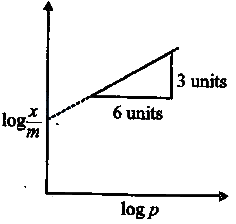
Adsorption of a gas on a solid adsorbent follows Freundlich adsorption isotherm. If \(x\) is the mass of the gas adsorbed on mass ' \(m\) ' of the adsorbent at pressure \(p\). From the graph given extent of adsorption is proportional to
- A \(p^{1 / 2}\)
- B \(p^2\)
- C \(p\)
- D \(p^{1 / 4}\)
Answer & Solution
Correct Answer
(A) \(p^{1 / 2}\)
Step-by-step Solution
Detailed explanation
According to Freundlich Isotherm- \(\begin{aligned} & \frac{x}{m}=k \cdot p^{1 / n} \\ & \log \frac{x}{m}=\log k+\frac{1}{n} \log p \end{aligned}\) Slope according to graph \(=\frac{1}{\mathrm{n}}=\frac{3}{6}=\frac{1}{2}\) \(\because \frac{x}{m}=k \cdot p^{1 / 2}\) Extent of…
See the Complete Solution
Get step-by-step explanations for this and 2.5 Lakh+ more JEE, NEET & CET questions.
- Unlock all solutions
- Practice the full chapter
- Track accuracy across PYQs
4.8 rated on Google Play · 14,000+ reviews
More questions from Chemistry
- Identify the non-reducing sugar from the following.TS EAMCET 2018 Easy
- The chlorination of ethane is an example for which type of the following reactions?TS EAMCET 2012 Easy
- Equal amount of gases are kept in two separate containers. If densities of the two gases are in \(1: 2\) ratio and their temperatures are in \(2: 1\) ratio, calculate the ratio of their respective pressures.TS EAMCET 2020 Medium
- The Gibbs energy change of the reaction (in \(\mathrm{kJ} \mathrm{mol}^{-1}\) ) corresponding to the following cell \(\mathrm{Cr}\left|\mathrm{Cr}^{3+}(0.1 \mathrm{M}) \| \mathrm{Fe}^{2+}(0.01 \mathrm{M})\right| \mathrm{Fe}\)TS EAMCET 2025 Medium
- In which of the following reactions at equilibria, the position of the equilibrium shifts towards the products, if the total pressure is increased? (i) \(\mathrm{X}_2(\mathrm{~g})+3 \mathrm{Y}_2(\mathrm{~g}) \rightleftharpoons 2 \mathrm{XY}_3(\mathrm{~g})\) (ii) \(\mathrm{X}_2(\mathrm{~g})+\mathrm{Y}_2(\mathrm{~g}) \rightleftharpoons 2 \mathrm{XY}(\mathrm{g})\) (iii) \(\mathrm{X}_2(\mathrm{~g})+\mathrm{Z}_2(\mathrm{~g}) \rightleftharpoons 2 \mathrm{XZ}(\mathrm{g})\) (iv) \(\mathrm{X}_2(\mathrm{~g})+\mathrm{Y}_4(\mathrm{~g}) \rightleftharpoons 2 \mathrm{XY}_2(\mathrm{~g})\)TS EAMCET 2022 Easy
- The degree of ionization of \(0.10 \mathrm{M}\) lactic acid is \(4.0 \%\)
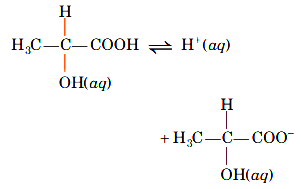
The value of \(K_c\) isTS EAMCET 2013 Medium
More PYQs from TS EAMCET
- If the ratio of the mass numbers of two nuclei is \(27: 125\), then the ratio of their surface areas isTS EAMCET 2025 Medium
- If is an interior point of the curve then lies inTS EAMCET 2021 Easy
- If then the interval of maximum length in which lies isTS EAMCET 2021 Easy
- The angle of contact is \(120^{\circ}\) when a cylindrical rod is vertically placed in a liquid. If the same rod is placed horizontally in the liquid, then the angle of contact isTS EAMCET 2023 Medium
- If \(\frac{3 x+2}{(x+1)\left(2 x^2+3\right)}=\frac{A}{x+1}+\frac{B x+C}{2 x^2+3}\), then \(A+C-B\) is equal to :TS EAMCET 2006 Easy
- Consider the following about the Tyndall effect. (I) It is used to distinguish between a true and colloidal solution (II) It is possible only when the dispersed medium and dispersed phase differ much in their refractive indices (III) It is observed only when the size of colloidal particles is much smaller than the wavelength of the light used The correct statements areTS EAMCET 2023 Medium