


NEET · Physics · STD 11 - 14. waves and sound
Two open organ pipes of fundamental frequencies \(n_{1}\) and \(n_{2}\) are joined in series. The fundamental frequecny of the new pipe so obtained will be
- A \(\frac{{{n_1} + {n_2}}}{2}\)
- B \(\sqrt {{n_1}^2 + {n_2}^2} \)
- C \(\;\frac{{{n_1}{n_2}}}{{{n_1} + {n_2}}}\)
- D \(\;({n_1} + n_2)\)
Answer & Solution
Correct Answer
(C) \(\;\frac{{{n_1}{n_2}}}{{{n_1} + {n_2}}}\)
Step-by-step Solution
Detailed explanation
Fundamental frequency of an open pipe of length \(L\) is given by \(n =\frac{ v }{2 L }\) \(\Longrightarrow L =\frac{ v }{2 n }\) So, we get lengths of two open pipes as \(L _{1}=\frac{ v }{2 n _{1}}\) and \(L _{2}=\frac{ v }{2 n _{2}}\) Now the pipes are join in series.
See the Complete Solution
Get step-by-step explanations for this and 2.5 Lakh+ more JEE, NEET & CET questions.
- Unlock all solutions
- Practice the full chapter
- Track accuracy across PYQs
4.8 rated on Google Play · 14,000+ reviews
More questions from Physics
- Radioactive material \('A'\) has decay constant \(8 \lambda\) and material \('B'\) has decay constant \( ' \lambda '\). Initially they have same number of nuclei . After what time, the ratio of number of nuclei of material \('B'\) to that \('A'\) will be \(\frac{1}{e}\) ?NEET 2017 Medium
- Given below are two statements : Statement \(I:\) The law of radioactive decay states that the number of nuclei undergoing the decay per unit time is inversely proportional to the total number of nuclei in the sample. Statement \(II:\) The half life of a radionuclide is the sum of the life time of all nuclei, divided by the initial concentration of the nuclei at time \(t =0\). In the light of the above statements, choose the most appropriate answer from the options given below :NEET 2022 Medium
- Three stars \(A, B, C\) have surface temperatures \(T _{A} ,T _{B}, T _{C}\) respectively. Star \(A\) appears bluish, star \(B\) appears reddish and star \(C\) yellowish. Hence,NEET 2020 Medium
- The displacement of a particle executing simple harmonic motion is given by \(\mathrm{y}=\mathrm{A}_{0}+\mathrm{A} \sin \omega \mathrm{t}+\mathrm{B} \cos \omega \mathrm{t}\) Then the amplitude of its oscillation is given byNEET 2019 Medium
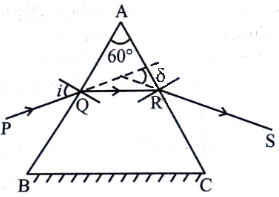
- A ray of monochromatic light is passing through an equilateral prism (ABC) as shown in the figure. The refracted ray (QR) is parallel to its base (BC) and the angle of incidence (i) is \(50^{\circ}\). Then the angle of deviation \((\delta)\) is :
 NEET 2026 Hard
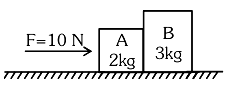
 - A horizontal force \(10 \mathrm{~N}\) is applied to a block \(A\) as shown in figure. The mass of blocks \(A\) and \(B\) are \(2 \mathrm{~kg}\) and \(3 \mathrm{~kg}\) respectively. The blocks slide over a frictionless surface. The force exerted by block \(A\) on block \(B\) is :
 NEET 2024 Medium
More PYQs from NEET
- A population of a species invades a new area. Which of the following condition will lead to Adaptive Radiation ?NEET 2019 Hard
- The outer electronic configuration of \(Gd \ (At. \ No. \ 64)\) isNEET 2013 Hard
- Match List I with List II :
List I List-II (A) Young's Modulus (I) \(\frac{\Delta d}{\Delta L}\left(\frac{L}{d}\right)\) (B) Compressibility (II) \(\frac{F L}{A(\Delta L)}\) (C) Bulk Modulus (III) \(-\frac{1}{\Delta P}\left(\frac{\Delta V}{V}\right)\) (D) Poisson's Ratio (IV) \(-P\left(\frac{V}{\Delta V}\right)\)
Choose the correct answer from the options given below:NEET 2026 Hard - For the cell reaction......\(kJ\, mol^{-1}\) \(2 \mathrm{Fe}^{3+}(\mathrm{aq})+2 \mathrm{I^-}(\mathrm{aq}) \rightarrow 2 \mathrm{Fe}^{2+}(\mathrm{aq})+\mathrm{I}_{2}(\mathrm{aq})\) \(\mathrm{E}_{\text {call }}^{\mathrm{e}}=0.24 \mathrm{V}\) at \(298\; \mathrm{K}\). The standard Gibbs energy \(\left( {{\Delta _r}{{\rm{G}}^ \ominus }} \right)\) of the cell reaction is: [Faraday constant \(\mathrm{F}=96500 \;\mathrm{C} \mathrm{mol}^{-1} \)]NEET 2019 Hard
- In a vernier callipers, 20 VSD coincide with 16 MSD (each division of length 1 mm). The least count of the vernier callipers is :NEET 2026 Medium
- A first order reaction has a rate constant of \(2.303 \times 10^{-3} \;\mathrm{s}^{-1} .\) The time required for \(40 \mathrm{g}\) of this reactant to reduce to \(10\; \mathrm{g}\) will be.....\(s\) [Given that \(\left.\log _{10} 2=0.3010\right]\)NEET 2019 Medium