


NEET · Physics · STD 12 - 1. Electric charges and fields
Two identical charged conducting spheres \(A\) and \(B\) have their centres separated by a certain distance. Charge on each sphere is \(q\) and the force of repulsion between them is \(F\). A third identical uncharged conducting sphere is brought in contact with sphere \(A\) first and then with \(B\) and finally removed from both. New force of repulsion between spheres \(A\) and \(B\) (Radii of \(A\) and \(B\) are negligible compared to the distance of separation so that for calculating force between them they can be considered as point charges) is best given as:
- A \(\frac{3 F}{5}\)
- B \(\frac{2 F}{3}\)
- C \(\frac{F}{2}\)
- D \(\frac{3 F}{8}\)
Answer & Solution
Correct Answer
(D) \(\frac{3 F}{8}\)
Step-by-step Solution
Detailed explanation
\( F=\frac{kQ^2}{r^2} \)
on touching; \(F^{\prime}=\frac{k(Q / 2)(3 Q / 4)}{r^2}\)
\( F^{\prime}=\frac{3 F}{8} \)
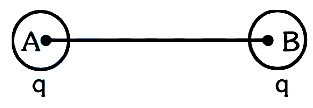
After touching \(\rightarrow\)
\(( A ) \& ( C ) \rightarrow\)
Total charge \(\rightarrow q +0= q\)
\(Q_A^{\prime}=\frac{q}{2}, \quad Q_C^{\prime}=\frac{q}{2}\)
(B) & (C)
Total charge \(=q+\frac{q}{2}=\frac{3}{2} q\)
\(Q_B^{\prime}=\frac{3}{4} q \quad Q_C^{\prime}=\frac{3}{4} q\)
on touching; \(F^{\prime}=\frac{k(Q / 2)(3 Q / 4)}{r^2}\)
\( F^{\prime}=\frac{3 F}{8} \)
After touching \(\rightarrow\)
\(( A ) \& ( C ) \rightarrow\)
Total charge \(\rightarrow q +0= q\)
\(Q_A^{\prime}=\frac{q}{2}, \quad Q_C^{\prime}=\frac{q}{2}\)
(B) & (C)
Total charge \(=q+\frac{q}{2}=\frac{3}{2} q\)
\(Q_B^{\prime}=\frac{3}{4} q \quad Q_C^{\prime}=\frac{3}{4} q\)
See the Complete Solution
Get step-by-step explanations for this and 2.5 Lakh+ more JEE, NEET & CET questions.
- Unlock all solutions
- Practice the full chapter
- Track accuracy across PYQs
4.8 rated on Google Play · 14,000+ reviews
More questions from Physics
- A model for quantized motion of an electron in a uniform magnetic field \(B\) states that the flux passing through the orbit of the electron is \(n(h / e)\) where \(n\) is an integer, \(h\) is Planck's constant and \(e\) is the magnitude of electron's charge. According to the model, the magnetic moment of an electron in its lowest energy state will be ( \(m\) is the mass of the electron)NEET 2025 Hard
- The distance covered by a body of mass \(5\,g\) having linear momentum \(0.3\,kg\,m / s\) in \(5\,s\) is \(..........\,m\)NEET 2022 Medium
- Find the value of the angle of emergence from the prism. Refractive index of the glass is \(\sqrt{3}\). (in \(^{\circ}\))
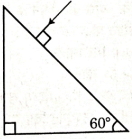 NEET 2021 Medium
 - An organ pipe filled with a gas at \(27^{\circ}\,C\) resonates at \(400\,Hz\) in its fundamental mode. If it is filled with the same gas at \(90^{\circ}\,C\), the resonance frequency at the same mode will be \(...........\,Hz\)NEET 2022 Medium
- In the figure shown here, what is the equivalent focal length (in \(cm\)) of the combination of lenses (Assume that all layers are thin)?
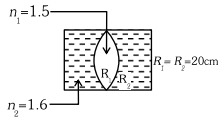 NEET 2023 Medium
 - The wave nature of electrons was experimentally verified by,NEET 2020 Easy
More PYQs from NEET
- The angular momentum of a rigid body of mass m about an axis is \(n\) times the linear momentum \((P)\) of the body. Total kinetic energy of the rigid body isNEET 2017 Medium
- Match List I with List II related to muscular/skeletal system :
Choose the correct answer from the options given below :List I List II A. Tetany I. Inflammation of joints B. Arthritis II. Autoimmune disorder affecting neuromuscular junction C. Myasthenia gravis III. Wild contraction in muscle due to low \(Ca ^{++}\)in body fluid D. Muscular dystrophy IV. Progressive degeneration of skeletal muscle NEET 2026 Easy - Pollen tablets are available in the market forNEET 2014 Medium
- To obtain virus free healthy plants from a diseased one by tissue culture technique, which part/parts of the diseased plant will be taken?NEET 2014 Medium
- Which one is wrongly matched?NEET 2018 Medium
- Which of the following statements is not correct?NEET 2019 Medium