


NEET · Physics · STD 11 - 6. system of particles and rotational motion
Three objects, \(A :\) (a solid sphere), \(B :\) (a thin circular disk) and \(C :\) (a circular ring), each have the same mass \(M\) and radius \(R.\) They all spin with the same angular speed \(\omega\) about their own symmetry axes. The amounts of work \((W)\) required to bring them to rest, would satisfy the relation
- A \(W_C>W_B>W_A\)
- B \(W_A>W_B>W_C\)
- C \(W_A>W_C>W_B\)
- D \(W_B>W_A>W_C\)
Answer & Solution
Correct Answer
(A) \(W_C>W_B>W_A\)
Step-by-step Solution
Detailed explanation
Work done required to bring a object to rest \(\Delta W = \Delta KE\) \(\begin{array}{l}
\Delta W = \frac{1}{2}I{\omega ^2}\,;\,where\,I\, = moment\,of\,inertia\\
For\,same\,\omega ,\,\Delta W \propto I\\
For\,a\,solid\,sphere,\,{I_A} = \frac{2}{5}M{R^2}\\
For\,a\,thin\,cicular\,disk,\,{I_B} = \frac{1}{2}M{R^2}\\
For\,a\,circular\,ring,\,{I_c} = M{R^2}\\
\therefore \,\,{I_c} > {I_B} > {I_A}\,\,\therefore \,\,{W_c} > {W_B} > {W_A}
\end{array}\)
\Delta W = \frac{1}{2}I{\omega ^2}\,;\,where\,I\, = moment\,of\,inertia\\
For\,same\,\omega ,\,\Delta W \propto I\\
For\,a\,solid\,sphere,\,{I_A} = \frac{2}{5}M{R^2}\\
For\,a\,thin\,cicular\,disk,\,{I_B} = \frac{1}{2}M{R^2}\\
For\,a\,circular\,ring,\,{I_c} = M{R^2}\\
\therefore \,\,{I_c} > {I_B} > {I_A}\,\,\therefore \,\,{W_c} > {W_B} > {W_A}
\end{array}\)
See the Complete Solution
Get step-by-step explanations for this and 2.5 Lakh+ more JEE, NEET & CET questions.
- Unlock all solutions
- Practice the full chapter
- Track accuracy across PYQs
4.8 rated on Google Play · 14,000+ reviews
More questions from Physics
- In a metre bridge experiment (see figure), the positions of the cell, \(E\), and galvanometer, \(G\), are interchanged. We shall observe in the galvanometer :
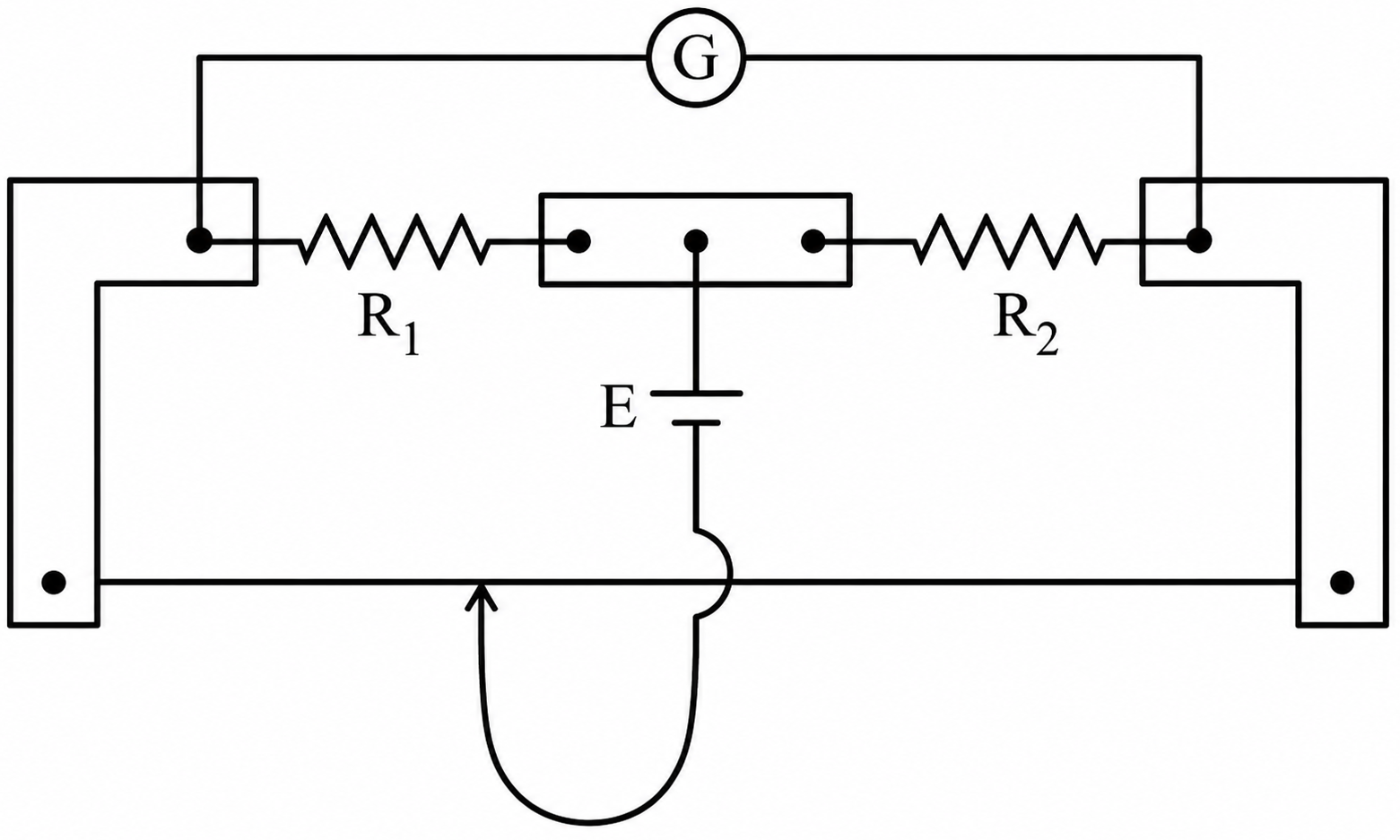 NEET 2026 Medium
 - A proton and an \(\alpha\) -particle are accelerated from rest to the same energy. The de Broglie wavelengths \(\lambda_{\mathrm{p}}\) and \(\lambda_{\alpha}\) are in the ratio,NEET 2019 Medium
- The equivalent capacitance of the combination shown in the figure is :
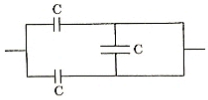 NEET 2021 Medium
 - An organ pipe filled with a gas at \(27^{\circ}\,C\) resonates at \(400\,Hz\) in its fundamental mode. If it is filled with the same gas at \(90^{\circ}\,C\), the resonance frequency at the same mode will be \(...........\,Hz\)NEET 2022 Medium
- A wire of length \(L\) metre carrying a current of \(I\) ampere is bent in the form of circle. Its magnetic moment isNEET 2020 Medium
- A dipole is placed in an electric field as shown. In which direction will it move ?
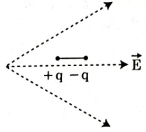 NEET 2021 Medium
More PYQs from NEET
- Choose the correct statement.NEET 2016 Medium
- Receptors for sperm binding in mammals are present on :NEET 2021 Hard
- In-situ conservation refers to:NEET 2022 Medium
- Match List \(I\) with List \(II\) :Choose the correct answer from the options given below :
List \(I\) List \(I\) \(A\) Exophthalmic goiter \(I\) Excess secretion of cortisol, moon face hypergylcemia. \(B\) Acromegaly \(II\) Hypo-secretion of thyroid hormone and stunted growth. \(C\) Cushing's syndrome \(III\) Hyper secretion of thyroid hormone protruding eye balls. \(D\) Cretinism \(IV\) Excessive secretion of growth hormone. NEET 2024 Medium - Which of these is least likely to act as a Lewis base?NEET 2013 Easy
- Two identical glass \((\mu_g = 3/2)\) equiconvex lenses of focal length \(f\) each are kept in contact. The space between the two lenses is filled with water \((\mu_w = 4/3).\) The focal length of the combination isNEET 2016 Hard