


enEnglishguગુજરાતી
NEET · Physics · STD 11 - 13. oscillations
The displacement of a particle executing simple harmonic motion is given by \(\mathrm{y}=\mathrm{A}_{0}+\mathrm{A} \sin \omega \mathrm{t}+\mathrm{B} \cos \omega \mathrm{t}\) Then the amplitude of its oscillation is given by
- A \(\mathrm{A}_{0}+\sqrt{\mathrm{A}^{2}+\mathrm{B}^{2}}\)
- B \(\sqrt{\mathrm{A}^{2}+\mathrm{B}^{2}}\)
- C \(\sqrt{\mathrm{A}_{0}^{2}+(\mathrm{A}+\mathrm{B})^{2}}\)
- D \(\mathrm{A}+\mathrm{B}\)
Answer & Solution
Correct Answer
(B) \(\sqrt{\mathrm{A}^{2}+\mathrm{B}^{2}}\)
Step-by-step Solution
Detailed explanation
\(y=A_{0}+A \sin \omega t+B \cos \omega t\) \(y=A_{0}+\sqrt{A^{2}+B^{2}} \sin (\omega t+\phi)\)
See the Complete Solution
Get step-by-step explanations for this and 2.5 Lakh+ more JEE, NEET & CET questions.
- Unlock all solutions
- Practice the full chapter
- Track accuracy across PYQs
4.8 rated on Google Play · 14,000+ reviews
More questions from Physics
- Given below are two statements : Statement\(-I:\)In an ac circuit, the current through a capacitor leads the voltage across it. Statement\(-II:\) In a.c. circuits containing pure capacitance only, the phase difference between the current and the voltage is \(\pi\) In the light of the above statements, choose the most appropriate answer from the options given belowNEET 2022 Easy
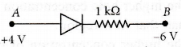
- Consider the junction diode as ideal. The value of current flowing through \(AB\) is
 NEET 2016 Easy
 - The length of the string of a musical instrument is \(90 \;cm\) and has a fundamental frequency of \(120 \;Hz\). Where (In \(cm\)) should it be pressed to produce fundamental frequency of \(180 \;Hz ?\)NEET 2020 Easy
- A filament bulb \((500 \,W,\,\, 100 \,V)\) is to be used in a \(230\, V\) main supply. When a resistance \(R\) is connected in series, it works perfectly and the bulb consumes \(500\,W.\) The value of \(R\) is .................. \(\Omega\)NEET 2016 Medium
- A \(250-\) turn rectangular coil of length \(2.1\, cm\) and width \(1.25\, cm\) carries a current of \(85\, \mu A\) and subjected to a magnetic field of strength \(0.85\, T.\) Work done for rotating the coil by \(180^o \) against the torque is .............. \(\mu\ J\)NEET 2017 Medium
- The minimum energy required to launch a satellite of mass \(m\) from the surface of earth of mass \(M\) and radius \(R\) in a circular orbit at an altitude of \(2 R\) from the surface of the earth is:NEET 2024 Medium
More PYQs from NEET
- Which of the following statements is not correct?NEET 2017 Easy
- Which of the following hormones can play a significant role in osteoporosis?NEET 2018 Medium
- Match the following columns and select the correct option.
\((a)\quad(b)\quad(c)\quad(d)\)Column\(-I\) Column\(-II\) \((a)\) Placenta \((i)\) Androgens \((b)\) Zona pellucida \((ii)\) Human Chorionic Gonadotropin \((hCG)\) \((c)\) Bulbo\(-\)urethral glands \((iii)\) Layer of the ovum \((d)\) Leydig cells \((iv)\) Lubrication of the Penis NEET 2020 Easy - A reaction having equal energies of activation for forward and reverse reactions hasNEET 2013 Medium
- Select the incorrect statement with regard to haemophilia.NEET 2013 Medium
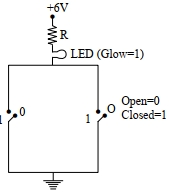
- Identify the equivalent logic gate represented by the given circuit
 NEET 2022 Medium