


NEET · Physics · STD 11 - 3.2 motion in plane
The angular acceleration of a body, moving along the circumference of a circle, is :
- A along the axis of rotation
- B along the tangent to its position
- C along the radius towards the centre
- D along the radius, away from centre
Answer & Solution
Correct Answer
(A) along the axis of rotation
Step-by-step Solution
Detailed explanation
Along the axis of rotation

See the Complete Solution
Get step-by-step explanations for this and 2.5 Lakh+ more JEE, NEET & CET questions.
- Unlock all solutions
- Practice the full chapter
- Track accuracy across PYQs
4.8 rated on Google Play · 14,000+ reviews
More questions from Physics
- A parallel beam of light of wavelength \(\lambda\) is incident normally on a single slit of width \(d\). Diffraction bands are obtained on a screen placed at a distance \(D\) from the slit. The second dark band from the central bright band will be at a distance given byNEET 2017 Easy
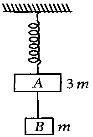
- Two blocks \(A\) and \(B\) of masses \(3\,m\) and \(m\) respectively are connected by a massless and inextensible string. The whole system is suspended by a massless spring as shown in figure. The magnitudes of acceleration of \(A\) and \(B\) immediately after the string is cut, are respectively
 NEET 2017 Medium
 - A bob is whirled in a horizontal plane by means of a string with an initial speed of \(\omega \mathrm{rpm}\). The tension in the string is \(T\). If speed becomes \(2 \omega\) while keeping the same radius, the tension in the string becomes:NEET 2024 Medium
- Given below are two statements: one is labelled as Assertion \(A\) and the other is labelled as Reason \(R\). Assertion \(A\): The potential ( \(V\) ) at any axial point, at \(2 \mathrm{~m}\) distance ( \(r\) ) from the centre of the dipole of dipole moment vector \(\vec{P}\) of magnitude, \(4 \times 10^{-6} \mathrm{C} \mathrm{m}\), is \(\pm 9 \times 10^3 \mathrm{~V}\). (Take \(\frac{1}{4 \pi \epsilon_0}=9 \times 10^9 \mathrm{Sl}\) units) Reason \(R\): \(V= \pm \frac{2 P}{4 \pi \epsilon_0 r^2}\), where \(r\) is the distance of any axial point, situated at \(2 \mathrm{~m}\) from the centre of the dipole. In the light of the above statements, choose the correct answer from the options given below:NEET 2024 Medium
- A photon and an electron (mass \(m\) ) have the same energy \(E\). The ratio ( \(\lambda_{\text {photon }} / \lambda_{\text {electron }}\) ) of their de Broglie wavelengths is: ( c is the speed of light)NEET 2025 Easy
- A solid cylinder of mass \(2\; kg\) and radius \(4 \;\mathrm{cm}\) is rotating about its axis at the rate of \(3\; \mathrm{rpm}\). The torque required to stop after \(2 \pi\) revolutions isNEET 2019 Hard
More PYQs from NEET
- Secondary xylem and phloem in dicot stem are produced byNEET 2018 Medium
- Which of the following is the most abundant protein in the animals?NEET 2020 Easy
- The phenomenon of pleiotropism refers toNEET 2023 Medium
- A room heater is rated 400 W, 220 V. If the supply voltage drops to 200 V, what will be the power consumed (approximately) ?NEET 2026 Medium
- What is the function of silks in the corn cob?NEET 2023 Medium
- In a Young's double slit experiment, a student observes \(8\) fringes in a certain segment of screen when a monochromatic light of \(600\,nm\) wavelength is used. If the wavelength of light is changed to \(400\,nm\), then the number of fringes he would observe in the same region of the screen is:NEET 2022 Medium