


NEET · Physics · STD 12 - 10. Wave optics
In Young's double slit experiment, using monochromatic light of wavelength \(\lambda\), the intensity of light at a point on the screen where the path difference is \(\lambda\), is K units. The intensity of light at a point where the path difference is \(\frac{\lambda}{3}\) will be :
- A \(\frac{K}{4}\)
- B K
- C 2K
- D \(\frac{K}{2}\)
Answer & Solution
Correct Answer
(A) \(\frac{K}{4}\)
Step-by-step Solution
Detailed explanation
(A) \(\frac{K}{4}\)
Phase difference \(\phi\) is related to path difference \(\Delta x\) by \(\phi=\frac{2 \pi}{\lambda} \Delta x\).
The intensity \(I\) at a point on the screen is given by \(I=I_{\max } \cos ^2\left(\frac{\phi}{2}\right)\).
For \(\Delta x=\lambda, \phi=\frac{2 \pi}{\lambda} \times \lambda=2 \pi\).
Intensity \(I=I_{\text {max }} \cos ^2(\pi)=I_{\text {max }}=K\).
For \(\Delta x=\frac{\lambda}{3}, \phi=\frac{2 \pi}{\lambda} \times \frac{\lambda}{3}=\frac{2 \pi}{3}\).
Intensity \(I^{\prime}=I_{\max } \cos ^2\left(\frac{\pi}{3}\right)=K\left(\frac{1}{2}\right)^2=\frac{K}{4}\).
Phase difference \(\phi\) is related to path difference \(\Delta x\) by \(\phi=\frac{2 \pi}{\lambda} \Delta x\).
The intensity \(I\) at a point on the screen is given by \(I=I_{\max } \cos ^2\left(\frac{\phi}{2}\right)\).
For \(\Delta x=\lambda, \phi=\frac{2 \pi}{\lambda} \times \lambda=2 \pi\).
Intensity \(I=I_{\text {max }} \cos ^2(\pi)=I_{\text {max }}=K\).
For \(\Delta x=\frac{\lambda}{3}, \phi=\frac{2 \pi}{\lambda} \times \frac{\lambda}{3}=\frac{2 \pi}{3}\).
Intensity \(I^{\prime}=I_{\max } \cos ^2\left(\frac{\pi}{3}\right)=K\left(\frac{1}{2}\right)^2=\frac{K}{4}\).
See the Complete Solution
Get step-by-step explanations for this and 2.5 Lakh+ more JEE, NEET & CET questions.
- Unlock all solutions
- Practice the full chapter
- Track accuracy across PYQs
4.8 rated on Google Play · 14,000+ reviews
More questions from Physics
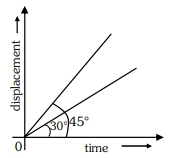
- The displacement-time graphs of two moving particles make angles of \(30^{\circ}\) and \(45^{\circ}\) with the \(x\)-axis as shown in the figure. The ratio of their respective velocity is :
 NEET 2022 Medium
 - The volume occupied by the molecules contained in \(4.5\,kg\) water at \(STP\), if the intermolecular forces vanish away is ........ \(m ^{3}\)NEET 2022 Easy
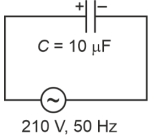
- A \(10 \mu \mathrm{F}\) capacitor is connected to a \(210 \mathrm{~V}, 50 \mathrm{~Hz}\) source as shown in figure. The peak current in the circuit is nearly \((\pi=3.14)\) :
 NEET 2024 Medium
 - The moment of inertia of a thin rod about an axis passing through its mid point and perpendicular to the rod is \(2400 \mathrm{~g} \mathrm{~cm}^2\). The length of the \(400 \mathrm{~g}\) rod is nearly:NEET 2024 Medium
- The moment of the force, \(\overrightarrow {\;F} = 4\hat i + 5\hat j - 6\hat k\) at \((2, 0, -3),\) about the point \((2, -2, -2),\) is given byNEET 2018 Medium
- Three stars \(A, B, C\) have surface temperatures \(T _{A} ,T _{B}, T _{C}\) respectively. Star \(A\) appears bluish, star \(B\) appears reddish and star \(C\) yellowish. Hence,NEET 2020 Medium
More PYQs from NEET
- Microtubules are the constituents ofNEET 2016 Medium
- A uniform rod of mass 20 kg and length 5 m leans against a smooth vertical wall making an angle of \(60^{\circ}\) with it. The other end rests on a rough horizontal floor. The friction force that the floor exerts on the rod is _______. (take \(\left.g =10 m / s ^2\right)\)NEET 2025 Medium
- Match List \(- I\) with List\(-II.\)
Choose the correct answer from the options given below.List \(- I\) List \(- II\) \((a)\) \(\left[\mathrm{Fe}(\mathrm{CN})_{6}\right]^{3-}\) \((i)\) \(5.92 \,\mathrm{BM}\) \((b)\) \(\left[\mathrm{Fe}\left(\mathrm{H}_{2} \mathrm{O}\right)_{6}\right]^{3+}\) \((ii)\) \(0 \,\mathrm{BM}\) \((c)\) \(\left[\mathrm{Fe}(\mathrm{CN})_{6}\right]^{4-}\) \((iii)\) \(4.90\, \mathrm{BM}\) \((d)\) \(\left[\mathrm{Fe}\left(\mathrm{H}_{2} \mathrm{O}\right)_{6}\right]^{2+}\) \((iv)\) \(1.73\, \mathrm{BM}\) NEET 2021 Medium - Which of the following pairs of \(d-\) orbitals will have electron density along the axes ?NEET 2016 Hard
- Match the following \(RNA\) polymerase with their transcribed products
Select the correct option from the following\((a) \;RNA\) polymerase \(I\) \((i) \;tRNA\) \((b) \;RNA\) polymerase \(II \) \((ii)\; rRNA\) \((c)\; RNA\) polymerase \(III \) \((iii) \;hnRNA\) NEET 2019 Hard - In which one of the following, both autogamy and geitonogamy are prevented?NEET 2019 Medium