


NEET · Physics · STD 12 - 3. current electricity
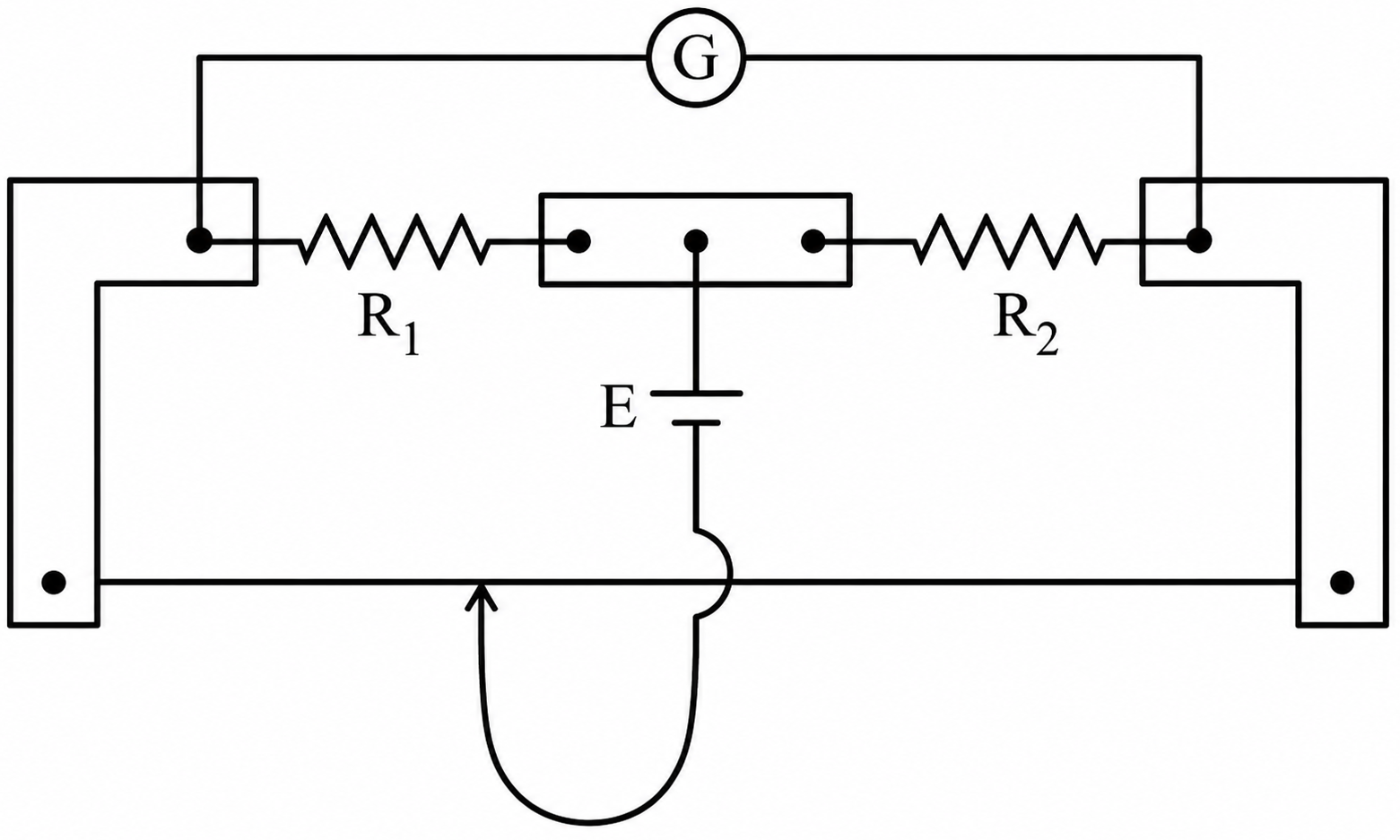
In a metre bridge experiment (see figure), the positions of the cell, \(E\), and galvanometer, \(G\), are interchanged. We shall observe in the galvanometer :
- A Only the left-sided deflection
- B There will be no deflection irrespective of the position of the jockey
- C Only the right-sided deflection
- D Both right-sided and left-sided deflection and at balance point, no deflection
Answer & Solution
Correct Answer
(D) Both right-sided and left-sided deflection and at balance point, no deflection
Step-by-step Solution
Detailed explanation
(D) Both right-sided and left-sided deflection and at balance point, no deflection
Let the nodes of the circuit be identified as follows:
Node A: Left L-shaped metallic strip.
Node B: Right L-shaped metallic strip.
Node C: Central metallic strip.
Node D: The point on the wire where the jockey touches.
The resistances in the four arms of the circuit are:
1. Resistance between A and C is \(R_1\).
2. Resistance between B and C is \(R_2\).
3. Resistance between A and D is \(R_{A D}\) (left part of the metre bridge wire).
4. Resistance between B and D is \(R_{D B}\) (right part of the metre bridge wire).
In the given figure, the cell \(E\) is connected between nodes C and D , and the galvanometer \(G\) is connected between nodes A and B. This arrangement forms a Wheatstone bridge.
Let the potential at node D be 0 and the potential at node C be \(V\).
The current from the cell divides at node C into two parallel branches: \(C \rightarrow A \rightarrow D\) and \(C \rightarrow B \rightarrow D\).
The potential at node A is given by the voltage divider rule:
\(V_A=V\left(\frac{R_{A D}}{R_1+R_{A D}}\right)\)
Similarly, the potential at node B is:
\(V_B=V\left(\frac{R_{D B}}{R_2+R_{D B}}\right)\)
The galvanometer shows no deflection when the potential difference across it is zero, i.e.,\(V_A=V_B\).
\(\frac{R_{A D}}{R_1+R_{A D}}=\frac{R_{D B}}{R_2+R_{D B}}\)
\(\Rightarrow \frac{R_1+R_{A D}}{R_{A D}}=\frac{R_2+R_{D B}}{R_{D B}}\)
\(\Rightarrow \frac{R_1}{R_{A D}}+1=\frac{R_2}{R_{D B}}+1\)
\(\Rightarrow \frac{R_1}{R_{A D}}=\frac{R_2}{R_{D B}}\)
This is the standard balance condition for a Wheatstone bridge. Thus, interchanging the cell and the galvanometer does not affect the balance condition. A null point will still be obtained on the wire.
If the jockey is moved to the left of the balance point, \(R_{A D}\) decreases and \(R_{D B}\) increases, making \(V_A<V_B\). Current will flow from B to A through the galvanometer, causing a deflection in one direction.
If the jockey is moved to the right of the balance point, \(R_{A D}\) increases and \(R_{D B}\) decreases, making \(V_A>V_B\). Current will flow from A to B, causing a deflection in the opposite direction.
Therefore, the galvanometer will show both right-sided and left-sided deflections depending on the jockey's position, and no deflection at the balance point.
Let the nodes of the circuit be identified as follows:
Node A: Left L-shaped metallic strip.
Node B: Right L-shaped metallic strip.
Node C: Central metallic strip.
Node D: The point on the wire where the jockey touches.
The resistances in the four arms of the circuit are:
1. Resistance between A and C is \(R_1\).
2. Resistance between B and C is \(R_2\).
3. Resistance between A and D is \(R_{A D}\) (left part of the metre bridge wire).
4. Resistance between B and D is \(R_{D B}\) (right part of the metre bridge wire).
In the given figure, the cell \(E\) is connected between nodes C and D , and the galvanometer \(G\) is connected between nodes A and B. This arrangement forms a Wheatstone bridge.
Let the potential at node D be 0 and the potential at node C be \(V\).
The current from the cell divides at node C into two parallel branches: \(C \rightarrow A \rightarrow D\) and \(C \rightarrow B \rightarrow D\).
The potential at node A is given by the voltage divider rule:
\(V_A=V\left(\frac{R_{A D}}{R_1+R_{A D}}\right)\)
Similarly, the potential at node B is:
\(V_B=V\left(\frac{R_{D B}}{R_2+R_{D B}}\right)\)
The galvanometer shows no deflection when the potential difference across it is zero, i.e.,\(V_A=V_B\).
\(\frac{R_{A D}}{R_1+R_{A D}}=\frac{R_{D B}}{R_2+R_{D B}}\)
\(\Rightarrow \frac{R_1+R_{A D}}{R_{A D}}=\frac{R_2+R_{D B}}{R_{D B}}\)
\(\Rightarrow \frac{R_1}{R_{A D}}+1=\frac{R_2}{R_{D B}}+1\)
\(\Rightarrow \frac{R_1}{R_{A D}}=\frac{R_2}{R_{D B}}\)
This is the standard balance condition for a Wheatstone bridge. Thus, interchanging the cell and the galvanometer does not affect the balance condition. A null point will still be obtained on the wire.
If the jockey is moved to the left of the balance point, \(R_{A D}\) decreases and \(R_{D B}\) increases, making \(V_A<V_B\). Current will flow from B to A through the galvanometer, causing a deflection in one direction.
If the jockey is moved to the right of the balance point, \(R_{A D}\) increases and \(R_{D B}\) decreases, making \(V_A>V_B\). Current will flow from A to B, causing a deflection in the opposite direction.
Therefore, the galvanometer will show both right-sided and left-sided deflections depending on the jockey's position, and no deflection at the balance point.
See the Complete Solution
Get step-by-step explanations for this and 2.5 Lakh+ more JEE, NEET & CET questions.
- Unlock all solutions
- Practice the full chapter
- Track accuracy across PYQs
4.8 rated on Google Play · 14,000+ reviews
More questions from Physics
- An inductor \(20 \,\,mH,\) a capacitor \(50\,\, \mu F\) and a resistor \(40 \,\,\Omega\) are connected in series across a source of emf \(V = 10 \,sin \,340t.\) The power loss in A.C. circuit is......\( W\)NEET 2016 Hard
- The output \(( Y )\) of the given logic implementation is similar to the output of an/a _____________ gate.
 NEET 2025 Hard
 - At a point \(A\) on the earth's surface the angle of \(\operatorname{dip}, \delta=+25^{\circ} .\) At a point \(B\) on the earth's surface the angle of dip, \(\delta=-25^{\circ} .\) We can interpret thatNEET 2019 Easy
- The radius of circle the period of revolution initial position and sense of revolution are indicated in the figure. \(y-\)projection of the radius vector of rotating particle \(\mathrm{P}\) is
 NEET 2019 Medium
 - A tightly wound \(100\) turns coil of radius \(10 \mathrm{~cm}\) carries a current of \(7 \mathrm{~A}\). The magnitude of the magnetic field at the centre of the coil is (Take permeability of free space as \(4 \pi \times 10^{-7} \mathrm{SI}\) units):NEET 2024 Medium
- A room heater is rated 400 W, 220 V. If the supply voltage drops to 200 V, what will be the power consumed (approximately) ?NEET 2026 Medium
More PYQs from NEET
- Which of the following is a basic amino acid :NEET 2020 Medium
- When initial concentration of a reactant is doubled in a reaction, its half-life period is not affected. The order of the reaction isNEET 2015 Medium
- Find the correct statement :
(A) In human pregnancy, the major organ systems are formed at the end of 12 weeks.
(B) In human pregnancy the major organ systems are formed at the end of 8 weeks.
(C) In human pregnancy heart is formed after one month of gestation.
(D) In human pregnancy, limbs and digits develop by the end of second month.
(E) In human pregnancy the appearance of hair is usually observed in the fifth month.
Choose the correct answer from the options given below :NEET 2025 Easy - Since the origin and diversification of life on Earth, there have been five episodes of mass extinction of species. How is the sixth extinction which is in progress, different from the previous episodes ?NEET 2026 Medium
- A flask contains argon and chlorine in the ratio of 2:1 by mass. The temperature of the mixture is \(27^{\circ} C\). The ratio of root mean square speed of the molecules of the two gases \(\left(\frac{v_{r m s}^{A r}}{v_{r m s}^{C l}}\right)\) is :
(Atomic mass of argon =40.0 u and molecular mass of chlorine =70.0 u)NEET 2026 Medium - \(6.02 \times 10^{20}\) molecules of urea are present in \(100\ mL\) of its solution. The concentration of solution is.....\(M\)NEET 2013 Hard