


NEET · Physics · STD 12 - 11. Dual nature of radiation and matter
For a metal of work function 6.6 eV, which of the following wavelengths of incident radiation does not give rise to the photoelectric effect ?
(Take Planck's constant as \(6.6 \times 10^{-34} J s\) )
- A 100 nm
- B 150 nm
- C 200 nm
- D 50 nm
Answer & Solution
Correct Answer
(C) 200 nm
Step-by-step Solution
Detailed explanation
(C) 200 nm
The threshold wavelength \(\lambda_0\) is given by \(\lambda_0=\frac{h c}{\Phi}\).
Substituting the given values:
\(\lambda_0=\frac{6.6 \times 10^{-34} \times 3 \times 10^8}{6.6 \times 1.6 \times 10^{-19}}\)
\(\lambda_0=\frac{3}{1.6} \times 10^{-7} m\)
\(\lambda_0=1.875 \times 10^{-7} m=187.5 nm\)
For the photoelectric effect to take place, the wavelength of incident radiation must be less than or equal to the threshold wavelength ( \(\lambda \leq \lambda_0\) ).
Among the given options, 200 nm is greater than 187.5 nm .
Thus, radiation of wavelength 200 nm will not give rise to the photoelectric effect.
The threshold wavelength \(\lambda_0\) is given by \(\lambda_0=\frac{h c}{\Phi}\).
Substituting the given values:
\(\lambda_0=\frac{6.6 \times 10^{-34} \times 3 \times 10^8}{6.6 \times 1.6 \times 10^{-19}}\)
\(\lambda_0=\frac{3}{1.6} \times 10^{-7} m\)
\(\lambda_0=1.875 \times 10^{-7} m=187.5 nm\)
For the photoelectric effect to take place, the wavelength of incident radiation must be less than or equal to the threshold wavelength ( \(\lambda \leq \lambda_0\) ).
Among the given options, 200 nm is greater than 187.5 nm .
Thus, radiation of wavelength 200 nm will not give rise to the photoelectric effect.
See the Complete Solution
Get step-by-step explanations for this and 2.5 Lakh+ more JEE, NEET & CET questions.
- Unlock all solutions
- Practice the full chapter
- Track accuracy across PYQs
4.8 rated on Google Play · 14,000+ reviews
More questions from Physics
- A 2 amp current is flowing through two different small circular copper coils having radii ratio \(1: 2\). The ratio of their respective magnetic moments will beNEET 2025 Medium
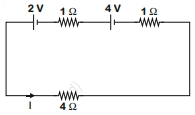
- For the circuit shown in the figure, the current \(I\) will be .......\(A\)
 NEET 2020 Medium
 - The magnetic flux linked with a coil (in \(Wb\)) is given by the equation \(\phi=5 t^{2}+3 t+16\) The magnitude of induced emf in the coil at the fourth second will be (In \(V\))NEET 2020 Medium
- A capacitor is charged by a battery. The battery is removed and another identical uncharged capacitor is connected in parallel. The total electrostatic energy of resulting systemNEET 2017 Medium
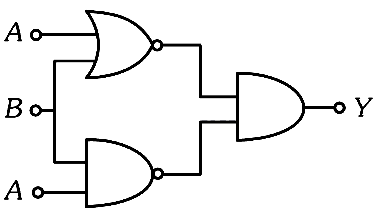
- The output \(( Y )\) of the given logic implementation is similar to the output of an/a _____________ gate.
 NEET 2025 Hard
 - In total internal reflection when the angle of incidence is equal to the critical angle for the pair of media in contact, what will be angle of refraction.......\(^o\) ?NEET 2019 Easy
More PYQs from NEET
- A liquid does not wet the solid surface if angle of contact isNEET 2020 Easy
- What is the hybridisation state of benzyl carbonium ion (image) ?
 NEET 2013 Medium
 - The value of Planck's constant is \(6.63 \times 10^{-34} \ J \ s.\) The speed of light is \(3 \times 10^{17}\, nm\, s ^{-1}.\) Which value is closest to the wavelength in nanometer of a quantum of light with frequency of \(6 \times 10^{18} s^{-1} \) ?NEET 2013 Hard
- When the light of frequency \(2v_0\) (where \(v_0\) is threshold frequency), is incident on a metal plate , the maximum velocity of electrons emitted is \(v_1\). When the frequency of the incident radiation is increased to \(5v_0,\) the maximum velocity of electrons emitted from the same plate is \(v_2\). The ratio of \(v_1\) to \(v_2\) isNEET 2018 Medium
- Identify the vertebrate group of animals characterized by crop and gizzard in its digestive system.NEET 2018 Medium
- Which amongst the following is incorrect statement?NEET 2022 Medium