


NEET · Physics · STD 12 - 9. Ray optics and optical instruments
A ray of monochromatic light is passing through an equilateral prism (ABC) as shown in the figure. The refracted ray (QR) is parallel to its base (BC) and the angle of incidence (i) is \(50^{\circ}\). Then the angle of deviation \((\delta)\) is :
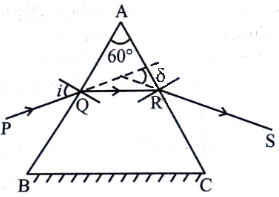
- A \(45^{\circ}\)
- B \(35^{\circ}\)
- C \(40^{\circ}\)
- D \(55^{\circ}\)
Answer & Solution
Correct Answer
(C) \(40^{\circ}\)
Step-by-step Solution
Detailed explanation
(C) \(40^{\circ}\)
For an equilateral prism, the angle of the prism is \(A=60^{\circ}\).
It is given that the refracted ray inside the prism is parallel to its base. This implies that the prism is in the position of minimum deviation.
In the position of minimum deviation, the angle of emergence \(e\) is equal to the angle of incidence \(i\).
Given \(i=50^{\circ}\), we have \(e =50^{\circ}\).
The angle of deviation \(\delta\) is given by the relation:
\(\delta=i+e-A\)
Substituting the values, we get:
\(\delta=50^{\circ}+50^{\circ}-60^{\circ}\)
\(\delta=100^{\circ}-60^{\circ}=40^{\circ}\)
For an equilateral prism, the angle of the prism is \(A=60^{\circ}\).
It is given that the refracted ray inside the prism is parallel to its base. This implies that the prism is in the position of minimum deviation.
In the position of minimum deviation, the angle of emergence \(e\) is equal to the angle of incidence \(i\).
Given \(i=50^{\circ}\), we have \(e =50^{\circ}\).
The angle of deviation \(\delta\) is given by the relation:
\(\delta=i+e-A\)
Substituting the values, we get:
\(\delta=50^{\circ}+50^{\circ}-60^{\circ}\)
\(\delta=100^{\circ}-60^{\circ}=40^{\circ}\)
See the Complete Solution
Get step-by-step explanations for this and 2.5 Lakh+ more JEE, NEET & CET questions.
- Unlock all solutions
- Practice the full chapter
- Track accuracy across PYQs
4.8 rated on Google Play · 14,000+ reviews
More questions from Physics
- The quantities which have the same dimensions as those of solid angle are:NEET 2024 Medium
- For a travelling harmonic wave \(y(x, t)=2.0 \cos 2 \pi(10 t-0.0080 x+0.35)\), where x and y are in cm and t in s. The phase difference between oscillatory motion of two points separated by a distance of 0.5 m is :NEET 2026 Easy
- A biconvex lens has radii of curvature, \(20\,cm\) each. If the refractive index of the material of the lens is \(1.5\), the power of the lens is .... \(D\)NEET 2022 Medium
- The temperature inside a refrigerator is \(t_2 \,^o C\) and the room temperature is \(t_1\,^o C.\) The amount of heat delivered to the room for each joule of electrical energy consumed ideally will beNEET 2016 Medium
- The following graph represents the \(T-V\) curves of an ideal gas (where \(T\) is the temperature and \(V\) the volume) at three pressures \(P_1, P_2\) and \(P_3\) compared with those of Charles's law represented as dotted lines. Then the correct relation is:
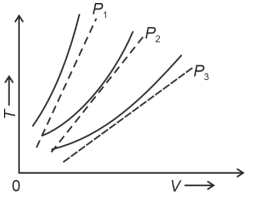 NEET 2024 Medium
 - The dimensions \(\left[ MLT ^{-2} A ^{-2}\right]\) belong to the :NEET 2022 Medium
More PYQs from NEET
- Two particles \(A\) and \(B\) are moving in uniform circular motion in concentric cirdes of radius \(r_{A}\) and \(r_{B}\) with speed \(v_A\) and \(v_B\) respectively. The time period of rotation is the same. The ratio of angular speed of \(A\) to that of \(B\) will beNEET 2019 Medium
- The given circuit has two ideal diodes connected as shown in the figure. The current flowing through the resistance \(R_1\) will be.....\( A\)
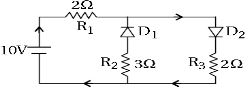 NEET 2016 Medium
 - Taking stability as the factor, which one of the following represents correct relationship?NEET 2023 Hard
- Which of the following is the most important causes for animals and plants being driven to extinction?NEET 2019 Easy
- Given below are two statements:
Statement \(I\): Parenchyma is living but collenchyma is dead tissue.
Statement \(II\) : Gymnosperms lack xylem vessels but presence of xylem vessels is the characteristic of angiosperms.
In the light of the above statements, choose the correct answer from the options given below:NEET 2024 Medium - Identify a molecule which does not exist.NEET 2020 Medium