


enEnglishguગુજરાતી
NEET · Physics · STD 11 - 7. gravitation
A mass falls from a helght \(h\) and its time of fall \(t\) is recorded in terms of time period \(T\) of a simple pendulum. On the surface of earth it is found that \(t =2 T\). The entre setup is taken on the surface of another planet whose mass is half of that of earth and radius the same. Same experiment is repeated and corresponding times noted as \(t'\) and \(T'\).
- A \(\mathrm{t}^{\prime}=\sqrt{2} \mathrm{T}^{\prime}\)
- B \(\mathrm{t}^{\prime} > 2 \mathrm{T}^{\prime}\)
- C \(\mathrm{t}^{\prime} < 2 \mathrm{T}^{\prime}\)
- D \(\mathrm{t}^{\prime}=2 \mathrm{T}^{\prime}\)
Answer & Solution
Correct Answer
(D) \(\mathrm{t}^{\prime}=2 \mathrm{T}^{\prime}\)
Step-by-step Solution
Detailed explanation
Time of flight \(=\sqrt{\frac{2 h}{g}} \propto \frac{1}{\sqrt{g}}\) Time perlod of pendulum \(=2 \pi \sqrt{\frac{l}{g}} \propto \frac{1}{\sqrt{g}}\)
See the Complete Solution
Get step-by-step explanations for this and 2.5 Lakh+ more JEE, NEET & CET questions.
- Unlock all solutions
- Practice the full chapter
- Track accuracy across PYQs
4.8 rated on Google Play · 14,000+ reviews
More questions from Physics
- Three vessels of equal capacity have gases at the same temperature and pressure. The first vessel contains helium (monoatomic), the second contains fluorine (diatomic) and the third contains sulfur hexafluoride (polyatomic). The correct statement, among the following isNEET 2022 Easy
- The total energy of an electron in an atom in an orbit is \(-3.4 \;eV.\) Its kinetic and potential energies are, respectivelyNEET 2019 Medium
- A common emitter amplifier circuit is shown in the figure below. For the transistor used in the circuit the current amplification factor, \({\beta _{dc}} = 100\). Other parameters are mentioned in the figure.
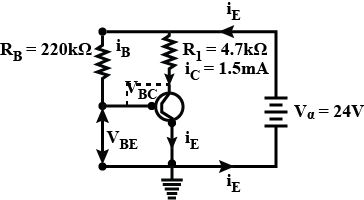 NEET 2017 Hard
 - The ratio of radius of gyration of a solid sphere of mass \(M\) and radius \(R\) about its own axis to the radius of gyration of the thin hollow sphere of same mass and radius about its axis is :-NEET 2023 Easy
- A spring of force constant \(k\) is cut into lengths of ratio \(1:2:3\) . They are connected in series and the new force constant is \(k'\) . Then they are connected in parallel and force constant is \(k''\) . Then \(k':k''\) isNEET 2017 Medium
- The magnetic potential energy stored in a certain inductor is \(25\,\, mJ,\) when the current in the inductor is \(60\,\, mA.\) This inductor is of inductance ......\(H\)NEET 2018 Medium
More PYQs from NEET
- Which of the following reagents would distinguish \(cis-\)cyclopenta\(-1-{2-}\)diol from the \(trans-\)isomer?NEET 2016 Medium
- In an ecosystem if the Net Primary Productivity (\(NPP\)) of first trophic level is \(100 \times\left(\mathrm{kcal} \mathrm{m}^{-2}\right) \mathrm{yr}^{-1}\), what would be the \(GPP\) (Gross Primary Productivity) of the third trophic level of the same ecosystem?NEET 2024 Medium
- A double convex lens has focal length \(25\; \mathrm{cm}\). The radius of curvature of one of the surfaces is double of the other. Find the radii If the refractive index of the material of the lens is \(1.5 \)NEET 2019 Medium
- Which of the following statements is incorrect?NEET 2019 Medium
- Hydrocolloid carrageen is obtained from :NEET 2022 Hard
- The variation of the boiling points ofthe hydrogen halides is in the order \(HF > HI > HBr > HCl.\) What explains the higher boiling point of hydrogen fluoride ?NEET 2015 Hard