


NEET · Physics · STD 11 - 4.2 friction
A box of mass 15 kg is kept on the floor of a stationary trolley. The coefficient of static friction between the box and the trolley is 0.12. Keeping the box in stationary state over the trolley, the maximum acceleration with which the trolley can be moved horizontally in \(m s ^{-2}\) is :
\(\left(g=10 m / s ^2\right)\)
- A 2.1
- B 1.8
- C 1.5
- D 1.2
Answer & Solution
Correct Answer
(D) 1.2
Step-by-step Solution
Detailed explanation
(D) 1.2
Let the acceleration of the trolley be a.
In the frame of the trolley, a pseudo force ma acts on the box in the direction opposite to the motion.
For the box to remain stationary relative to the trolley, the static friction force must balance this pseudo force.
The maximum static friction force available is given by \(f_{s, \max }=\mu_s N=\mu_s m g\).
Equating the pseudo force to the maximum static friction force gives the maximum acceleration:
\(m a_{\max }=\mu_s m g\)
\(a_{\max }=\mu_s g\)
Substituting the given values \(\mu_s=0.12\) and \(g=10 m / s ^2\) :
\(a_{\max }=0.12 \times 10=1.2 m / s ^2\)
Let the acceleration of the trolley be a.
In the frame of the trolley, a pseudo force ma acts on the box in the direction opposite to the motion.
For the box to remain stationary relative to the trolley, the static friction force must balance this pseudo force.
The maximum static friction force available is given by \(f_{s, \max }=\mu_s N=\mu_s m g\).
Equating the pseudo force to the maximum static friction force gives the maximum acceleration:
\(m a_{\max }=\mu_s m g\)
\(a_{\max }=\mu_s g\)
Substituting the given values \(\mu_s=0.12\) and \(g=10 m / s ^2\) :
\(a_{\max }=0.12 \times 10=1.2 m / s ^2\)
See the Complete Solution
Get step-by-step explanations for this and 2.5 Lakh+ more JEE, NEET & CET questions.
- Unlock all solutions
- Practice the full chapter
- Track accuracy across PYQs
4.8 rated on Google Play · 14,000+ reviews
More questions from Physics
- Polar molecules are the molecules:NEET 2021 Easy
- A nucleus with mass number \(240\) breaks into two fragments each of mass number \(120 ,\) the binding energy per nucleon of unfragmented nuclei is \(7.6 \,\mathrm{MeV}\) while that of fragments is \(8.5\, \mathrm{MeV}\). The total gain in the Binding Energy in the process is : (In \(\mathrm{MeV}\))NEET 2021 Medium
- A gravitational field is present in a region and a mass is shifted from \(A\) to \(B\) through different paths as shown. If \(W _1, W _2\) and \(W _3\) represent the work done by the gravitational force along the respective paths, then
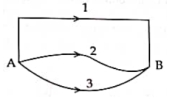 NEET 2022 Easy
 - In a concave lens, a ray of light emanating from the object parallel to the principal axis of the lens, after refraction :NEET 2026 Medium
- Two bodies of mass \(m\) and \(9 m\) are placed at a distance \(R\). The gravitational potential on the line joining the bodies where the gravitational field equals zero, will be ( \(G=\) gravitational constant) :NEET 2023 Medium
- The molecules of a given mass of a gas have \(r.m.s.\) velocity of \(200 \,m s^{-1}\) at \(27^o C\) and \(1.0 \times 10^5 \,Nm^{-2}\) pressure. When the temperature and pressure of the gas are respectively, \(127^o C\) and \(0.05 \times 10^5 \,Nm^{-2},\) the \(r.m.s.\) velocity of its molecules in \(m s^{-1}\) isNEET 2016 Medium
More PYQs from NEET
- Which of the following statements with respect to Endoplasmic Reticulum is incorrect?NEET 2022 Easy
- Which is the basis of genetic mapping of human genome as well as \(DNA\) finger printing?NEET 2020 Easy
- A cylinder contains hydrogen gas at pressure of \(249\; kPa\) and temperature \(27^{\circ} C\). Its density is\(.............kg / m ^{3}\) \(\left( R =8.3\, J\, mol ^{-1} K ^{-1}\right)\)NEET 2020 Easy
- An ideal gas expands isothermally from \(10^{-3} \;\mathrm{m}^{3}\) to \(10^{-2} \;\mathrm{m}^{3}\) at \(300 \;\mathrm{K}\) against a constant pressure of \(10^{5}\; \mathrm{Nm}^{-2} .\) The work done on the gas isNEET 2019 Medium
- Select the option which is not correct with respect to enzyme action.NEET 2014 Medium
- Following limiting molar conductivities are given as \(\lambda_{\mathrm{m}\left(\mathrm{H}_{2} \mathrm{SO}_{4}\right)}^{0}=\mathrm{x} \;\mathrm{S}\; \mathrm{cm}^{2} \mathrm{mol}^{-1}\) \(\lambda_{\mathrm{m}\left(\mathrm{K}_{2} \mathrm{SO}_{4}\right)}^{0}=\mathrm{y} \;\mathrm{S\;cm}^{2} \mathrm{mol}^{-1}\) \(\lambda_{\mathrm{m}(\mathrm{CH_3} \mathrm{COOK})}^{0}=\mathrm{z}\; \mathrm{S\;cm}^{2} \mathrm{mol}^{-1}\) \(\lambda_{\mathrm{m}}^{0}\left(\mathrm{in}\; \mathrm{S} \;\mathrm{cm}^{2} \mathrm{mol}^{-1}\right)\) for \(\mathrm{CH}_{3} \mathrm{COOH}\) will beNEET 2019 Hard