


NEET · Physics · STD 11 - 5. work,energy,power and collision
A body of mass \(1\, kg\) begins to move under the action of a time dependent force \(\overrightarrow {\;F\;} = (2t\hat i + 3{t^2}\hat j\)) \(N\) where \(\hat i\) and \(\hat j\) are unit vectors along \(x\) and \(y\) axis. What 10.Power will be developed by the force at the time \(t\)?
- A \((2t^2+4t^4)\;W\)
- B \((2t^3+3t^4)\;W\)
- C \((2t^3+3t^5)\;W\)
- D \((2t^2+3t^3)\;W\)
Answer & Solution
Correct Answer
(C) \((2t^3+3t^5)\;W\)
Step-by-step Solution
Detailed explanation
\(\begin{array}{l}
\,\,\,\,\,\,\,\,Here,\,\overrightarrow F = \left( {2t\hat i + 3{t^2}\hat j} \right)N,\,m = 1\,kg\\
Acceleration\,of\,the\,body,\,\overrightarrow a = \frac{{\overrightarrow F }}{m}\\
\,\, = \frac{{\left( {2t\hat i + 3{t^2}\hat j} \right)N}}{{1\,kg}}\\
Velocity\,of\,the\,body\,at\,time\,t,
\end{array}\) \(\begin{array}{l}
\overrightarrow v = \int {\overrightarrow a dt = \int {\left( {2t\hat i + 3{t^2}\hat j} \right)dt = {t^2}\hat i + {t^3}\hat j\,m{s^{ - 1}}} } \\
\therefore \,10.Power\,devloped\,by\,the\,force\,at\,time\,t,\\
P = \overrightarrow F .\overrightarrow v \, = \left( {2t\hat i + 3{t^2}\hat j} \right).\left( {{t^2}\hat i + {t^3}\hat j\,} \right)\\
W = \left( {2{t^3} + 3{t^5}} \right)W
\end{array}\)
\,\,\,\,\,\,\,\,Here,\,\overrightarrow F = \left( {2t\hat i + 3{t^2}\hat j} \right)N,\,m = 1\,kg\\
Acceleration\,of\,the\,body,\,\overrightarrow a = \frac{{\overrightarrow F }}{m}\\
\,\, = \frac{{\left( {2t\hat i + 3{t^2}\hat j} \right)N}}{{1\,kg}}\\
Velocity\,of\,the\,body\,at\,time\,t,
\end{array}\) \(\begin{array}{l}
\overrightarrow v = \int {\overrightarrow a dt = \int {\left( {2t\hat i + 3{t^2}\hat j} \right)dt = {t^2}\hat i + {t^3}\hat j\,m{s^{ - 1}}} } \\
\therefore \,10.Power\,devloped\,by\,the\,force\,at\,time\,t,\\
P = \overrightarrow F .\overrightarrow v \, = \left( {2t\hat i + 3{t^2}\hat j} \right).\left( {{t^2}\hat i + {t^3}\hat j\,} \right)\\
W = \left( {2{t^3} + 3{t^5}} \right)W
\end{array}\)
See the Complete Solution
Get step-by-step explanations for this and 2.5 Lakh+ more JEE, NEET & CET questions.
- Unlock all solutions
- Practice the full chapter
- Track accuracy across PYQs
4.8 rated on Google Play · 14,000+ reviews
More questions from Physics
- In a potentiometer circuit a cell of \(EMF\) \(1.5\, {V}\) gives balance point at \(36\, {cm}\) length of wire. If another cell of \(EMF\) \(2.5\, {V}\) replaces the first cell, then at what length of the wire, the balance point occurs ? (in \(cm\))NEET 2021 Medium
- The angle of incidence for a ray of light at a refracting surface of a prism is \(45^o \). The angle of prism is \(60^o \) . If the ray suffers minimum deviation through the prism, the angle of minimum deviation and refractive index of the material of the prism respectively, areNEET 2016 Medium
- The magnetic field of a plane electromagnetic wave is given by \(\overrightarrow{ B }=3 \times 10^{-8} \cos \left(1.6 \times 10^3 x +48 \times 10^{10} t \right) \hat{ j }\), then the associated electric field will be :NEET 2022 Medium
- The ratio of the magnitude of the magnetic field and electric field intensity of a plane electromagnetic wave in free space of permeability \(\mu_0\) and permittivity \(\varepsilon_0\) is (Given that \(c\) - velocity of light in free space)NEET 2022 Easy
- The radius of the first permitted Bohr orbit for the electron, in a hydrogen atom equals \(0.51 \mathring A\) and its ground state energy equals \(-13.6\; eV\). If the electron in the hyrogen atom is replaced by muon (\(\mu^{-}\)) [charge same as electron and mass \(207 \mathrm{m}_{e}\)], the first Bohr radius and ground state energy will beNEET 2019 Hard
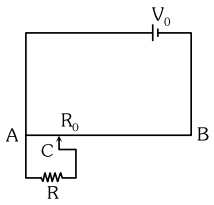
- The sliding contact \(C\) is at one fourth of the length of the potentiometer wire \(( AB )\) from \(A\) as shown in the circuit diagram. If the resistance of the wire \(AB\) is \(R _0\), then the potential drop \(( V )\) across the resistor \(R\) is
 NEET 2022 Medium
More PYQs from NEET
- Assisted reproductive technology, \(IVF\) involves transfer ofNEET 2014 Medium
- The recombination frequency between the genes \(a\, \& \, c\) is \(5 \,\% \,, b\, \& \,c\) is \(15 \,\%,\, b\, \& \,d\) is \(9 \%, \,a\, \& \,b\) is \(20 \%\) , \(c\, \& \,d\) is \(24 \%\) and \(a \, \& \,d\) is \(29 \%\). What will be the sequence of these genes on a linear chromosome?NEET 2022 Medium
- Transformation was discovered byNEET 2014 Medium
- Among the following acids, the strongest acid isNEET 2017 Easy
- Match the following genera with their respective phylum
Select the correct optionGenera Phylum (a) Ophura (i) Mollusca (b) Physalia (ii) Platyhelminthes (c) Pinctada (iii) Echinodermata (d) Planaria (iv) Coelenterata NEET 2019 Medium - A photon and an electron (mass \(m\) ) have the same energy \(E\). The ratio ( \(\lambda_{\text {photon }} / \lambda_{\text {electron }}\) ) of their de Broglie wavelengths is: ( c is the speed of light)NEET 2025 Easy