


NEET · Chemistry · STD 11 - 4. Chemical bonding and molecular structure
Which of the following molecules has the maximum dipole moment ?
- A \(CO_2\)
- B \(CH_4\)
- C \(NH_3\)
- D \(NF_3\)
Answer & Solution
Correct Answer
(C) \(NH_3\)
Step-by-step Solution
Detailed explanation
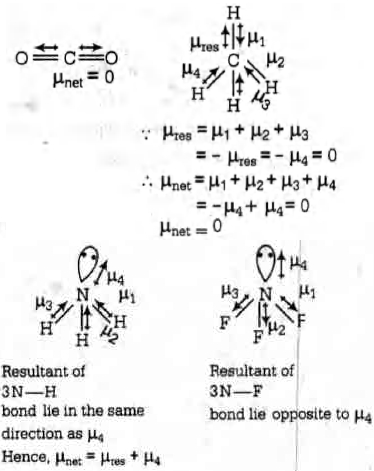
\(\mathrm{CO}_{2}\) and \(\mathrm{CH}_{4}\) have zero dipole moment as these are symmetrical in nature. Between \(N H_{3}\) and \(N F_{3}, N F_{3}\) has greater dipole mough in \(N H_{3}\) and \(N F_{3}\) both, \(N\) possesses one lone pair of electrons. This is because in case of \(N H_{3},\) the net \(N\) - \(H\) bond dipole is in the same direction as the direction of dipole of lone pair but in case of \(N F_{3},\) the direction of net bond dipole of three- \(N-F\) bonds is opposite than that of the dipole of the then lone pair.
See the Complete Solution
Get step-by-step explanations for this and 2.5 Lakh+ more JEE, NEET & CET questions.
- Unlock all solutions
- Practice the full chapter
- Track accuracy across PYQs
4.8 rated on Google Play · 14,000+ reviews
More questions from Chemistry
- Consider the following reaction for which the change in enthalpy is positive \(2 A ( g ) + B ( g ) \rightleftharpoons C ( g )+ D ( g )\) Which of the following will not affect the equilibrium?NEET 2017 Easy
- Given below are two statements : one is labelled as Assertion \(A\) and the other is labelled as Reason \(R:\) Assertion \(A:\) Metallic sodium dissolves in liquid ammonia giving a deep blue solution, which is paramagnetic. Reason \(R:\) The deep blue solution is due to the formation of amide. In the light of the above statements, choose the correct answer from the options given below :NEET 2023 Hard
- If for a certain reaction \(\Delta_{r} H\) is \(30 \;kJ \;mol ^{-1}\) at \(450 \;K ,\) the value of \(\Delta_{r} S \left(\right.\) in \(\left. J K ^{-1} mol ^{-1}\right)\) for which the same reaction will be spontaneous at the same temperature isNEET 2020 Medium
- Match List I with List II :
Choose the correct answer from the options given below:List I (Order of reaction) List II (Unit of rate constant) (A) Zero order (I) \(mol ^{-1} Ls ^{-1}\) (B) First order (II) \(mol ^{-2} L^2 s^{-1}\) (C) Second order (III) \(s ^{-1}\) (D) Third order (IV) \(mol L ^{-1} s^{-1}\) NEET 2026 Easy - Calculate the energy in joule corresponding to light of wavelength \(45\ nm.\) (Planck's constant, \(h=6.63 \times 10^{-34} \ J \ s,\) speed of light, \(c=3 \times 10^8 \ m \ s^{-1}\))NEET 2014 Medium
- The anion of acetylacetone \((acac)\) forms \(Co\, (acac)_3\) chelate with \(Co^{3+}.\) The rings of the chelate areNEET 2013 Medium
More PYQs from NEET
- Viroids differ from viruses in havingNEET 2017 Medium
- Which one of the following statements is wrong?NEET 2016 Medium
- Large, colourful, fragrant flowers with nectar are seen inNEET 2023 Medium
- Which of the following organisms are known as chief producers in the oceans?NEET 2018 Medium
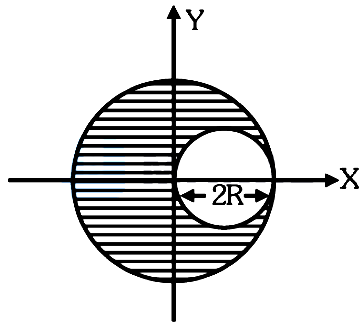
- A sphere of radius \(R\) is cut from a larger solid sphere of radius \(2 R\) as shown in the figure. The ratio of the moment of inertia of the smaller sphere to that of the rest part of the sphere about the Y-axis is _______.
 NEET 2025 Hard
 - Match the following
Which of the following is the correct option ? \((a)\quad (b)\quad (c) \quad (d)\)(a) Pure nitrogen (i) Chlorine (b) Haber process (ii) Sulphuric acid (c) Contact process (iii) Ammonia (d) Deacon's process (iv) Sodium azide or Barium azide NEET 2019 Hard