


NEET · Chemistry · STD 12 - 3. Chemical kinetics
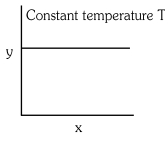
The given graph is a representation of kinetics of a reaction. \([Image]\) The \(y\) and \(x\) axes for zero and first order reactions, respectively are
- A zero order \((y=\) concentration and \(x=\) time), first order \((y=\) rate constant and \(x=\) concentration)
- B zero order ( \(y=\) rate and \(x=\) concentration), first order \(\left(y=t_{1 / 2}\right.\) and \(x=\) concenration)
- C zero order ( \(y=\) rate and \(x=\) concentration), first order \(\left(y=\right.\) rate and \(\left.x= t _{1,2}\right)\)
- D zero order ( \(y=\) concentration and \(x=\) time), first order \(\left(y=t_{1 / 2}\right.\) and \(x=\) concentration)
Answer & Solution
Correct Answer
(B) zero order ( \(y=\) rate and \(x=\) concentration), first order \(\left(y=t_{1 / 2}\right.\) and \(x=\) concenration)
Step-by-step Solution
Detailed explanation
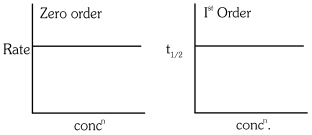
\((I)\) curve is suitable for zero order if \(y=\) rate and \(x =\) concentration because in case of zero order reaction rate is constant and does not depend on conc \(^{n}\). \((II)\) curve is suitable for first order if \(y=t_{1 / 2}\) and \(x=\) conc \(^{n}\) because in case of first order \(t_{1 / 2}\) does not depend on conc \(^{ n }\).
See the Complete Solution
Get step-by-step explanations for this and 2.5 Lakh+ more JEE, NEET & CET questions.
- Unlock all solutions
- Practice the full chapter
- Track accuracy across PYQs
4.8 rated on Google Play · 14,000+ reviews
More questions from Chemistry
- The correct statement regarding the basicity of arylamines isNEET 2016 Hard
- For irreversible expansion of an ideal gas under isothermal condition, the correct option is :NEET 2021 Medium
- The reason for greater range of oxidation states in actinoids is attributed toNEET 2017 Medium
- A \(20\, litre\) container at \(400\, K\) contains \(CO_{2(g)}\) at pressure \(0.4\, atm\) and an excess of \(SrO\) (neglect the volume of solid \(SrO\)). The volume of the container is now decreased by movingthe movable piston fitted in the container. The maximum volume of the container, when pressure of \(CO_2\) attains its maximum value, will be........\(litre\) (Given that : \(SrCO_{3(s)} \rightleftharpoons SrO_{(s)}+ CO_{2(g)} \,, K_p=1.6\,atm\))NEET 2017 Medium
- The van't Hoff factor \((i)\) for a dilute aqueous solution of the strong electrolyte barium hydroxide isNEET 2016 Easy
- What is the hybridisation state of benzyl carbonium ion (image) ?
 NEET 2013 Medium
More PYQs from NEET
- Two particles of mass \(5\, kg\) and \(10\, kg\) respectively are attached to the two ends of a rigid rod of length \(1\, m\) with negligible mass. The centre of mass of the system from the \(5\, kg\) particle is nearly at a distance of \(..........\, cm\)NEET 2020 Medium
- Which of these statements is incorrect?NEET 2018 Medium
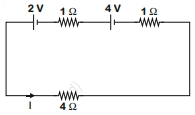
- For the circuit shown in the figure, the current \(I\) will be .......\(A\)
 NEET 2020 Medium
 - A physical quantity of the dimensions of length that can be formed out of \(c, G\) and \(\frac{e^2}{4\pi \varepsilon _0}\) is \([c\) is velocity of light, \(G\) is the universal constant of gravitation and \(e\) is charge \(] \)NEET 2017 Hard
- The wings of a bird and the wings of an insect areNEET 2015 Medium
- A biconvex lens has radii of curvature, \(20\,cm\) each. If the refractive index of the material of the lens is \(1.5\), the power of the lens is .... \(D\)NEET 2022 Medium