


NEET · Chemistry · STD 12 - 3. Chemical kinetics
Match List I with List II :
| List I (Order of reaction) | List II (Unit of rate constant) |
| (A) Zero order | (I) \(mol ^{-1} Ls ^{-1}\) |
| (B) First order | (II) \(mol ^{-2} L^2 s^{-1}\) |
| (C) Second order | (III) \(s ^{-1}\) |
| (D) Third order | (IV) \(mol L ^{-1} s^{-1}\) |
- A A-IV, B-II, C-I, D-III
- B A-IV, B-III, C-I, D-II
- C A-IV, B-III, C-II, D-I
- D A-I, B-II, C-III, D-IV
Answer & Solution
Correct Answer
(B) A-IV, B-III, C-I, D-II
Step-by-step Solution
Detailed explanation
(B) A-IV, B-III, C-I, D-II
The unit of rate constant \(k\) for an \(n\)-th order reaction is given by \(\left( mol L ^{- 1 }\right)^{ 1 - n } s ^{- 1 }\).
For zero order reaction ( \(n =0\) ):
\(\text { Unit }=\left(mol L^{-1}\right)^{1-0} s^{-1}=mol L^{-1} s^{-1} \text { (Matches A with IV) }\)
For first order reaction ( \(n = 1\) ):
\(\text { Unit }=\left(mol L^{-1}\right)^{1-1} s^{-1}=s^{-1} \text { (Matches B with III) }\)
For second order reaction ( \(n=2\) ):
\(\text { Unit }=\left(mol L^{-1}\right)^{1-2} s^{-1}=mol^{-1} L s^{-1} \text { (Matches C with I) }\)
For third order reaction \((n=3)\) :
\(\text { Unit }=\left(mol L^{-1}\right)^{1-3} s^{-1}=mol^{-2} L^2 s^{-1} \text { (Matches D with II) }\)
Therefore, the correct matching is A-IV, B-III, C-I, D-II.
The unit of rate constant \(k\) for an \(n\)-th order reaction is given by \(\left( mol L ^{- 1 }\right)^{ 1 - n } s ^{- 1 }\).
For zero order reaction ( \(n =0\) ):
\(\text { Unit }=\left(mol L^{-1}\right)^{1-0} s^{-1}=mol L^{-1} s^{-1} \text { (Matches A with IV) }\)
For first order reaction ( \(n = 1\) ):
\(\text { Unit }=\left(mol L^{-1}\right)^{1-1} s^{-1}=s^{-1} \text { (Matches B with III) }\)
For second order reaction ( \(n=2\) ):
\(\text { Unit }=\left(mol L^{-1}\right)^{1-2} s^{-1}=mol^{-1} L s^{-1} \text { (Matches C with I) }\)
For third order reaction \((n=3)\) :
\(\text { Unit }=\left(mol L^{-1}\right)^{1-3} s^{-1}=mol^{-2} L^2 s^{-1} \text { (Matches D with II) }\)
Therefore, the correct matching is A-IV, B-III, C-I, D-II.
See the Complete Solution
Get step-by-step explanations for this and 2.5 Lakh+ more JEE, NEET & CET questions.
- Unlock all solutions
- Practice the full chapter
- Track accuracy across PYQs
4.8 rated on Google Play · 14,000+ reviews
More questions from Chemistry
- The correct bond order in the following species isNEET 2015 Medium
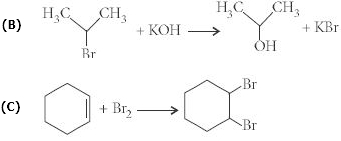
- For the following reactions . . .Which of the following statements is correct ? \((A)\,\,CH_3CH_2CH_2Br + KOH \rightarrow CH_3CH CH_2 + KBr + H_2O\)
 NEET 2016 Medium
 - Which reaction is \(NOT\) a redox reaction?NEET 2024 Medium
- The standard heat of formation, in \(kcal / mol ^{\text {of }} Ba ^{2+}\) is :
[Given : standard heat of formation of \(SO _4^{2-}\) ion \(( aq )=-216 kcal / mol\),
Standard heat of crystallisation of
\(BaSO _4(s)=-4.5 kcal / mol\), standard heat of formation of \(\left.BaSO _4(s)=-349 kcal / mol \right]\)NEET 2025 Medium - Identify the major product \(\mathrm{C}\) formed in the following reaction sequence: \(Image\)
 NEET 2024 Medium
 - A device that converts energy of combustion of fuels like hydrogen and methane, directly into electrical energy is known asNEET 2015 Easy
More PYQs from NEET
- For a plane electromagnetic wave propagating in \(x\)-direction, which one of the following combination gives the correct possible directions for electric field \((E)\) and magnetic field \((B)\) respectively?NEET 2021 Medium
- Mad cow disease in catttle is caused by an organism which hasNEET 2019 Medium
- In which blood corpuscles, the HIV undergoes replication and produces progeny viruses?NEET 2023 Medium
- A flask contains argon and chlorine in the ratio of 2:1 by mass. The temperature of the mixture is \(27^{\circ} C\). The ratio of root mean square speed of the molecules of the two gases \(\left(\frac{v_{r m s}^{A r}}{v_{r m s}^{C l}}\right)\) is :
(Atomic mass of argon =40.0 u and molecular mass of chlorine =70.0 u)NEET 2026 Medium - A body is executing simple harmonic motion with frequency \('n',\) the frequency of its potential energy is :NEET 2021 Medium
- A particle of mass \(5 \;\mathrm{m}\) at rest suddenly breaks on its own into three fragments. Two fragments of mass \(m\) each move along mutually perpendicetion with speed \(v\) each. The energy released during the process isNEET 2019 Medium