


NEET · Chemistry · STD 11 -p-Block elements - I
Identify the incorrect statement from the following :
- A Carbon has the ability to form \(p \pi-p \pi\) multiple bond with itself.
- B \(ECl _3(E=B\) and Al \()\) is a monomer when \(E=B\) and a dimer when \(E=A l\).
- C The order of catenation property of Group 14 elements is \(C \gg S i>G e \approx S n\).
- D Oxygen exhibits only −2 oxidation state.
Answer & Solution
Correct Answer
(D) Oxygen exhibits only −2 oxidation state.
Step-by-step Solution
Detailed explanation
(D) Carbon has a strong tendency to form \(p \pi-p \pi\) multiple bonds with itself, such as in alkenes and alkynes. Thus, the first statement is correct.
\(BCl _3\) exists as a monomer because boron cannot expand its octet to form a dimer, whereas \(AlCl _3\) exists as a dimer
\(\left( Al _2 Cl _6\right)\) complete its octet. Thus, the second statement is correct.
The catenation property depends on the element-element bond strength. The bond enthalpy decreases down the group, so the order of catenation is \(C \gg S i>G e \approx S n\). Thus, the third statement is correct.
Oxygen exhibits a -2 oxidation state in most of its compounds, but it also exhibits a -1 oxidation state in peroxides (e.g., \(H _2 O _2\) ), a \(-1 / 2\) oxidation state in superoxides (e.g., \(KO _2\) ), and positive oxidation states when bonded to fluorine (e.g., +2 in \(OF _2\) and +1 in \(O _2 F_2\) ). Thus, the fourth statement is incorrect.
\(BCl _3\) exists as a monomer because boron cannot expand its octet to form a dimer, whereas \(AlCl _3\) exists as a dimer
\(\left( Al _2 Cl _6\right)\) complete its octet. Thus, the second statement is correct.
The catenation property depends on the element-element bond strength. The bond enthalpy decreases down the group, so the order of catenation is \(C \gg S i>G e \approx S n\). Thus, the third statement is correct.
Oxygen exhibits a -2 oxidation state in most of its compounds, but it also exhibits a -1 oxidation state in peroxides (e.g., \(H _2 O _2\) ), a \(-1 / 2\) oxidation state in superoxides (e.g., \(KO _2\) ), and positive oxidation states when bonded to fluorine (e.g., +2 in \(OF _2\) and +1 in \(O _2 F_2\) ). Thus, the fourth statement is incorrect.
See the Complete Solution
Get step-by-step explanations for this and 2.5 Lakh+ more JEE, NEET & CET questions.
- Unlock all solutions
- Practice the full chapter
- Track accuracy across PYQs
4.8 rated on Google Play · 14,000+ reviews
More questions from Chemistry
- Sucrose on hydrolysis glvesNEET 2020 Easy
- A gas is allowed to expand in a well insulated container against a constant external pressure of \(2.5\ atm\) from an initial volume of \(2.50\ L\) to a final volume of \(4.50\ L.\) The change in internal energy \(\Delta U\) of the gas in joules will be .............. \(\mathrm{J}\)NEET 2017 Medium
- In the electrochemical cell : \(Zn \,|\,ZnSO_4\,(0.01\,M)\,||\,CuSO_4\,(1.0\, M)\,|\,Cu,\) the \(emf\) of this Daniell cell is \(E_1.\) When the concentration of \(ZnSO_4\) is changed to \(1.0\, M\) and that of \(CuSO_4\) changed to \(0.01\, M,\) the \(emf\) changes to \(E_2.\) Fromthe followings, which one is the relationship between \(E_1\) and \(E_2\) ? (Given, \(RT/F = 0.059\))NEET 2017 Hard
- The given compound is an example of \(..........\)
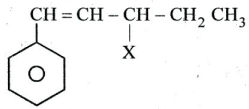 NEET 2023 Medium
 - Of the following \(0.10\, m\) aqueous solutions, which one will exhibit the largest freezing point depression ?NEET 2014 Easy
- The electronic configurations of \(Eu\) (Atomic No. \(63\)), \(Gd\) (Atomic No. \(64\)) and \(Tb\) (Atomic No. \(65\)) areNEET 2016 Medium
More PYQs from NEET
- In the electrical circuit shown in the figure, the current \(i\) through the side \(AB\) is
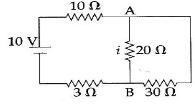 NEET 2017 Medium
 - The magnetic potential energy stored in a certain inductor is \(25\,\, mJ,\) when the current in the inductor is \(60\,\, mA.\) This inductor is of inductance ......\(H\)NEET 2018 Medium
- Among halogens, the one which can oxidise water to oxygen is:NEET 2017 Medium
- Norepinephrine \((i)\) is released by sympathetic fibers \((ii)\) is released by parasympathetic fibers \((iii)\) increases the heart rate \((iv)\) decreases blood pressure. Which of the above statements are correct ?NEET 2013 Medium
- If the magnitude of sum of two vectors is equal to the magnitude of difference of the two vectors, the angle between these vectors is ........ \(^o\)NEET 2016 Medium
- What causes a green plant exposed to the light, on only one side, to bend towards the source of light as it grows?NEET 2015 Medium