


NEET · Chemistry · STD 12 - p -Block elements - ll
Identify the incorrect statement from the following :
- A Nitrogen can form \(p \pi-p \pi\) multiple bonds with itself.
- B \(P \left( C _2 H _5\right)_3\) and \(As \left( C _6 H _5\right)_3\) form \(d \pi-d \pi\) bond with transition metals.
- C Phosphorus, arsenic and antimony show catenation property.
- D Nitrogen can form \(d \pi-p \pi\) bond with oxygen.
Answer & Solution
Correct Answer
(D) Nitrogen can form \(d \pi-p \pi\) bond with oxygen.
Step-by-step Solution
Detailed explanation
(D) Nitrogen can form \(d \pi-p \pi\) bond with oxygen.
Nitrogen and oxygen both belong to the second period of the periodic table.
The valence shell electronic configuration of nitrogen is \(2 s^2 2 p^3\) and that of oxygen is \(2 s^2 2 p^4\).
Since the principal quantum number is \(n=2\) for both elements, they do not have vacant d-orbitals in their valence shells.
Therefore, nitrogen cannot form \(d \pi-p \pi\) bonds with oxygen. They can only form \(p \pi-p \pi\) multiple bonds.
Statement (1) is correct as nitrogen forms \(p \pi-p \pi\) multiple bonds with itself (e.g., in \(N_2\) ).
Statement (2) is correct because phosphorus and arsenic have vacant d-orbitals and can act as \(\pi\)-acceptor ligands, forming \(d \pi-d \pi\) back-bonds with the filled d-orbitals of transition metals.
Statement (3) is correct as phosphorus, arsenic, and antimony exhibit the property of catenation.
Thus, the incorrect statement is (4).
Nitrogen and oxygen both belong to the second period of the periodic table.
The valence shell electronic configuration of nitrogen is \(2 s^2 2 p^3\) and that of oxygen is \(2 s^2 2 p^4\).
Since the principal quantum number is \(n=2\) for both elements, they do not have vacant d-orbitals in their valence shells.
Therefore, nitrogen cannot form \(d \pi-p \pi\) bonds with oxygen. They can only form \(p \pi-p \pi\) multiple bonds.
Statement (1) is correct as nitrogen forms \(p \pi-p \pi\) multiple bonds with itself (e.g., in \(N_2\) ).
Statement (2) is correct because phosphorus and arsenic have vacant d-orbitals and can act as \(\pi\)-acceptor ligands, forming \(d \pi-d \pi\) back-bonds with the filled d-orbitals of transition metals.
Statement (3) is correct as phosphorus, arsenic, and antimony exhibit the property of catenation.
Thus, the incorrect statement is (4).
See the Complete Solution
Get step-by-step explanations for this and 2.5 Lakh+ more JEE, NEET & CET questions.
- Unlock all solutions
- Practice the full chapter
- Track accuracy across PYQs
4.8 rated on Google Play · 14,000+ reviews
More questions from Chemistry
- Identify the incorrect statement related to \(\mathrm{PCl}_{5}\) from the followingNEET 2019 Hard
- Sugar 'X'
A. is found in honey.
B. is a keto sugar.
C. exists in \(\alpha\) and \(\beta\) - anomeric forms.
D. is laevorotatory.
'X' is :NEET 2025 Medium - Which of the following processes does not involve oxidation of iron?NEET 2015 Medium
- Match the metal ions given in Column\(- I\) with the spin magnetic moments of the ions given in Column\(-II\) and assign the correct code
\((a)\quad (b)\quad (c)\quad (d)\)Column\(-I\) Column\(-II\) \((a)\;Co^{+3}\) \((i)\;\sqrt{8}\; B.M.\) \((b)\;Cr^{+3}\) \((ii)\;\sqrt{35}\; B.M.\) \((c)\;Fe^{+3}\) \((iii)\;\sqrt{3}\; B.M.\) \((d)\;Ni^{+2}\) \((iv)\;\sqrt{24}\; B.M.\) \((v)\;\sqrt{15}\; B.M.\) NEET 2018 Medium - Strong reducing behaviour of \(H _{3} PO _{2}\) is due toNEET 2017 Medium
- In which of the following options the order of arrangement does not agree with the variation of property indicated against it ?NEET 2016 Medium
More PYQs from NEET
- The three boxes in this diagram represent the three major biosynthetic pathways in aerobic respiration. Arrows represent net reactants or products.Arrows numbered \(4, 8\) and \(12\) can all be
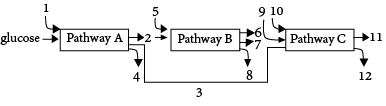 NEET 2013 Medium
 - Identify the statement that is NOT correct.NEET 2025 Easy
- A bullet of mass \(10\, g\) moving horizontally with a velocity of \(400\, m s^{-1}\) strikes a wood block of mass \(2\, kg\) which is suspended by light inextensible string of length \(5\, m.\) As a result, the centre of gravity of the block found to rise a vertical distance of \(10\, cm.\) The speed of the bullet after it emerges out horizontally from the block will be ................... \(\mathrm{ms}^{-1}\)NEET 2016 Hard
- Find the torque about the orlgin when a force of \(3 \hat{j}\, N\) acts on a particle whose position vector is \(2 \hat{k}\, m \)NEET 2020 Easy
- For a first order reaction \(A \rightarrow\) Products, initial concentration of \(A\) is \(0.1\, M\), which becomes \(0.001 \,M\) after \(5\) minutes. Rate constant for the reaction in \(\min ^{-1}\) is .... .NEET 2022 Medium
- \(\text{AB}\) is a part of an electrical circuit (see figure). The potential difference "\(\text V_\text A-\text V_\text B\)"\(,\) at the instant when current \(\text i =2\text A\) and is increasing at a rate of \(1\text{ amp} /\) second is _______.
 NEET 2025 Easy