


enEnglishguગુજરાતી
NEET · Chemistry · STD 12 - 2. Electrochemistry
Following limiting molar conductivities are given as \(\lambda_{\mathrm{m}\left(\mathrm{H}_{2} \mathrm{SO}_{4}\right)}^{0}=\mathrm{x} \;\mathrm{S}\; \mathrm{cm}^{2} \mathrm{mol}^{-1}\) \(\lambda_{\mathrm{m}\left(\mathrm{K}_{2} \mathrm{SO}_{4}\right)}^{0}=\mathrm{y} \;\mathrm{S\;cm}^{2} \mathrm{mol}^{-1}\) \(\lambda_{\mathrm{m}(\mathrm{CH_3} \mathrm{COOK})}^{0}=\mathrm{z}\; \mathrm{S\;cm}^{2} \mathrm{mol}^{-1}\) \(\lambda_{\mathrm{m}}^{0}\left(\mathrm{in}\; \mathrm{S} \;\mathrm{cm}^{2} \mathrm{mol}^{-1}\right)\) for \(\mathrm{CH}_{3} \mathrm{COOH}\) will be
- A \(x + y + 2 z\)
- B \(x + y - z\)
- C \(x + y + z\)
- D \(\frac{x-y}{2}+z\)
Answer & Solution
Correct Answer
(D) \(\frac{x-y}{2}+z\)
Step-by-step Solution
Detailed explanation
\(\mathrm{CH}_{3} \mathrm{COOH} \rightarrow \mathrm{CH}_{3} \mathrm{COO}^{-}+\mathrm{H}^{+}\dots (1)\) \(\mathrm{H}_{2} \mathrm{SO}_{4} \rightarrow 2 \mathrm{H}^{+}+\mathrm{SO}_{4}^{-2}\dots (2)\)
See the Complete Solution
Get step-by-step explanations for this and 2.5 Lakh+ more JEE, NEET & CET questions.
- Unlock all solutions
- Practice the full chapter
- Track accuracy across PYQs
4.8 rated on Google Play · 14,000+ reviews
More questions from Chemistry
- Of the following alcohols, the one that would react fastest with conc. \(HCl\) and anhydrous \(ZnCl_{2}\) is,NEET 2017 Medium
- In the following reaction: \(HC \equiv CH\,\xrightarrow[{H{g^{2 + }}}]{{{H_2}S{O_4}}}\,'P'\) Product \('P'\) will not giveNEET 2013 Medium
- In hydrogen atom, the de Broglie wavelength of an electron in the second Bohr orbit is \([\) Given that Bohr radius, \(a_0 = 52.9 \;pm]\)NEET 2019 Hard
- The order of stability of the following tautomeric compounds is \(\mathop {\begin{array}{*{20}{c}}
{OH\,\,\,\,\,\,\,\,\,\,\,\,\,\,\,\,\,\,\,\,\,\,\,O} \\
{|\,\,\,\,\,\,\,\,\,\,\,\,\,\,\,\,\,\,\,\,\,\,\,\,\,\,\,\,||} \\
{C{H_2} = C - C{H_2} - C - C{H_3}}
\end{array}}\limits_{(I)} \rightleftharpoons \) \(\mathop {\begin{array}{*{20}{c}}
{OH\,\,\,\,\,\,\,\,\,\,\,\,\,\,\,\,\,\,\,O} \\
{|\,\,\,\,\,\,\,\,\,\,\,\,\,\,\,\,\,\,\,\,\,\,\,\,\,||} \\
{C{H_3} - C - C{H_2} - C - C{H_3}}
\end{array}}\limits_{(II)} \rightleftharpoons \) \(\mathop {\begin{array}{*{20}{c}}
{OH\,\,\,\,\,\,\,\,\,\,\,\,\,\,\,\,\,\,\,O} \\
{|\,\,\,\,\,\,\,\,\,\,\,\,\,\,\,\,\,\,\,\,\,\,\,\,\,||} \\
{C{H_3} - C = CH - C - C{H_3}}
\end{array}}\limits_{(III)} \)NEET 2013 Medium - Under isothermal and reversible conditions, the term "free energy" in thermodynamics signifiesNEET 2017 Easy
- Isotonic solutions have sameNEET 2020 Medium
More PYQs from NEET
- The term "glycocalyx" is used forNEET 2013 Medium
- A wall consists of alternating blocks of length \(d\) and coefficient of thermal conductivity \(K_{1}\) and \(K_{2}\) respectively as shown in figure. The cross sectional area of the blocks are the same. The equivalent coefficient of thermal conductivity of the wall between left and right is
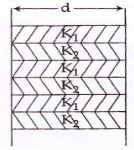 NEET 2017 Medium
 - The power of a biconvex lens is \(10\) dioptre and the radius of curvature of each surface is \(10 \;cm\). Then the refractive index of the material of the lens is,NEET 2020 Medium
- Which one of the following equations represents the Verhulst-Pearl Logistic Growth of population?NEET 2025 Easy
- The correct difference between first- and second-order reaction is thatNEET 2018 Hard
- The number of structural isomers possible from the molecular formula \(C_3H_9N\) isNEET 2015 Hard