


NEET · Chemistry · STD 11 - 8.3. Organic chemistry purification and characterization
During Lassaigne's test, the elements present in an organic compound are converted from :
- A ionic form to ionic form
- B covalent form to ionic form
- C covalent form to covalent form
- D ionic form to covalent form
Answer & Solution
Correct Answer
(B) covalent form to ionic form
Step-by-step Solution
Detailed explanation
(B) covalent form to ionic form
In Lassaigne's test, an organic compound is fused with sodium metal. The elements present in the organic compound, such as nitrogen, sulphur, and halogens, are initially present in covalent form.
During the fusion process, these elements react with sodium to form ionic sodium salts. For example, nitrogen and carbon form sodium cyanide (NaCN), sulphur forms sodium sulphide \(\left( Na _2 S\right)\), and halogens form sodium halides ( NaX ).
Therefore, the elements are converted from covalent form to ionic form.
In Lassaigne's test, an organic compound is fused with sodium metal. The elements present in the organic compound, such as nitrogen, sulphur, and halogens, are initially present in covalent form.
During the fusion process, these elements react with sodium to form ionic sodium salts. For example, nitrogen and carbon form sodium cyanide (NaCN), sulphur forms sodium sulphide \(\left( Na _2 S\right)\), and halogens form sodium halides ( NaX ).
Therefore, the elements are converted from covalent form to ionic form.
See the Complete Solution
Get step-by-step explanations for this and 2.5 Lakh+ more JEE, NEET & CET questions.
- Unlock all solutions
- Practice the full chapter
- Track accuracy across PYQs
4.8 rated on Google Play · 14,000+ reviews
More questions from Chemistry
- Which of the following reactions is the metal displacement reaction? Choose the right option.NEET 2021 Medium
- Among halogens, the one which can oxidise water to oxygen is:NEET 2017 Medium
- Which one of the following is an ambidentate ligand ?NEET 2026 Easy
- Although +3 oxidation state is most common in lanthanoids, cerium still shows +4 oxidation state because :NEET 2026 Easy
- The species \(Ar, K^+\) and \(Ca^{2+}\) contain the same number of electrons. In which order do their radii increase ?NEET 2015 Medium
- The compound \(A\) on treatment with \(Na\) gives \(B\), and with \(\mathrm{PCl}_{5}\) gives \(\mathrm{C} . \mathrm{B}\) and \(\mathrm{C}\) react together to give diethyl ether. \(\mathrm{A}, \mathrm{B}\) and \(\mathrm{C}\) are in the orderNEET 2018 Medium
More PYQs from NEET
- Given below are two statements:
Statement I : The primary source of energy in an ecosystem is solar energy.
Statement II : The rate of production of organic matter during photosynthesis in an ecosystem is called net primary productivity (NPP).
In the light of the above statements, choose the most appropriate answer from the options given below:NEET 2025 Easy - For the cell reaction......\(kJ\, mol^{-1}\) \(2 \mathrm{Fe}^{3+}(\mathrm{aq})+2 \mathrm{I^-}(\mathrm{aq}) \rightarrow 2 \mathrm{Fe}^{2+}(\mathrm{aq})+\mathrm{I}_{2}(\mathrm{aq})\) \(\mathrm{E}_{\text {call }}^{\mathrm{e}}=0.24 \mathrm{V}\) at \(298\; \mathrm{K}\). The standard Gibbs energy \(\left( {{\Delta _r}{{\rm{G}}^ \ominus }} \right)\) of the cell reaction is: [Faraday constant \(\mathrm{F}=96500 \;\mathrm{C} \mathrm{mol}^{-1} \)]NEET 2019 Hard
- Which of the following molecules represents the order of hybridisation \(sp^2, sp^2, sp, sp\) from left to right atoms ?NEET 2018 Easy
- Figure shows a circuit that contains three identical resistors with resistance \(R = 9.0 \,\,\Omega\) each, two identical inductors with inductance \(L = 2.0\, mH\) each, and an ideal battery with \(emf\,\, = 18 \,\,V.\) The current \(i\) through the battery just after the switch closed is
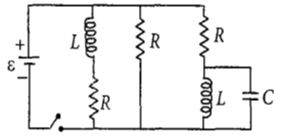 NEET 2017 Medium
 - The correct sequence of bond enthalpy of \('\mathrm{C}-\mathrm{X}'\) bond is :NEET 2021 Easy
- The \(RBC\) deficiency is deficiency disease of :NEET 2021 Easy