


NEET · Chemistry · STD 12 -8.1. Aldehydes and ketones
Compound \(P \left( C _8 H _8 O \right)\) gives a red orange precipitate with 2, 4-DNP reagent and it does not reduce Fehling's reagent. On drastic oxidation with chromic acid, \(P\) gives an aromatic product \(Q\) that produces effervescence on treating with aq. \(NaHCO _3\). Compounds P and Q , respectively, are :
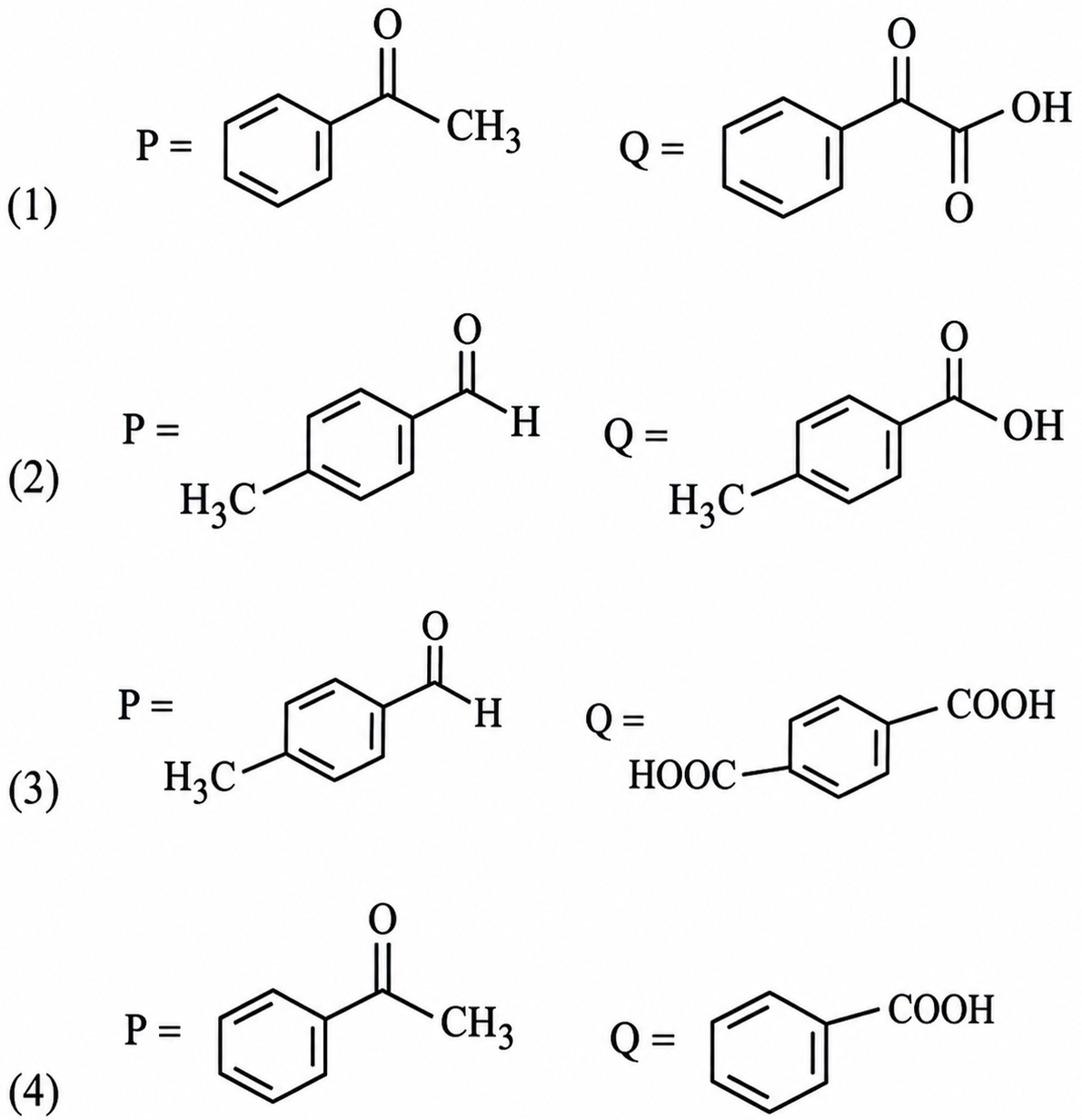
- A 1
- B 2
- C 3
- D 4
Answer & Solution
Correct Answer
(D) 4
Step-by-step Solution
Detailed explanation
(D) 4
Compound \(P \left( C _8 H _8 O \right)\) gives a red-orange precipitate with 2,4 -DNP reagent, indicating the presence of a carbonyl group.
P does not reduce Fehling's reagent, which implies it is either a ketone or an aromatic aldehyde.
The requirement of "drastic oxidation" strongly suggests that P is a ketone. Ketones resist mild oxidation and require drastic conditions (such as chromic acid) to undergo C-C bond cleavage, whereas aldehydes are easily oxidized.
Acetophenone \(\left( C _6 H _5 COCH _3\right)\) is a ketone that fits the molecular formula \(C _8 H _8 O\).
Drastic oxidation of acetophenone with chromic acid cleaves the methyl group to yield benzoic acid ( \(C _6 H _5 COOH\) ), which is compound Q .
Benzoic acid is an aromatic carboxylic acid that reacts with aqueous \(NaHCO _3\) to produce effervescence of \(CO _2\) gas.
Therefore, P is acetophenone and Q is benzoic acid.
Compound \(P \left( C _8 H _8 O \right)\) gives a red-orange precipitate with 2,4 -DNP reagent, indicating the presence of a carbonyl group.
P does not reduce Fehling's reagent, which implies it is either a ketone or an aromatic aldehyde.
The requirement of "drastic oxidation" strongly suggests that P is a ketone. Ketones resist mild oxidation and require drastic conditions (such as chromic acid) to undergo C-C bond cleavage, whereas aldehydes are easily oxidized.
Acetophenone \(\left( C _6 H _5 COCH _3\right)\) is a ketone that fits the molecular formula \(C _8 H _8 O\).
Drastic oxidation of acetophenone with chromic acid cleaves the methyl group to yield benzoic acid ( \(C _6 H _5 COOH\) ), which is compound Q .
Benzoic acid is an aromatic carboxylic acid that reacts with aqueous \(NaHCO _3\) to produce effervescence of \(CO _2\) gas.
Therefore, P is acetophenone and Q is benzoic acid.
See the Complete Solution
Get step-by-step explanations for this and 2.5 Lakh+ more JEE, NEET & CET questions.
- Unlock all solutions
- Practice the full chapter
- Track accuracy across PYQs
4.8 rated on Google Play · 14,000+ reviews
More questions from Chemistry
- In which of the following pair both the species have \(sp^3\) hybridization?NEET 2013 Medium
- Identify the incorrect statement related to \(\mathrm{PCl}_{5}\) from the followingNEET 2019 Hard
- The hydrolysis reaction that takes place at the slowest rate, among the following isNEET 2019 Hard
- \(MY\) and \(NY_3,\) two nearly insoluble salts, have the same \(K_{sp} \) values of \(6.2 \times 10^{-13}\) at roomtemperature. Which statement would be true in regard to \(MY\) and \(NY_3\) ?NEET 2016 Hard
- The correct order of energies of molecular orbitals of \(N _2\) molecule, isNEET 2023 Easy
- Identify the Incorrect statement from the followingNEET 2020 Medium
More PYQs from NEET
- Choose the correct statements regarding cell organelles and their inclusions.
A. The endomembrane system includes Golgi complex, endoplasmic reticulum and mitochondria.
B. Rough endoplasmic reticulum bears ribosomes on its surface.
C. Both mitochondria and plastids have circular DNA.
D. A network of microtubules, microfilaments and intermediate filaments present in the cytoplasm is called cytoskeleton.
E. Mitochondrion is a single membrane-bound structure.
Choose the correct answer from the options given below :NEET 2026 Medium - Jahn-Teller effect is not observed in high spin complexes ofNEET 2016 Medium
- Which of the following will be most stable diazonium salt \(RN_2^+X^-\) ?NEET 2014 Medium
- Chronic auto immune disorder affecting neuro muscular junction leading to fatigue, weakening and paralysis of skeletal muscle is called as :NEET 2021 Medium
- After passing through a polariser a linearly polarised light of intensity \(I\) is incident on an analyser making an angle of \(30^{\circ}\) with that of the polariser. The intensity of light emitted from the analyser will beNEET 2022 Easy
- Match List \(I\) with List \(II\).
Choose the correct answer from the options give below:List \(I\) List \(II\) (A). Mast cells (I). Ciliated epithelium (B). Inner surface of bronchiole (II). Areolar connective tissue (C). Blood (III). Cuboidal epithelium (D). Tubular parts of nephron (IV). Specialised connective tissue NEET 2023 Medium