


NEET · Chemistry · STD 12 - 4. d and f- block elements
Although +3 oxidation state is most common in lanthanoids, cerium still shows +4 oxidation state because :
- A After losing one more electron, it acquires \(4 f^{14}\) electronic configuration.
- B Its nearest inert gas is Radon.
- C Its atomic number is 61
- D After losing one more electron, it acquires \(4 f^0\) electronic configuration.
Answer & Solution
Correct Answer
(D) After losing one more electron, it acquires \(4 f^0\) electronic configuration.
Step-by-step Solution
Detailed explanation
(D) After losing one more electron, it acquires \(4 f^0\) electronic configuration.
The atomic number of Cerium (Ce) is 58.
The electronic configuration of Ce is \([X e] 4 f^1 5 d^1 6 s^2\).
In +3 oxidation state, the electronic configuration of \(Ce ^{3+}\) is \([X e] 4 f^1\).
By losing one more electron, it forms \(Ce ^{4+}\) ion.
The electronic configuration of \(C e^{4+}\) is \([X e] 4 f^0\), which is a highly stable noble gas configuration.
Thus, Cerium shows +4 oxidation state because after losing one more electron from +3 state, it acquires \(4 f^0\) electronic configuration.
The atomic number of Cerium (Ce) is 58.
The electronic configuration of Ce is \([X e] 4 f^1 5 d^1 6 s^2\).
In +3 oxidation state, the electronic configuration of \(Ce ^{3+}\) is \([X e] 4 f^1\).
By losing one more electron, it forms \(Ce ^{4+}\) ion.
The electronic configuration of \(C e^{4+}\) is \([X e] 4 f^0\), which is a highly stable noble gas configuration.
Thus, Cerium shows +4 oxidation state because after losing one more electron from +3 state, it acquires \(4 f^0\) electronic configuration.
See the Complete Solution
Get step-by-step explanations for this and 2.5 Lakh+ more JEE, NEET & CET questions.
- Unlock all solutions
- Practice the full chapter
- Track accuracy across PYQs
4.8 rated on Google Play · 14,000+ reviews
More questions from Chemistry
- Which of the following aqueous solution will exhibit highest boiling point?NEET 2025 Medium
- Consider the half-cell reduction reaction \(Mn^{2+} + 2e^- \rightarrow Mn,\, \)\(E^o = - 1.18\, V\) \(Mn^{2+} \rightarrow Mn^{3+} + e^-,\) \( E^o = - 1.51 \,V\) The \(E^o\) for the reaction \(3Mn^{2+} \rightarrow Mn^o + 2Mn^{3+},\) and possibility of the forward reaction are respectivelyNEET 2013 Hard
- The pressure of \(H_2\) required to make the potential of \(H_{2}-\) electrode zero in pure water at \(298\, K\) isNEET 2016 Medium
- In a typical fuel cell, the reactant (\(R\)) and product (\(P\)) areNEET 2020 Easy
- Which one of the following conditions will favour maximum formation of the product in the reaction \(\mathrm{A}_{2}(\mathrm{g})+\mathrm{B}_{2}(\mathrm{g}) \rightleftharpoons \mathrm{X}_{2}(\mathrm{g}) \Delta_{r} \mathrm{H}=-\mathrm{X} \mathrm{kJ} ?\)NEET 2018 Medium
- Identify the incorrect statement from the following :NEET 2026 Medium
More PYQs from NEET
- Two parallel infinite line charges with linear charge densities \(+\lambda\; \mathrm{C} / \mathrm{m}\) and \(-\lambda\; \mathrm{C} / \mathrm{m}\) are placed at a distance of \(2 \mathrm{R}\) in free space. What is the electric field mid-way between the two line charges?NEET 2019 Medium
- In which animal do haploid cells divide mitotically to produce gametes ?NEET 2026 Medium
- Lungs do not collapse between breaths and some air always remains in the lungs which can never be expelled becauseNEET 2016 Medium
- Read the following statements and choose the set of correct statements: In the members of Phaeophyceae,
\(A\). Asexual reproduction occurs usually by biflagellate zoospores.
\(B\). Sexual reproduction is by oogamous method only.
\(C\). Stored food is in the form of carbohydrates which is either mannitol or laminarin.
\(D\). The major pigments found are chlorophyll \(a\), \(c\) and carotenoids and xanthophyll.
\(E\). Vegetative cells have a cellulosic wall, usually covered on the outside by gelatinous coating of algin.
Choose the correct answer from the options given below:NEET 2024 Medium - How many different proteins does the ribosome consist of?NEET 2023 Medium
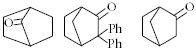
- Which among the given molecules can exhibit tautomerism ?
 NEET 2016 Hard