


NEET · Biology · STD 11 - 13. Plant growth and development
Which one of the following is not a characteristic of plant cells in the phase of elongation ?
- A New cell wall deposition
- B Cell enlargement
- C Increased vacuolation
- D Large conspicuous nuclei
Answer & Solution
Correct Answer
(D) Large conspicuous nuclei
Step-by-step Solution
Detailed explanation
(D) Large conspicuous nuclei
The period of growth is generally divided into three phases: meristematic, elongation, and maturation.
The cells in the meristematic phase are rich in protoplasm and possess large conspicuous nuclei. Their cell walls are primary in nature, thin, and cellulosic with abundant plasmodesmatal connections.
The cells in the phase of elongation are characterised by increased vacuolation, cell enlargement, and new cell wall deposition.
Therefore, large conspicuous nuclei are a characteristic of meristematic cells, not cells in the phase of elongation.
The period of growth is generally divided into three phases: meristematic, elongation, and maturation.
The cells in the meristematic phase are rich in protoplasm and possess large conspicuous nuclei. Their cell walls are primary in nature, thin, and cellulosic with abundant plasmodesmatal connections.
The cells in the phase of elongation are characterised by increased vacuolation, cell enlargement, and new cell wall deposition.
Therefore, large conspicuous nuclei are a characteristic of meristematic cells, not cells in the phase of elongation.
See the Complete Solution
Get step-by-step explanations for this and 2.5 Lakh+ more JEE, NEET & CET questions.
- Unlock all solutions
- Practice the full chapter
- Track accuracy across PYQs
4.8 rated on Google Play · 14,000+ reviews
More questions from Biology
- Match List \(I\) with List \(II\) :
Choose the correct answer from the options given below:List \(I\) List \(II\) \(A\) Typhoid \(I\) Fungus \(B\) Leishmaniasis \(II\) Nematode \(C\) Ringworm \(III\) Protozoa \(D\) Filariasis \(IV\) Bacteria NEET 2024 Medium - The maximum volume of air a person can breathe in after a forced expiration is known asNEET 2019 Easy
- Name the class of enzyme that usually catalyze the following reaction :
\(\mathrm{S}-\mathrm{G}+\mathrm{S}^{\prime} \rightarrow \mathrm{~S}+\mathrm{S}^{\prime}-\mathrm{G}\)
Where, \(G \rightarrow\) a group other than hydrogen
\(S \rightarrow\) a substrate
\(\mathrm{S}^{\prime} \rightarrow\) another substrateNEET 2025 Medium - Correct position of floral parts over thalamus in mustard plant isNEET 2020 Medium
- Name the chronic respiratory disorder caused mainly by cigarette smoking.NEET 2016 Medium
- Fertilisation in humans is practically feasible only ifNEET 2016 Medium
More PYQs from NEET
- Colostrum, the yellowish fluid, secreted by mother during the Inittlal days of lactation is very essentlal to impart immunity to the newbom infants because it containsNEET 2019 Medium
- The final proof for \(DNA\) as the genetic material came from the experiments ofNEET 2017 Medium
- Which one of the following statements is incorrect?NEET 2015 Medium
- The most suitable reagent for the following conversion is
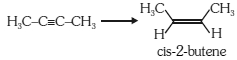 NEET 2019 Medium
 - A pink flowered Snapdragon plant was crossed with a red flowered Snapdragon plant. What type of phenotype/s is/are expected in the progeny?NEET 2024 Medium
- Which structures perform the function of mitochondria in bacteria?NEET 2014 Medium