


enEnglishguગુજરાતી
NEET · Biology · STD 12 - 13. biodiversity and conservation
Which of the following is the most important cause of animals and plants being driven to extinction?
- A Habitat loss and fragmentation
- B Coextinctions
- C Overexploitation
- D Alien species invasion
Answer & Solution
Correct Answer
(A) Habitat loss and fragmentation
Step-by-step Solution
Detailed explanation
(a) : Destruction of natural habitat causes the most serious threat to the biodiversity. Over population, urbanisation and industrialisation lead to the destruction or fragmentation of natural habitats to fulfill the requirement of additional land. Loss of habitat results in annihilation of plants, microorganisms and forcing out of animals which in alien lands die out after some time. Fragmentation of habitats results in disruption of complex interactions amongst species, destruction of species in the cleared regions, annihilation of species restricted to deeper undisturbed parts of forests and decreased biodiversity in the habitat fragments.
See the Complete Solution
Get step-by-step explanations for this and 2.5 Lakh+ more JEE, NEET & CET questions.
- Unlock all solutions
- Practice the full chapter
- Track accuracy across PYQs
4.8 rated on Google Play · 14,000+ reviews
More questions from Biology
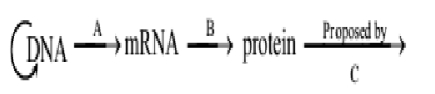
- The diagram shows an important concept in the genetic implication of \(DNA\). Fill in the blanks \(A\) to \(C\).
 NEET 2013 Medium
 - Read the following statements:
\((a)\) In roots, xylem and phloem in a vascular bundle are arranged in an alternate manner along the different radii.
\((b)\) Conjoint closed vascular bundles do not possess cambium
\((c)\) In open vascular bundles, cambium is present in between xylem and phloem
\((d)\) The vascular bundles of dicotyledonous stem possess endarch protoxylem
\((e)\) In monocotyledonous root, usually there are more than six xylem bundles present.
Choose the correct answer from the options given below:NEET 2022 Hard - Sliding filament theory can be best explained asNEET 2015 Medium
- Match List \(I\) with List \(II\).
Choose the correct answer from the options given below:List \(I\) List \(II\) \(A\). Cartilaginous Joint \(I\). Between flat skull bones \(B\). Ball and Socket Joint \(II\). Between adjacent vertebrae in vertebral column \(C\). Fibrous Joint \(III\). Between carpal and metacarpal of thumb \(D\). Saddle Joint \(IV\). Between Humerus and Pectoral girdle NEET 2023 Medium - After maturation, in primary lymphoid organs, the lymphocytes migrate for interaction with antigens to secondary lymphoid organ(s) / tissue(s) like :
A. thymus
B. bone marrow
C. spleen
D. lymph nodes
E. Peyer's patches
Choose the correct answer from the options given belowNEET 2025 Easy - Stomata in grass leaf areNEET 2018 Medium
More PYQs from NEET
- Which one of the following statements is correct regarding sexually transmitted diseases \((STDs)\) ?NEET 2013 Medium
- Time intervals measured by a clock give the following readings : \(1.25 \;s , 1.24\; s , 1.27\; s , 1.21 \;s\) and \(1.28\; s\) What is the percentage relative error of the observations?NEET 2020 Medium
- The infectious stage of Plasmodium that enters the human body is :NEET 2020 Easy
- Identify the correct formula of oleum from the followingNEET 2019 Easy
- The number of angular nodes and radial nodes in \(3 s\) orbital areNEET 2020 Easy
- Which organization publishes the ‘Red Data Book’ ?NEET 2013 Medium