


NEET · Biology · STD 11 - 15. Body fluids and criculations
Match List \(I\) with List \(II\).
| List \(I\) | List \(II\) |
| \(A\). \(P\)-wave | \(I\). Beginning of systole |
| \(B\). \(Q\)-wave | \(II\). Repolarisation of ventricles |
| \(C\). \(QRS\) complex | \(III\). Depolarisation of atria |
| \(D\). \(T\)-wave | \(IV\). Depolarisation of ventricles |
- A A-I, B-II, C-III, D-IV
- B A-III, B-I, C-IV, D-II
- C A-IV, B-III, C-II, D-I
- D A-II, B-IV, C-I, D-III
Answer & Solution
Correct Answer
(B) A-III, B-I, C-IV, D-II
Step-by-step Solution
Detailed explanation
The correct answer is option (2) as in a standard ECG, P-wave represents the electrical excitation (or depolarisation) of the atria which leads to the contraction of both the atria. - QRS complex represents the depolarisation of ventricles which initiates the ventricular contraction.
See the Complete Solution
Get step-by-step explanations for this and 2.5 Lakh+ more JEE, NEET & CET questions.
- Unlock all solutions
- Practice the full chapter
- Track accuracy across PYQs
4.8 rated on Google Play · 14,000+ reviews
More questions from Biology
- Given below is the representation of the extent of global diversity of invertebrates. What groups the four portions \((A-D)\) represent respectively?
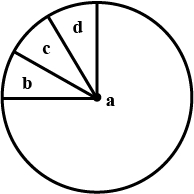 NEET 2014 Medium
 - The term 'Nuclein' for the genetic material was used byNEET 2020 Easy
- Which one of the following is a hallucinogenic drug ?NEET 2013 Medium
- Multiple alleles are presentNEET 2015 Medium
- Given below are two statements: Statement \(I:\) Vas deferens receives a duct from seminal vesicle and opens into urethra as the ejaculatory duct. Statement \(II:\) The cavity of the cervix is called cervical canal which along with vagina forms birth canal. In the light of the above statements, choose the correct answer from the options given below:NEET 2023 Medium
- Bicarpellary ovary with obliquely placed septum is seen inNEET 2019 Medium
More PYQs from NEET
- Read the following statements:
\((a)\) In roots, xylem and phloem in a vascular bundle are arranged in an alternate manner along the different radii.
\((b)\) Conjoint closed vascular bundles do not possess cambium
\((c)\) In open vascular bundles, cambium is present in between xylem and phloem
\((d)\) The vascular bundles of dicotyledonous stem possess endarch protoxylem
\((e)\) In monocotyledonous root, usually there are more than six xylem bundles present.
Choose the correct answer from the options given below:NEET 2022 Hard - Match List \(I\) with List \(II\).
Choose the correct answer from the options given below:List \(I\) (Conversion) List \(II\) (Number of Faraday required) \(A\). \(1 \mathrm{~mol}\) of \(\mathrm{H}_2 \mathrm{O}\) to \(\mathrm{O}_2\) \(l\). \(3 \mathrm{~F}\) \(B\). \(1 \mathrm{~mol}\) of \(\mathrm{MnO}_4^{-}\)to \(\mathrm{Mn}^{2+}\) \(II\). \(2 F\) \(C\). \(1.5 \mathrm{~mol}\) of \(\mathrm{Ca}\) from molten \(\mathrm{CaCl}_2\) \(III\). \(1F\) \(D\). \(1 \mathrm{~mol}\) of \(\mathrm{FeO}\) to \(\mathrm{Fe}_2 \mathrm{O}_3\) \(IV\). \(5 \mathrm{~F}\) NEET 2024 Medium - Given that \(\Lambda_{ m }^{\alpha}=133.4\,\left( AgNO _{3}\right) ; \Lambda_{ m }^{\alpha}=149.9( KCl )\) \(\Lambda_{ m }^{\alpha}=144.9\, S\, cm ^{2} \,mol ^{-1}\left( KNO _{3}\right)\) the molar conductivity at infinite dilution for \(AgCl\) is \(.......\, S \,cm ^{2}\, mol ^{-1}\)NEET 2017 Easy
- Two hollow conducting spheres of radii \(R_{1}\) and \(R_{2}\) \(\left(R_{1}>>R_{2}\right)\) have equal charges. The potential would be:NEET 2022 Easy
- Which of the following floral formula is the correct floral formula of Solanaceae family ?
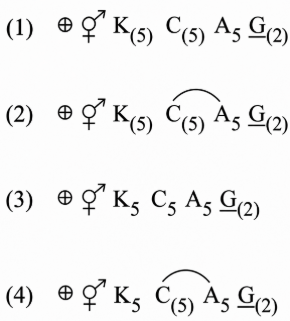 NEET 2026 Medium
 - An iron bar of length \(L\) has magnetic moment \(M\). It is bent at the middle of its length such that the two arms make an angle \(60^{\circ}\) with each other. The magnetic moment of this new magnet is :NEET 2024 Medium