


NEET · Biology · STD 12 - 11. organisms and populations
Choose the correct statements regarding population interactions between two species.
A. In both parasitism and commensalism, only one species benefits and the other species is harmed.
B. Both species benefit in mutualism.
C. Both species benefit in commensalism.
D. In parasitism, only one species benefits and the other species is harmed.
E. In amensalism, one species is harmed and the other is unaffected.
Choose the correct answer from the options given below :
- A B and E only
- B A and B only
- C B, D and E only
- D A and D only
Answer & Solution
Correct Answer
(C) B, D and E only
Step-by-step Solution
Detailed explanation
(C) B, D and E only
In mutualism, both species benefit from the interaction (+, +).
In commensalism, one species benefits and the other is neither harmed nor benefited (+, 0).
In parasitism, one species benefits and the other is harmed (+, -).
In amensalism, one species is harmed and the other is unaffected (-, 0).
Therefore, statements B, D, and E are correct.
In mutualism, both species benefit from the interaction (+, +).
In commensalism, one species benefits and the other is neither harmed nor benefited (+, 0).
In parasitism, one species benefits and the other is harmed (+, -).
In amensalism, one species is harmed and the other is unaffected (-, 0).
Therefore, statements B, D, and E are correct.
See the Complete Solution
Get step-by-step explanations for this and 2.5 Lakh+ more JEE, NEET & CET questions.
- Unlock all solutions
- Practice the full chapter
- Track accuracy across PYQs
4.8 rated on Google Play · 14,000+ reviews
More questions from Biology
- An association of individuals of different species living in the same habitat and having functional interactions isNEET 2015 Medium
- Match the following columns and select the correct option
Column \(I\) Column \(II\) (\(a\)) Pneumotaxic Centre (\(i\)) Alveoli (\(b\)) \(O _{2}\) Dissociation curve (\(ii\)) Pons region of brain (\(c\)) Carbonic Anhydrase (\(iii\) Haemoglobin (\(d\)) Primary site of exchange of gases (\(iv\)) \(R.B.C.\) NEET 2020 Easy - Ciliates differ from all other protozoans inNEET 2018 Medium
- Match the organisms in Column\(-I\) with habitats in Column\(-II\)
Select the correct answer from the options given belowColumn\(-I\) Column\(-II\) \((a)\) Halophiles \((i)\) Hot springs \((b)\) Thermoacidophiles \((ii)\) Aquatic environment \((c)\) Methanogens \((iii)\) Guts of ruminants \((d)\) Cyanobacteria \((iv)\) Salty area NEET 2019 Easy - Twins are born to a family that lives next door to you. The twins are a boy and a girl. Which of the following must be true?NEET 2025 Easy
- The genotypes of a husband and wife are \(I^AI^B\) and \(I^Ai\). Among the blood types of their children, how many different genotypes and phenotypes are possible?NEET 2017 Medium
More PYQs from NEET
- Two cylinders \(A\) and \(B\) of equal capacity are connected to each other via a stop cock. A contains an Ideal gas at standard temperature and pressure. \(B\) is completely evacuated. The entire system is thermally insulated. The stop cock is suddenly opened. The process is :NEET 2020 Easy
- For the logic circuit shown, the truth table is :
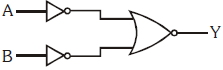 NEET 2020 Medium
 - The \(RBC\) deficiency is deficiency disease of :NEET 2021 Easy
- Twenty seven drops of same size are charged at \(220\, \mathrm{~V}\) each. They combine to form a bigger drop. Calculate the potential of the bigger drop. (In \(\mathrm{~V}\))NEET 2021 Medium
- Given below are two statements:
Statement \(I\): Ligaments are dense irregular tissue.
Statement \(II\): Cartilage is dense regular tissue.
In the light of the above statements, choose the correct answer from the options given below:NEET 2023 Medium - A \(N-P-N\) transistor is connected in common emitter configuration (see figure) in which collector voltage drop across load resistance \((800 \; \Omega)\) connected to the collector circuit is \(0.8 \;V\). The collector current is .............. \(mA\)
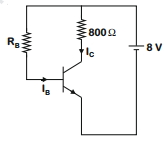 NEET 2020 Easy