


MHT CET · Physics · Alternating Current
With an alternating voltage source frequency ' f ', inductor ' \(L\) ', capacitor ' \(C\) ' and resistance ' \(R\) ' are connected in series. The voltage leads the current by \(45^{\circ}\). The value of ' \(L\) ' is \(\left(\tan 45^{\circ}=1\right)\)
- A \(\left(\frac{1+2 \pi \mathrm{fCR}}{4 \pi^2 \mathrm{f}^2 \mathrm{C}}\right)\)
- B \(\left(\frac{1-2 \pi \mathrm{fCR}}{4 \pi^2 \mathrm{f}^2 \mathrm{C}}\right)\)
- C \(\left(\frac{4 \pi^2 \mathrm{f}^2 \mathrm{C}}{1+2 \pi \mathrm{fCR}}\right)\)
- D \(\left(\frac{4 \pi^2 \mathrm{f}^2 \mathrm{C}}{1-2 \pi \mathrm{fCR}}\right)\)
Answer & Solution
Correct Answer
(A) \(\left(\frac{1+2 \pi \mathrm{fCR}}{4 \pi^2 \mathrm{f}^2 \mathrm{C}}\right)\)
Step-by-step Solution
Detailed explanation
The phase difference between the current and the voltage is given by \(\tan \phi=\frac{\omega \mathrm{L}-\frac{1}{\omega \mathrm{C}}}{\mathrm{R}}\)
\(\begin{array}{ll}
\therefore & \omega L-\frac{1}{\omega C}=R \quad \ldots\left(\because \tan \phi=\tan 45^{\circ}=1\right) \\
\therefore & \omega L=R+\frac{1}{\omega C} \\
\therefore & L=\frac{R}{\omega}+\frac{1}{\omega^2 C}=\frac{R \omega C+1}{\omega^2 C} \\
\therefore & L=\frac{1+2 \pi f C R}{4 \pi^2 f^2 C} \quad \ldots(\because \omega=2 \pi f)
\end{array}\)
\(\begin{array}{ll}
\therefore & \omega L-\frac{1}{\omega C}=R \quad \ldots\left(\because \tan \phi=\tan 45^{\circ}=1\right) \\
\therefore & \omega L=R+\frac{1}{\omega C} \\
\therefore & L=\frac{R}{\omega}+\frac{1}{\omega^2 C}=\frac{R \omega C+1}{\omega^2 C} \\
\therefore & L=\frac{1+2 \pi f C R}{4 \pi^2 f^2 C} \quad \ldots(\because \omega=2 \pi f)
\end{array}\)
See the Complete Solution
Get step-by-step explanations for this and 2.5 Lakh+ more JEE, NEET & CET questions.
- Unlock all solutions
- Practice the full chapter
- Track accuracy across PYQs
4.8 rated on Google Play · 14,000+ reviews
More questions from Physics
- When the distance separations between the slit and screen is doubled, the angular separation between the fringes in slit diffraction experiment.MHT CET 2022 Easy
- A body is situated on the surface of the earth becomes weightless at equator when the rotational kinetic energy of the earth reaches a critical value ' \(K\) '. The value of \(K\) is given by [ \(\mathrm{g}\) = gravitational acceleration on earth's surface, \(M=\) mass of the earth and \(\mathrm{R}=\) radius of the earth]MHT CET 2021 Hard
- During thermodynamic process, the increase in internal energy of a system is equal to the work done on the system. Which process does the system undergo?MHT CET 2025 Easy
- The value of gravitational acceleration \(g\) at a height \(h\) above the earth's surface is \(\frac{g}{4}\) then (\(R =\) radius of earth)MHT CET 2016 Medium
- If a ball is thrown vertically upwards with speed ' \(u\) ', the distance covered by it during the last ' \(t\) ' second of its ascent is ( \(g=\) acceleration due to gravity)MHT CET 2025 Medium
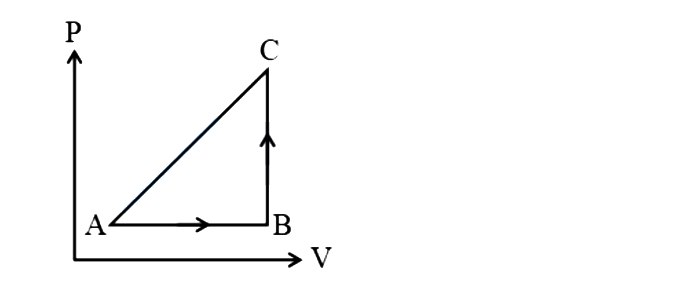
- The \(p-V\) diagram of a system undergoing thermodynamic changes is as shown in the figure. The work done by the system in going from \(A \rightarrow B \rightarrow C\) is \(30 \mathrm{~J}\). If \(68 \mathrm{~J}\) of heat is given to the system, then the change in the internal energy of the system between \(\mathrm{A}\) and \(\mathrm{C}\) is
 MHT CET 2022 Easy
More PYQs from MHT CET
- The probability distribution of a random variable X is given by
\(\mathrm{X}=x_i\) 0 1 2 3 4 \(\mathrm{P}\left(\mathrm{X}=x_i\right)\) \(0.4\) \(0.3\) \(0.1\) \(0.1\) \(0.1\)
Then the variance of X isMHT CET 2025 Medium - If the equation \(7 x^2-14 x y+p y^2-12 x+q y-4=0\) represents a pair of parallel lines then the value of \(\sqrt{p^2+q^2-p q}\) isMHT CET 2024 Medium
- If \(\mathrm{f}(x)=(1+x)\left(1+x^2\right)\left(1+x^4\right)\left(1+x^8\right)\), then \(f^{\prime}(1)=\)MHT CET 2024 Medium
- If \((\bar{a} \times \bar{b}) \times \bar{c}=-5 \bar{a}+4 \bar{b}\) and \(\bar{a} \cdot \bar{b}=3\), then the value of \(\bar{a} \times(\bar{b} \times \bar{c})\) isMHT CET 2023 Medium
- Identify the monomer used to prepare Teflon.MHT CET 2023 Easy
- If \(2 \sin ^{2} x+7 \cos x=5\), then permissible value of \(\cos x\) isMHT CET 2020 Easy