


MHT CET · Physics · Dual Nature of Matter
When an electron is accelerated through a potential ' \(\mathrm{V}\) ', the de-Broglie wavelength associated with it is ' \(4 \lambda\) '. When the accelerating potential is increased to \(4 \mathrm{~V}\), its wavelength will be
- A \(\frac{\lambda}{4}\)
- B \(\frac{\lambda}{2}\)
- C \(\lambda\)
- D \(2 \lambda\)
Answer & Solution
Correct Answer
(B) \(\frac{\lambda}{2}\)
Step-by-step Solution
Detailed explanation
\(\begin{aligned} & \text { We know } \lambda=\frac{\mathrm{h}}{\sqrt{2 \mathrm{meV}}} \\ & \Rightarrow \lambda \propto \frac{1}{\sqrt{\mathrm{v}}}\end{aligned}\)
\(\begin{array}{ll} & \text { Given } \mathrm{V}=4 \mathrm{~V} \\ \therefore \quad & \lambda \propto \frac{1}{\sqrt{4 \mathrm{~V}}}=\frac{4}{2 \sqrt{\mathrm{V}}} \\ \therefore \quad & \lambda \text { reduces to } \frac{\lambda}{2}\end{array}\)
\(\begin{array}{ll} & \text { Given } \mathrm{V}=4 \mathrm{~V} \\ \therefore \quad & \lambda \propto \frac{1}{\sqrt{4 \mathrm{~V}}}=\frac{4}{2 \sqrt{\mathrm{V}}} \\ \therefore \quad & \lambda \text { reduces to } \frac{\lambda}{2}\end{array}\)
See the Complete Solution
Get step-by-step explanations for this and 2.5 Lakh+ more JEE, NEET & CET questions.
- Unlock all solutions
- Practice the full chapter
- Track accuracy across PYQs
4.8 rated on Google Play · 14,000+ reviews
More questions from Physics
- The compressibility of water is \(5 \times 10^{-10} \mathrm{~m}^{2} / \mathrm{N}\). Pressure of \(15 \times 10^{6} \mathrm{~Pa}\) is applied
on \(100 \mathrm{ml}\) volume of water. The change in the volume of water isMHT CET 2020 Easy - In potentiometer experiment, cells of e.m.f. ' \(E_1\) ' and ' \(E_2\) ' are connected in series \(\left(E_1>E_2\right)\) the balancing length is \(64 \mathrm{~cm}\) of the wire. If the polarity of \(\mathrm{E}_2\) is reversed, the balancing length becomes \(32 \mathrm{~cm}\). The ratio \(\frac{E_1}{E_2}\) isMHT CET 2021 Medium
- Two circular loops \(\mathrm{P}\) and \(\mathrm{Q}\) are made from a uniform wire. The radii of \(P\) and \(Q\) are \(R_1\) and \(R_2\) respectively. The moments of inertia about their own axis are \(\mathrm{I}_{\mathrm{P}}\) and \(\mathrm{I}_{\mathrm{Q}}\) respectively. If \(\frac{\mathrm{I}_{\mathrm{P}}}{\mathrm{I}_{\mathrm{Q}}}=\frac{1}{8}\) then \(\frac{\mathrm{R}_2}{\mathrm{R}_1}\) isMHT CET 2021 Easy
- Which one of the following equations specifies an isochoric process?
\(\text {[ } Q=\text { heat supplied, } \Delta p=\text {change in pressure, }\) \(\Delta V=\text { change in volume, } \Delta T=\text { change in temperature }]\)MHT CET 2022 Easy - A graph is plotted between the fringe-width (z) and the distance (D) between the slit and eye-piece, keeping other adjustment same. The correct graph is
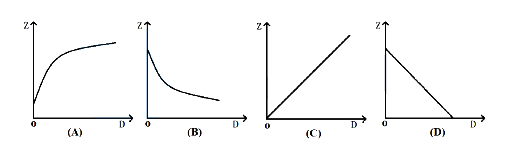 MHT CET 2020 Easy
 - A bullet is fired from the gun. It hits the solid block resting on a frictionless surface, gets embedded into it and both move jointly. In this process,MHT CET 2022 Easy
More PYQs from MHT CET
- In ozone molecule the formal charge on the central oxygen atom isMHT CET 2019 Easy
- To determine the internal resistance of a cell with potentiometer, when the cell is shunted by a resistance of \(5 \Omega\), the balancing length is 250 cm . When the cell is shunted by \(20 \Omega\), the balancing length of potentiometer wire is 400 cm . The internal resistance of the cell isMHT CET 2025 Medium
- Calculate rate constant of a first order reaction having pre exponential factor \(1.6 \times 10^{13} \mathrm{~s}^{-1} \quad\left(\mathrm{E}_{\mathrm{a}} / 2.303 \mathrm{RT}=21\right)\)MHT CET 2025 Medium
- If the angle between the planes \(x-2 y+3 z-5=0\) and \(x+\alpha y+2 z+7=0\) is \(\cos ^{-1}\left(\frac{1}{14}\right)\) then the difference between the values of \(\alpha\) isMHT CET 2025 Medium
- Which of the following is not an alkali metal?MHT CET 2025 Easy
- If \(\mathrm{g}(x)=x^2+x-1\) and (gof) \((x)=4 x^2-10 x+5\), then \(\mathrm{f}(2)\) is equal toMHT CET 2024 Easy