


MHT CET · Physics · Waves and Sound
When a string of length ' \(l\) ' is divided into three segments of length \(l_1, l_2\) and \(l_3\). The fundamental frequencies of three segments are \(\mathrm{n}_1, \mathrm{n}_2\) and \(\mathrm{n}_3\) respectively. The original fundamental frequency ' \(n\) ' of the string is
- A \(\mathrm{n}=\mathrm{n}_1+\mathrm{n}_2+\mathrm{n}_3\)
- B \(\sqrt{\mathrm{n}}=\sqrt{\mathrm{n}_1}+\sqrt{\mathrm{n}_2}+\sqrt{\mathrm{n}_3}\)
- C \(\frac{1}{\mathrm{n}}=\frac{1}{\mathrm{n}_1}+\frac{1}{\mathrm{n}_2}+\frac{1}{\mathrm{n}_3}\)
- D \(\frac{1}{\sqrt{\mathrm{n}}}=\frac{1}{\sqrt{\mathrm{n}_1}}+\frac{1}{\sqrt{\mathrm{n}_2}}+\frac{1}{\sqrt{\mathrm{n}_3}}\)
Answer & Solution
Correct Answer
(C) \(\frac{1}{\mathrm{n}}=\frac{1}{\mathrm{n}_1}+\frac{1}{\mathrm{n}_2}+\frac{1}{\mathrm{n}_3}\)
Step-by-step Solution
Detailed explanation
The fundamental frequency of a string is given by
Given: \(l=l_1+l_2+l_3\)... (i)
\(\mathrm{n}=\frac{1}{2 l} \sqrt{\frac{\mathrm{T}}{\mathrm{m}}}\)
\(\Rightarrow \mathrm{n} \propto \frac{1}{l}\) or \(\mathrm{n} l=\mathrm{k}\)
\(\therefore \quad l_1=\frac{\mathrm{k}}{\mathrm{n}_1}, l_2=\frac{\mathrm{k}}{\mathrm{n}_2}\) and \(l_3=\frac{\mathrm{k}}{\mathrm{n} 3}\)... (ii)
\(\therefore \quad\) Original length \(l=\frac{\mathrm{k}}{\mathrm{n}}\)... (iii)
Putting eq (ii) and (iii) into eq (i)
\(\frac{\mathrm{k}}{\mathrm{n}}=\frac{\mathrm{k}}{\mathrm{n}_1}+\frac{\mathrm{k}}{\mathrm{n}_2}+\frac{\mathrm{k}}{\mathrm{n}_3}\)
\(\therefore \quad \frac{1}{n}=\frac{1}{n_1}+\frac{1}{n_2}+\frac{1}{n_3}\)
Given: \(l=l_1+l_2+l_3\)... (i)
\(\mathrm{n}=\frac{1}{2 l} \sqrt{\frac{\mathrm{T}}{\mathrm{m}}}\)
\(\Rightarrow \mathrm{n} \propto \frac{1}{l}\) or \(\mathrm{n} l=\mathrm{k}\)
\(\therefore \quad l_1=\frac{\mathrm{k}}{\mathrm{n}_1}, l_2=\frac{\mathrm{k}}{\mathrm{n}_2}\) and \(l_3=\frac{\mathrm{k}}{\mathrm{n} 3}\)... (ii)
\(\therefore \quad\) Original length \(l=\frac{\mathrm{k}}{\mathrm{n}}\)... (iii)
Putting eq (ii) and (iii) into eq (i)
\(\frac{\mathrm{k}}{\mathrm{n}}=\frac{\mathrm{k}}{\mathrm{n}_1}+\frac{\mathrm{k}}{\mathrm{n}_2}+\frac{\mathrm{k}}{\mathrm{n}_3}\)
\(\therefore \quad \frac{1}{n}=\frac{1}{n_1}+\frac{1}{n_2}+\frac{1}{n_3}\)
See the Complete Solution
Get step-by-step explanations for this and 2.5 Lakh+ more JEE, NEET & CET questions.
- Unlock all solutions
- Practice the full chapter
- Track accuracy across PYQs
4.8 rated on Google Play · 14,000+ reviews
More questions from Physics
- An engine operating between temperatures \(T_1\) and \(T_2\) has efficiency \(\frac{1}{5}\). When \(\mathrm{T}_2\) is lowered by 45 K , its efficiency becomes \(\frac{1}{2}\). Temperatures \(\mathrm{T}_1\) and \(\mathrm{T}_2\) are respectivelyMHT CET 2025 Medium
- A series combination of is charged to a potential difference . Another parallel combination of (each of capacity is charged to a potential difference . The total energy stored in both the combination is the same. The value of in terms of isMHT CET 2018 Easy
- De-Broglie wavelength associated with an electron accelerated through a potential difference ' \(\mathrm{V}\) ' is ' \(\lambda\) '. When the accelerating potential is increased to ' \(4 \mathrm{~V}\) ', de-Broglie wavelength.MHT CET 2021 Easy
- Three inductances are connected as shown in the figure. The equivalent inductance between \(A\) and \(B\) is
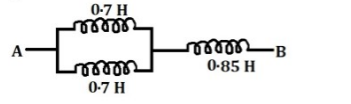 MHT CET 2025 Easy
 - A potentiometer wire of length \(100 \mathrm{~cm}\) and resistance \(3 \Omega\) is connected in series
with resistance of \(8 \Omega\) and an accumulator of 4 volt whose internal resistance is
\(1 \Omega\)
A cell of e.m.f. 'E' is balanced by \(50 \mathrm{~cm}\) length of the wire. The e.m.f. of the
cell isMHT CET 2020 Medium - A current of 5 A is flowing at 220 V in a primary coil of a transformer. If the voltage produced in the secondary coil is 2200 V and \(50 \%\) of power is lost, then the current in the secondary coil will beMHT CET 2025 Medium
More PYQs from MHT CET
- A solution of nonvolatile solute is obtained by dissolving 0.8 g in \(0.3 \mathrm{dm}^3\) water has osmotic pressure 0.2 atm at 300 K . Calculate the molar mass of solute.
\(\left[\mathrm{R}=0.082 \mathrm{~atm} \mathrm{dm}^3 \mathrm{~K}^{-1} \mathrm{~mol}^{-1}\right]\)MHT CET 2024 Hard - Which of the following molecules has bond order greater than one?MHT CET 2022 Easy
- What is the product formed when bauxite ore is treated with sodium hydroxide?MHT CET 2020 Easy
- ADH carries out following functions, exceptMHT CET 2016 Easy
- If a random variable \(X\) has the following probability distribution values

Then \(P(X \geq 6)\) has the valueMHT CET 2024 Easy - If \(\mathrm{f}(x)=\left\{\begin{array}{cc}\frac{9^x-2 \cdot 3^x+1}{\log (1+3 x) \cdot \tan 2 x} & , \text { if } x \neq 0 \\ \mathrm{a}(\log \mathrm{b})^{\mathrm{c}} & , \text { if } x=0\end{array}\right.\) is continuous at \(x=0\), then \(\mathrm{a}+\mathrm{b}+\mathrm{c}=\)MHT CET 2025 Medium