


MHT CET · Physics · Dual Nature of Matter
When a metallic surface is illuminated with radiation of wavelength ' \(\lambda\) ', the stopping potential is ' \(\mathrm{V}\) '. If the same surface is illuminated with radiation of wavelength ' \(2 \lambda\) ', the stopping potential is ' \(\left(\frac{\mathrm{v}}{4}\right)\),. The threshold wavelength for the metallic surface is
- A \(\frac{5}{2} \lambda\)
- B \(3 \lambda\)
- C \(4 \lambda\)
- D \(5 \lambda\)
Answer & Solution
Correct Answer
(B) \(3 \lambda\)
Step-by-step Solution
Detailed explanation
For stopping potential \(\mathrm{V}, \mathrm{eV}=\frac{\mathrm{hc}}{\lambda}-\frac{\mathrm{hc}}{\lambda_0}\)
For stopping potential \(\frac{\mathrm{V}}{4}, \frac{\mathrm{eV}}{4}=\frac{\mathrm{hc}}{2 \lambda}-\frac{\mathrm{hc}}{\lambda_0}\)
Taking the ratio, we get
\(\begin{aligned}
& \quad 4=\frac{\left(\frac{1}{\lambda}-\frac{1}{\lambda_0}\right)}{\frac{1}{2 \lambda}-\frac{1}{\lambda_0}} \\
& 4\left(\frac{1}{2 \lambda}-\frac{1}{\lambda_0}\right)=\frac{1}{\lambda}-\frac{1}{\lambda_0} \\
& \left(\frac{2}{\lambda}-\frac{4}{\lambda_0}\right)=\frac{1}{\lambda}-\frac{1}{\lambda_0} \\
& \left(\frac{2}{\lambda}-\frac{1}{\lambda}\right)=\frac{1}{\lambda_0}+\frac{4}{\lambda_0} \\
& \quad\left(\frac{1}{\lambda}\right)=\frac{3}{\lambda_0} \\
& \therefore \quad \lambda_0=3 \lambda
\end{aligned}\)
For stopping potential \(\frac{\mathrm{V}}{4}, \frac{\mathrm{eV}}{4}=\frac{\mathrm{hc}}{2 \lambda}-\frac{\mathrm{hc}}{\lambda_0}\)
Taking the ratio, we get
\(\begin{aligned}
& \quad 4=\frac{\left(\frac{1}{\lambda}-\frac{1}{\lambda_0}\right)}{\frac{1}{2 \lambda}-\frac{1}{\lambda_0}} \\
& 4\left(\frac{1}{2 \lambda}-\frac{1}{\lambda_0}\right)=\frac{1}{\lambda}-\frac{1}{\lambda_0} \\
& \left(\frac{2}{\lambda}-\frac{4}{\lambda_0}\right)=\frac{1}{\lambda}-\frac{1}{\lambda_0} \\
& \left(\frac{2}{\lambda}-\frac{1}{\lambda}\right)=\frac{1}{\lambda_0}+\frac{4}{\lambda_0} \\
& \quad\left(\frac{1}{\lambda}\right)=\frac{3}{\lambda_0} \\
& \therefore \quad \lambda_0=3 \lambda
\end{aligned}\)
See the Complete Solution
Get step-by-step explanations for this and 2.5 Lakh+ more JEE, NEET & CET questions.
- Unlock all solutions
- Practice the full chapter
- Track accuracy across PYQs
4.8 rated on Google Play · 14,000+ reviews
More questions from Physics
- The scale of a galvanometer is divided into 160 equal divisions. The galvanometer shows full scale deflection of 16 mA and maximum voltage is 80 mV . Now the range is changed so that galvanometer reads 160 V . The required resistance to be connected isMHT CET 2025 Medium
- If magnetization of a paramagnetic sample, external magnetic field, absolute temperature, curie constant then according to Curie's law in magnetism, the correct realtion isMHT CET 2018 Easy
- A ray of light is incident at polarising angle such that its deviation is \(24^{\circ}\), then angle of incidence isMHT CET 2009 Easy
- For measurement of potential difference, potentiometer is preferred in comparison to voltmeter becauseMHT CET 2010 Easy
- Two spheres ' \(\mathrm{S}_{1}\) ' and ' \(\mathrm{S}_{2}\) ' have same radii but temperatures \(\mathrm{T}_{1}\) and \(\mathrm{T}_{2}\) respectively.
Their emissive power is same and emissivity is in the ratio \(1: 4\). Then the ratio of \(\mathrm{T}_{1}\)
to \(\mathrm{T}_{2}\) isMHT CET 2020 Easy - A galvanometer of resistance ' \(G\) ' is shunted by a resistance of \(5 \Omega\). To keep the main current in the circuit unchanged, the resistance to be put in series with the same galvanometer isMHT CET 2022 Medium
More PYQs from MHT CET
- Five objects of different masses are simultaneously released vertically downwards from height 'h' (in air). Which physical quantity associated with the objects will change at the instant they strike the ground ? (Neglect the air resistance.)MHT CET 2020 Easy
- A plane mirror is placed at the bottom of a tank containing a liquid of refractive index ' \(\mu\) ', ' p ' is a small object at a height ' \(h\) ' above the mirror. An observer ' \(O\) ' vertically above ' \(p\) ' outside the liquid sees ' \(p\) ' and the image in a mirror. The apparent distance between these two will be
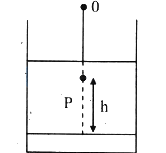 MHT CET 2024 Medium
 - Three inductances are connected as shown in the figure. The equivalent inductance between \(A\) and \(B\) is
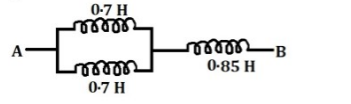 MHT CET 2025 Easy
 - Read the following statements regarding gynoecium in angiosperms.
i. Embryo sac is located towards micropylar en of the ovule
ii. Placenta is present inside the ovary locules.
iii. Stigma serves as the receptive organ for pollen grains.
iv. Cells of the nucellus are haploid with abunday food.
v. Ovules generally have more haploid cells the diploid cells
Identify the correct set of statements from the following.MHT CET 2024 Easy - The area bonded by the curve \(y=\sin ^{2} x, x\) -axis and the lines \(x=0\) and \(x=\frac{\pi}{2}\) isMHT CET 2020 Easy
- Identify example of sorption from following.MHT CET 2025 Easy