


MHT CET · Physics · Laws of Motion
When a mass ' \(\mathrm{m}\) ' is suspended from a spring of length ' \(\ell^{\prime}\), the length of the spring
becomes ' \(\mathrm{L}^{\prime}\). The mass is pulled down by a distance ' \(\mathrm{d}\) ' and released. If the equation of motion of the mass is \(\frac{d^{2} x}{d t^{2}}+\mathrm{P}^{2} x=0\), then \(\mathrm{P}\) is equal to
\((\mathrm{g}=\) acceleration due to gravity \()\)
- A \(\frac{\mathrm{L}-\ell}{\mathrm{g}}\)
- B \(\frac{\mathrm{g}}{\mathrm{L}-\ell}\)
- C \(\sqrt{\frac{\mathrm{g}}{\mathrm{L}-\ell}}\)
- D \(\sqrt{\frac{\mathrm{L}-\ell}{\mathrm{g}}}\)
Answer & Solution
Correct Answer
(C) \(\sqrt{\frac{\mathrm{g}}{\mathrm{L}-\ell}}\)
Step-by-step Solution
Detailed explanation
INTIAL LENGTH \(=l\)
FINAL LENGTH=L.
NET DISTANCE/LENGTH
PULLED \(=L-l\)
\(\therefore T I M E P E R I O D=2 \pi \sqrt{\frac{L-\ell}{g}}\) allo, \(P=\frac{2 \pi}{T .}\)
\(\begin{aligned} \therefore P=& \frac{g}{L-l} . \\ &(\text { option }-3) . \end{aligned}\)
FINAL LENGTH=L.
NET DISTANCE/LENGTH
PULLED \(=L-l\)
\(\therefore T I M E P E R I O D=2 \pi \sqrt{\frac{L-\ell}{g}}\) allo, \(P=\frac{2 \pi}{T .}\)
\(\begin{aligned} \therefore P=& \frac{g}{L-l} . \\ &(\text { option }-3) . \end{aligned}\)
See the Complete Solution
Get step-by-step explanations for this and 2.5 Lakh+ more JEE, NEET & CET questions.
- Unlock all solutions
- Practice the full chapter
- Track accuracy across PYQs
4.8 rated on Google Play · 14,000+ reviews
More questions from Physics
- A long solenoid carrying a current produces magnetic field B along its axis. If the number of turns per cm are tripled and the current is made \(\left(\frac{1}{4}\right)^{\mathrm{th}}\) then the new value of magnetic field will beMHT CET 2024 Easy
- As shown in the figure, \(S_1\) and \(S_2\) are identical springs with spring constant \(K\) each. The oscillation frequency of the mass ' \(m\) ' is ' \(f\) '. If the spring \(S_2\) is removed, the oscillation frequency will become
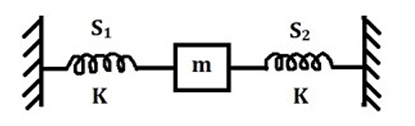 MHT CET 2025 Medium
 - A network of 4 capacitors is connected to a battery as shown. The ratio of the charges on capacitors \(\mathrm{C}_{2}\) and \(\mathrm{C}_{4}\) is
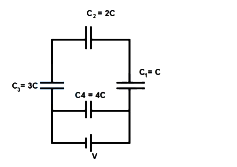 MHT CET 2020 Easy
 - The fundamental frequency of a closed pipe of length \(L\) is equal to the second overtone of a pipe open at both the ends of length (XL). The value of X is (Neglect end correction)MHT CET 2025 Medium
- In a diffraction pattern due to single slit of width 'a', the first minimum is observed at an angle of \(30^{\circ}\) when the light of wavelength \(5400 Å\) is incident on the slit. The first secondary maximum is observed at an angle of \(\left(\sin 30^{\circ}=\frac{1}{2}\right)\)MHT CET 2023 Medium
- The acceleration of a moving body can be found fromMHT CET 2024 Easy
More PYQs from MHT CET
- Which among the following is powerful bleaching and oxidising agent?MHT CET 2020 Easy
- What is total number of donor atoms in \(\left[\mathrm{Co}\left(\mathrm{H}_2 \mathrm{O}\right)\left(\mathrm{NH}_3\right)_5\right] \mathrm{I}_3\) ?MHT CET 2023 Easy
- The solution of \(\log \left(\frac{\mathrm{dy}}{\mathrm{d} x}\right)=2 \mathrm{x}-5 \mathrm{y}, \mathrm{y}(0)=0\) isMHT CET 2025 Medium
- An electric dipole of moment \(\overrightarrow{\mathrm{p}}\). is lying along a uniform electric field \(\overrightarrow{\mathrm{E}} \cdot\) The work done in rotating the dipole through \(90^{\circ}\) is
\(\left[\sin 0^{\circ}=\cos 90^{\circ}=0, \cos 0^{\circ}=\sin 90^{\circ}=1\right]\)MHT CET 2022 Easy - A wire of length \(L\) carries current \(I\) along \(x\)-axis. A magnetic field \(\vec{B}=B_0(\hat{i}-\hat{j}-\hat{k}) T\) acts on the wire. The magnitude of magnetic force acting on the wire isMHT CET 2025 Easy
- \(\lim _{x \rightarrow 0} \frac{\mathrm{e}^{\tan x}-\mathrm{e}^x}{\tan x-x}=\)MHT CET 2025 Medium